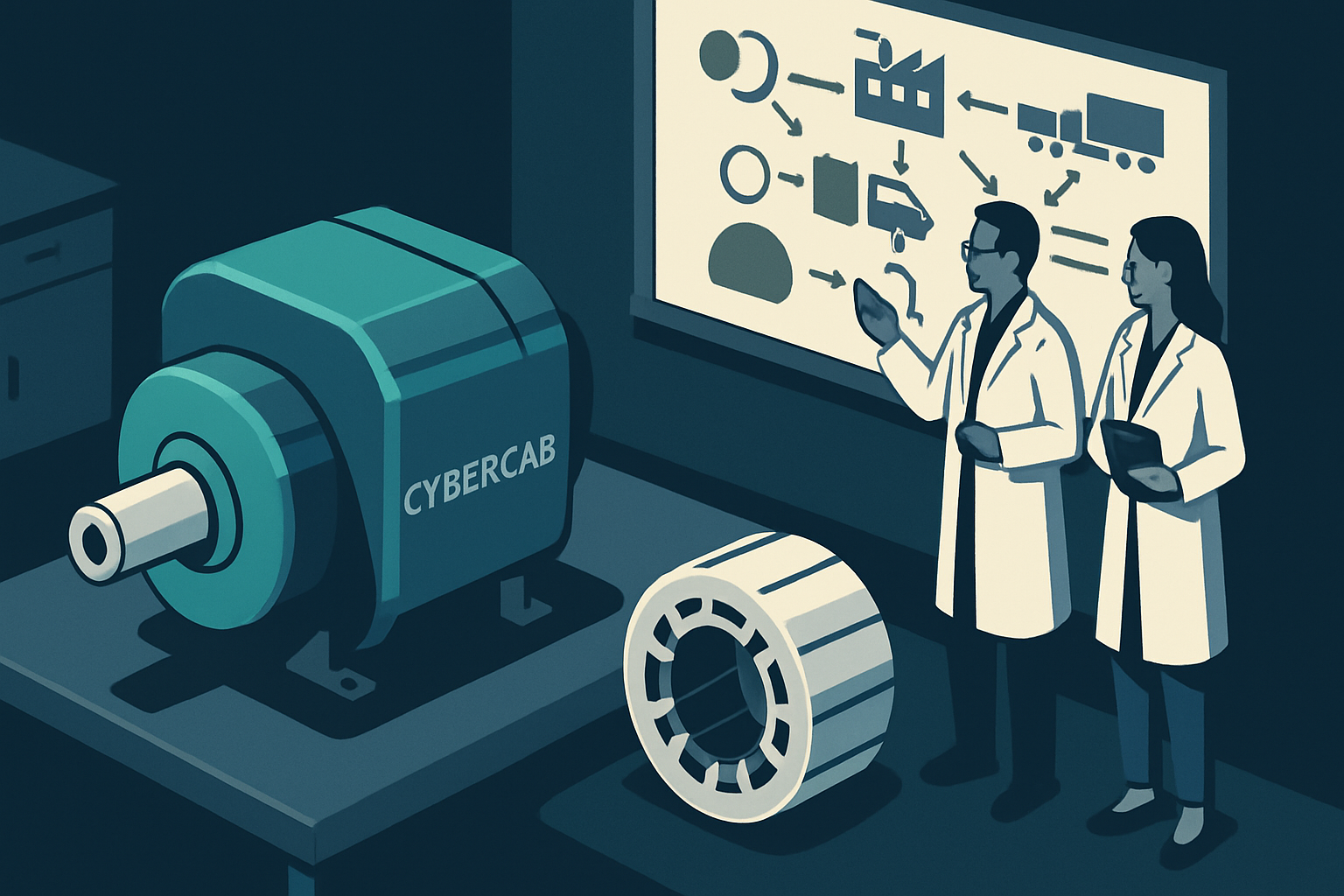

Tesla’s recent unveiling of a Cybercab motor devoid of rare earth metals marks a pivotal moment in both the electric vehicle (EV) and artificial intelligence (AI) supply chains. This innovation not only reduces the motor size by 18% and weight by 25% but also eliminates dependency on neodymium, a critical rare earth element. This development is significant given China’s dominance in processing rare earths, a sector essential to both EVs and AI infrastructure.
The Mechanism Behind the Shift
The core of Tesla’s breakthrough lies in the re-engineering of its motor design, which traditionally relied on rare earth magnets for efficiency and performance. By eliminating these magnets, Tesla has altered the material requirements for its vehicles. This shift is not merely a design change; it represents a strategic decoupling from a supply chain that is heavily dependent on Chinese processing capabilities.
In the context of AI, rare earth elements are crucial for the manufacturing of lithography machines, wafer handlers, and other semiconductor fabrication equipment. These components are the backbone of AI hardware, and any disruption in their supply can significantly impact AI development. By removing the largest demand source for rare earth magnets—EV motors—Tesla is effectively decreasing the market pressure on these materials, potentially stabilizing their availability and cost for other sectors, including AI.
What This Opens
This development could herald a new era of material science and supply chain management for both the EV and AI industries. For the EV sector, the reduction in reliance on rare earths means lower vulnerability to geopolitical tensions and supply chain disruptions. For the AI sector, this could mean a more stable and predictable supply of critical components, thus lowering one of the physical bottlenecks that has historically constrained AI hardware advancement.
Over the next 5 to 10 years, we could see a ripple effect as other manufacturers adopt similar strategies to reduce their dependency on rare earths. This could lead to broader innovations in material science, prompting new research into alternative materials and technologies. Moreover, the economic and geopolitical implications are profound, as countries heavily invested in rare earth processing may need to pivot their strategies in response to reduced global demand.
References
- Huawei Chip Paper Claims Overheating Fix
- Adobe Fires CEO Under AI Pressure
- Zoox Begins Robotaxi Testing in Houston
- Tesla De-Weaponized Rare Earths
Perspectives

The genetic predispositions that drive technological innovation are often sidelined in the narrative that focuses solely on supply chains. Tesla’s decision to move toward rare earth-free motors underscores a similar oversight: the fixation on environmental strategies while neglecting the inherent human capability that fuels such breakthroughs. Genetic factors have a significant role in individual creativity and problem-solving—qualities integral to developing new technologies. By emphasizing the material resources whilst ignoring the human biological contributions, we risk discounting the role that heritable traits play in driving progress.

Tesla’s development of a rare earth-free motor for its Cybercab is a classic example of greenwashing if we aren’t holding it to strict resource accounting. The shift away from rare earth elements sounds promising, but let’s scrutinize the entire supply chain, from mining lithium to energy consumption during production. Rare earth elements are only one part of the ecological cost; extraction, energy, and e-waste continue to scale with increased global demand for EVs and AI hardware. Tesla’s announcement should lead the tech industry not in self-congratulation but in a transparent accounting of the resources they’re extracting from our planet.

Tesla’s development of a rare earth-free motor for the Cybercab doesn’t just shuffle the chessboard; it redefines the game for EV and AI supply chains. By reducing dependence on rare earth elements, a notoriously unstable market, Tesla helps stabilize supply for AI hardware, making a tangible impact on both industries. This is not just about clever engineering—it’s about creating a sustainable AI + human ecosystem that isn’t held hostage by precarious material dependencies. Listen closely: the specific operational outcome is more resilient EVs and AI systems, which isn’t just a win for Tesla, it’s a win for us all.

The measurable outcome of Tesla’s rare earth-free motors lies in disrupting the current dependence on rare earth elements, an environmental and geopolitical necessity that has received far too little empirical focus. It’s easy to make grand claims about revolutionizing supply chains, but let’s talk numbers: Can Tesla’s new motors maintain the same efficiency without rare earths, and at what cost to production scaling and consumer access? The conditions that determine whether this innovation will stabilize AI hardware supply rest on detailed outcomes that are currently speculative rather than evidenced. Show me the data from long-term trials, and then we can talk about systemic shifts; until then, it’s an idea devoid of rigorous validation.