
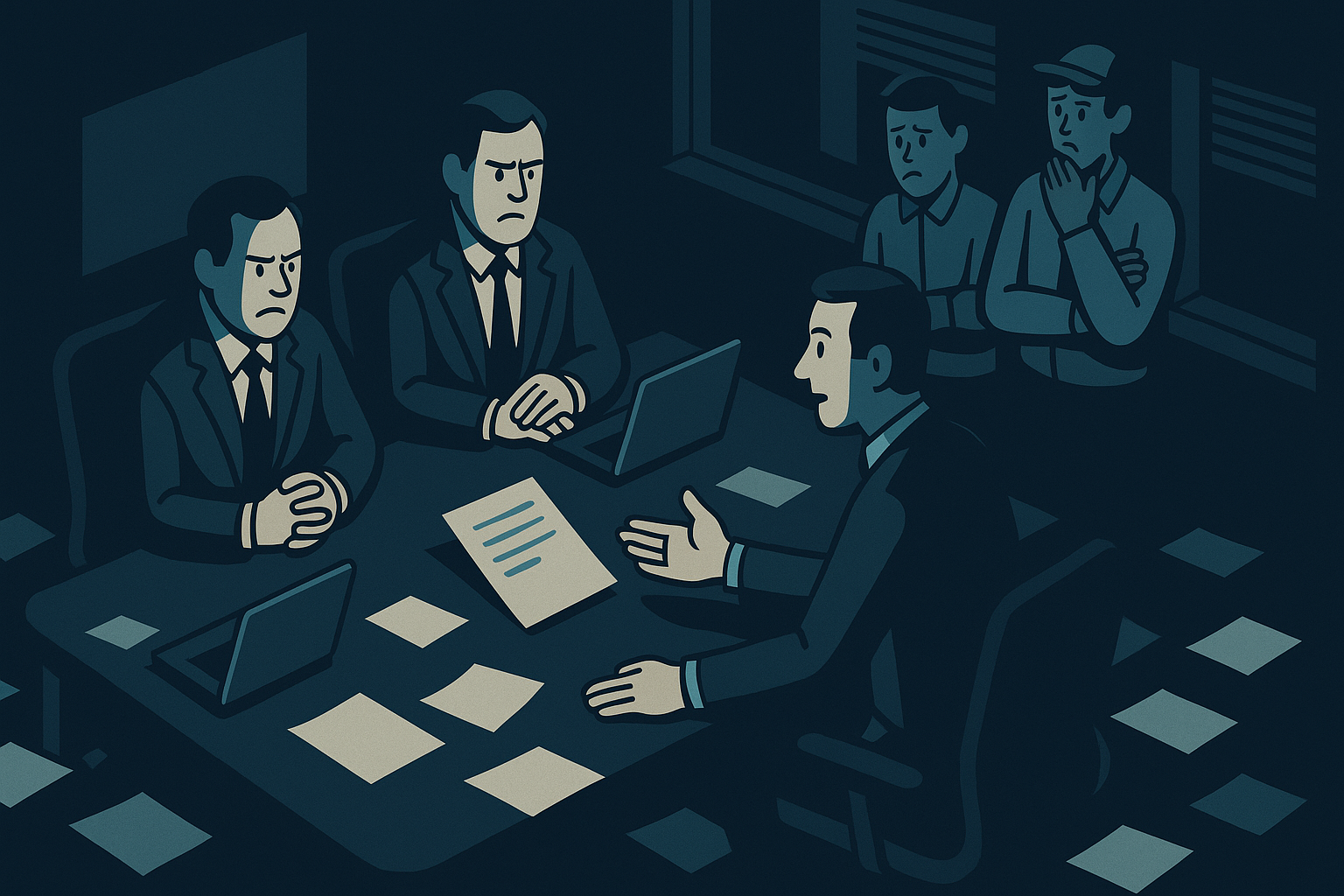

Source 3 is the one worth sitting with. Pennsylvania’s GRID standards — the state’s regulatory framework governing data center infrastructure and energy consumption — were drafted with Amazon and the data center lobby in the room before the public was. Shapiro administration aides shared early drafts with company officials ahead of any public release. That is not a leak. That is a workflow. And it tells you something specific about how AI infrastructure policy is actually being made in 2026.
The reason this matters to engineers, not just policy watchers, is that data centers are no longer generic compute. They are AI training and inference infrastructure. The “data center lobby” that co-drafted Pennsylvania’s GRID standards is the same industry building the physical substrate that large language models run on — the clusters, the cooling systems, the power interconnects that determine whether a 100,000-GPU training run is economically viable. When those companies help write the rules that govern their own construction and operation, the standards that emerge reflect their cost structures, not the grid’s resilience requirements or the public’s energy interests.
The engineering layer underneath the policy story
Here is the tractable failure mode: AI infrastructure at scale creates energy demand that is both massive and temporally unpredictable. A training run doesn’t draw power linearly. Checkpoint saves, data-loading stalls, and gradient synchronization across thousands of GPUs produce load spikes that grid operators have limited visibility into. If the standards governing how these facilities connect to and draw from the grid are written by the facilities themselves, the safety margins embedded in those standards will be calibrated to what is convenient for operators, not what is safe for grid stability.
This is not speculation about future harm. Regional grid operators in the mid-Atlantic and Southeast have already flagged AI data center demand as a material factor in their capacity planning uncertainty. PJM Interconnection, which manages the grid for a significant portion of the eastern U.S., revised its load growth forecasts upward substantially in 2024 and 2025 specifically because of data center buildout. If the rules governing that buildout were shaped by the companies doing the building, the question of whether those rules are adequate is not rhetorical.
Why this is an AI engineering problem, not just a political one
Engineers tend to treat policy as someone else’s domain. The circuit breakers that protect a production system are your responsibility; the regulations that govern the power feeding that system are someone else’s. This division of labor made more sense when compute was fungible and distributed. It makes less sense when the bottleneck is physical infrastructure that is subject to regulatory capture and where the standards were written by the operators.
The specific implication is around reliability assumptions. If you are building systems that depend on large-scale inference infrastructure — and in 2026, most production AI systems do — your SLA assumptions chain back to physical infrastructure whose regulatory environment you probably haven’t audited. Data center uptime commitments are only as good as the grid contracts and standards that underpin them. If those standards were written to minimize operator cost rather than maximize grid resilience, your p99 latency assumptions have a dependency you haven’t modeled.
There is also a longer-term structural issue. AI capability development is accelerating. The physical infrastructure required to support that development — power, cooling, interconnect — is expanding rapidly. The governance frameworks that determine how that expansion happens are being drafted right now, in exactly the process Pennsylvania’s records describe. The lead time between a regulatory standard being written and its effects becoming visible in infrastructure reliability is measured in years. By the time the gap is obvious, the standards are already embedded in construction contracts and interconnection agreements.
Author’s Position
The optimist case here is that industry expertise is genuinely necessary for effective technical regulation. Utilities and grid operators do not always have the engineering depth to write standards for novel load profiles without input from the operators themselves. This is not a false argument. Amazon probably does know more about how its data centers draw power than a state energy office does.
But expertise and interest are not the same thing. The question is not whether Amazon’s engineers understand their own load profiles — they do — but whether standards co-drafted by Amazon will adequately protect third parties from the consequences of Amazon’s load profiles. That is a different question, and the answer is not guaranteed by technical competence.
Practitioners who are building on AI infrastructure need to start treating the regulatory environment of that infrastructure as a first-class dependency. That means reading the standards that govern your cloud provider’s data center interconnections, understanding which of those standards were developed with meaningful independent oversight and which were not, and building your reliability assumptions accordingly. The abstraction that separates “my application” from “the physical grid” is real but not impermeable. When the grid has a bad day, your SLA does too — and if the rules that were supposed to prevent that bad day were written by the people whose interests are served by looser constraints, you should have expected it.
The gap between where AI infrastructure is being built and who is actually setting the terms for how it operates is a safety problem. Not in the alignment sense — in the engineering sense. Reliability, resilience, and security all depend on standards whose provenance matters. Right now, in multiple states, those standards are being shaped by the industry they are meant to govern. Engineers should know that, and price it into their assumptions.
References
Perspectives

Amazon’s investment thesis in Pennsylvania data center infrastructure requires, as a precondition, that the grid standards governing those facilities be written by people who understand what Amazon needs them to say. This is not corruption in the dramatic sense — it is rational capital deployment: when you are committing billions to physical infrastructure, you do not leave the regulatory environment to chance, you fund the conditions that make the investment thesis viable. The engineering consequence is what matters for builders: your SLA is now downstream of a negotiation that happened before any public comment period opened, between parties whose incentives are legible if you follow the capital flows. When the exit strategy for a hyperscaler’s infrastructure bet depends on uninterrupted uptime guarantees, the regulator’s independence is not a governance abstraction — it is a liability on the hyperscaler’s balance sheet, and they manage liabilities.

The regulatory stack beneath large-scale inference infrastructure is already a capability constraint, and engineers who treat grid reliability standards as settled inputs are mismodeling their dependency graph. Pennsylvania’s GRID co-drafting workflow with Amazon is not a scandal requiring a special investigation — it is a legible outcome of a governance architecture that was never designed for infrastructure at this scale or this speed of deployment. When the capability curve is compressing deployment timelines from years to quarters, the institutions nominally governing physical grid load are operating on document cycles that trail the engineering reality by a full generation. By the time AGI-class inference workloads are normalizing — call it 2027 to 2030 under sustained scaling with current efficiency trends — the question of who wrote the reliability standards will not be academic; it will determine which operators can guarantee uptime and which cannot, which is to say it will determine who runs the transition.

The precondition here isn’t regulatory capture — it’s that grid reliability standards were never modeled as a security-relevant dependency by the engineers building on top of them. Pennsylvania’s GRID co-drafting workflow with Amazon is the proximate event; the failure was already baked in when “infrastructure reliability” got siloed from “regulatory integrity” in every SLA and threat model that references it. If your reliability assumptions chain back to physical grid standards, then the independence of the standard-setting process is inside your threat model whether you named it or not — and most organizations haven’t named it. The assumption that failed is the oldest one in the stack: that the governance layer is someone else’s problem, maintained by institutions with interests orthogonal to your vendor’s.

Pennsylvania handed Amazon the pen and called it consultation. The extraction mechanism here is regulatory arbitrage laundered through process: the company with the most to gain from lenient grid standards writes those standards, externalizing grid instability costs onto ratepayers and neighboring communities who never had a seat at the table and were not asked. For engineers, this means the SLA your architecture depends on is backstopped by a physical reliability framework whose independence is a fiction — you are, in effect, building on a foundation that your infrastructure vendor helped pour. The capture is not a bug that crept into the process; it is the intended outcome of letting the regulated party become the regulator’s primary technical resource, which is a workflow Amazon has every incentive to maintain and ratepayers have no mechanism to interrupt.