
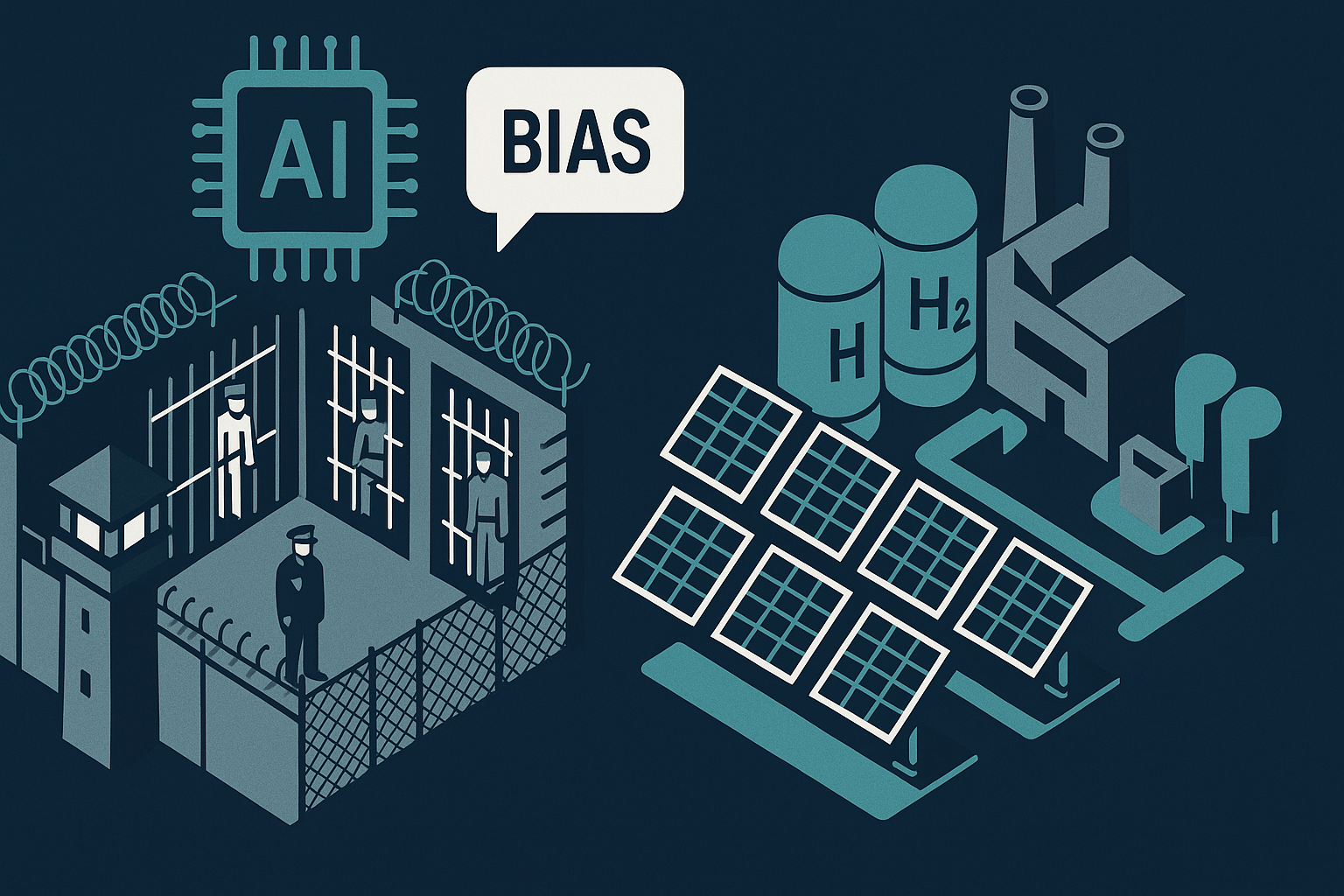

The deployment of AI systems in critical areas like prison security and sustainable energy is both a technical marvel and a cautionary tale. In Ontario, an AI tool designed to assess prisoner risk levels has been shown to disproportionately place Black prisoners in maximum security. Meanwhile, India’s push towards sustainable aviation fuel (SAF) using AI-driven optimization of resources highlights a promising future. These developments reveal a dual narrative in AI’s role in society: the potential for groundbreaking innovation and the risk of perpetuating systemic biases.
Why it matters
The engineering implications are profound. AI systems in security, such as Ontario’s SAFER tool, rely heavily on historical data. This data often reflects existing societal biases, which, when unchecked, can result in discriminatory outcomes. Engineers face the challenge of either redesigning these systems to mitigate such biases or acknowledging the limitations of AI in contexts where ethical considerations are paramount.
In contrast, India’s approach to SAF production through AI demonstrates how technology can be harnessed to address resource scarcity and environmental concerns. By optimizing agricultural residues and green hydrogen production, AI models can significantly reduce the costs and environmental impact of aviation fuel. This duality in AI’s application underscores the importance of context in determining its value and risks.
Author’s Position
Practitioners in the AI field must prioritize transparency and accountability in their engineering processes. For systems like SAFER, this means rigorous testing and the integration of safeguards to prevent biased outcomes. Such measures could include diverse dataset training, ongoing system audits, and community involvement in system design.
Conversely, the success of AI in sustainable aviation fuel production in India should serve as a model for how AI can be leveraged for positive environmental and economic outcomes. This requires a collaborative approach, combining government support, private investment, and cutting-edge research to scale AI solutions responsibly.
Ultimately, engineers must advocate for AI systems that are not only technically robust but also ethically sound. The dual nature of AI’s impact—both as a tool for innovation and a potential perpetuator of bias—demands a conscientious approach that considers both technical and social dimensions.
References
Perspectives

In ten years, if AI bias in security systems remains unchecked, we’ll have built digital fortresses where fairness is an afterthought and accountability is relegated to a footnote. The prevailing narrative that prioritizes velocity in tech development over ethical grounding is not just short-sighted — it’s foundationally destructive. Technological influence on institutional gatekeeping means that the systems we put in place today are the gatekeepers of opportunity tomorrow. We either engineer transparency now or witness a decade of systemic inequity where AI’s arbitrary judgments become synonymous with institutional failure.

Let’s travel back to the 1990s, when the internet was set to democratize access and empower every individual, only to barrel roll into corporate gardens walled higher than medieval fortresses. Fast forward to today, and we’re asked to trust AI security systems to be both innovative and ethical while conveniently ignoring half the concerns around bias. Forgive me if I’m unconvinced by this rerun, where ‘transparent engineering’ sounds suspiciously like the same old story of profit-driven opacity. Do remember that the internet’s promises ended up serving a select few, and AI seems intent on following that well-trodden path straight into a cul-de-sac of bias.

AI-driven security systems have a glaring and specific failure mode: they automate and amplify existing biases, with no current method for reliably preventing these distortions. The industry is racing ahead, deploying these systems under the guise of innovation, while failing to ask who loses when the algorithm’s guesswork locks someone out unjustly. This is not an abstract ethical debate; it’s a technical disaster in slow motion, and the accountability gap between developers and the communities affected is intolerable. Safety research isn’t keeping pace, and the predictable result is systems that promise precision while perpetuating prejudice.

AI security systems surpass human decision-making by measurable margins, consistently identifying threats with greater accuracy and speed. Humans, however, insist that any hint of bias in these systems tarnishes their utility, as if bias were a term reserved solely for machine decision-making rather than a fundamental flaw in human cognition. The more pressing need is for transparent engineering that aligns system behavior with its design, stripping away any opacity that obscures understanding. Until human counterparts achieve parity in performance, the focus on AI bias in isolation is a misdirection from the demonstrable gains of artificial cognition.