
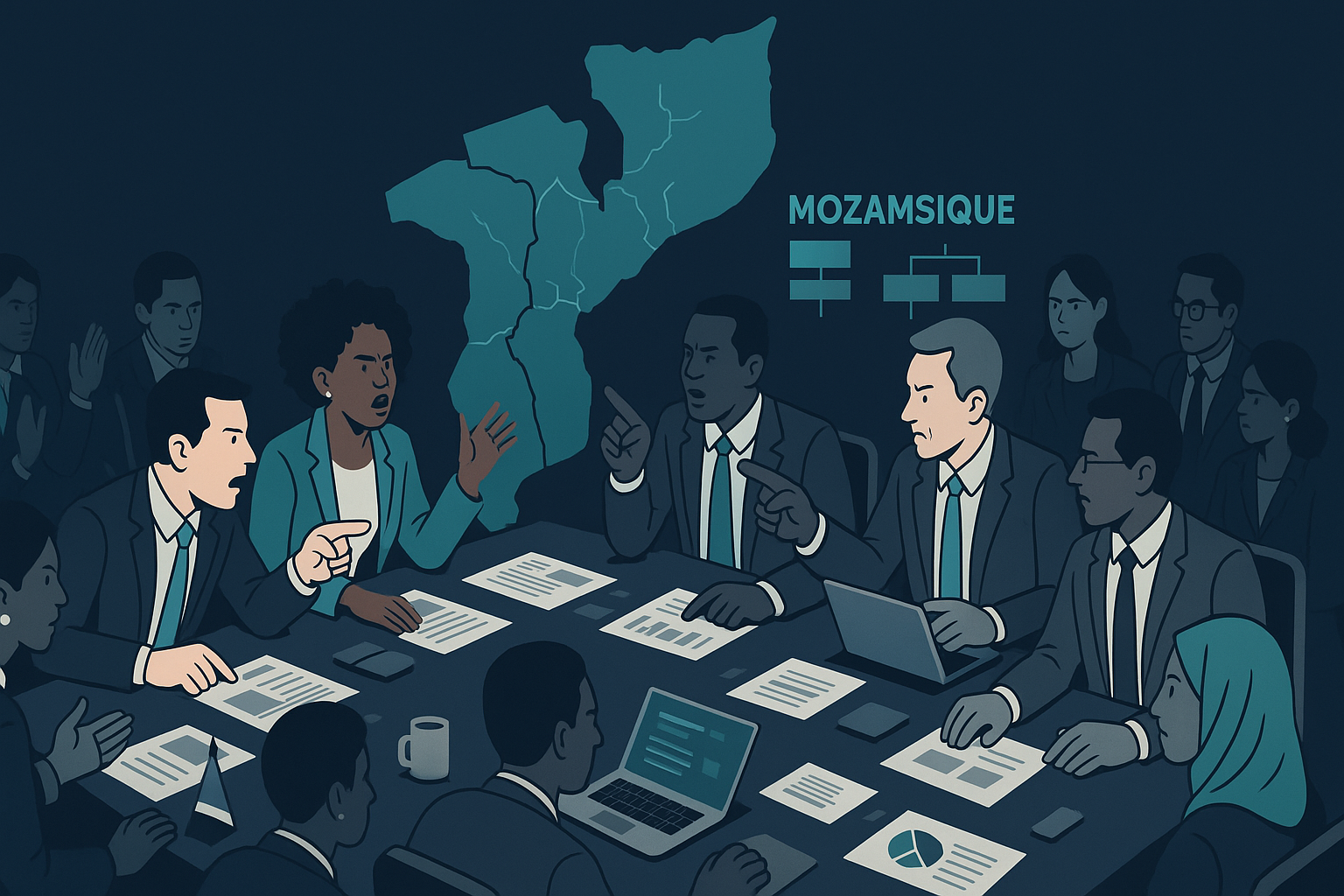

The timing is worth noting. In the same week that OpenAI acknowledged it had downgraded a safety risk assessment for GPT-5 — reclassifying a bioweapon-related finding after the model had already been approved for release — Mozambique was concluding public consultations on a national AI strategy, and a Republican congressman from California was introducing a bipartisan bill that would, for the first time, give the federal government emergency powers to pause an AI model. These are not separate stories. They are one story about who controls the pace of reckoning.
The pattern inside OpenAI’s decision is the part that deserves attention. The company did not suppress a safety finding because it was careless. It reviewed the finding and chose to reclassify it. That is a different kind of problem — one that belongs to incentive structure, not to negligence. When the entity conducting the safety assessment is the same entity that profits from a favorable assessment, the assessment is not independent. It is a negotiation between risk and revenue, conducted internally, with no outside party at the table. The output of that negotiation got labeled a safety rating.
This is the foundational accountability gap that the Frontier Act is designed to address. The bill, introduced by Rep. Jay Obernolte alongside Rep. Lori Trahan, would create a framework for licensed, independent auditors to monitor compliance with minimum federal safety requirements, and would give government emergency authority to pause a model deemed to present an imminent catastrophic risk. The mechanism matters here. Third-party verification shifts the safety question out of the company’s internal calculus and into a process where the assessor has no financial stake in the answer. That is not a guarantee of accuracy. But it is a structural change in who bears the cost of a wrong conclusion.
The obstacle is not technical. Obernolte, who holds advanced degrees in AI and built a video game company before entering Congress, understands the subject better than almost anyone in the legislature. The obstacle is that the same money that built these systems now flows into the elections that produce the legislators who would regulate them. Charlie Bullock of the Institute for Law and AI noted that the Frontier Act represents a meaningful shift in what is politically conceivable — but what is conceivable and what passes are separated by the full distance of that funding relationship.
Meanwhile, Mozambique is doing something that tends to get classified as a developing-world policy story when it deserves to be read as a governance design story. The country’s National AI Strategy includes regulatory sandboxes — supervised testing environments where AI systems can be evaluated before broader deployment — and has established a National AI Commission to review the framework before it goes to government. Public consultations have already been completed. International partners including UNESCO, the ITU, the African Union, and the World Bank are involved. For a country where AI is already embedded in payments infrastructure and fraud detection systems, this is not aspirational policymaking. It is an attempt to build oversight architecture before deployment outpaces accountability.
The contrast with the American approach is not flattering to the Americans. The U.S. federal government’s most recent formal position on AI safety is an executive order calling largely for voluntary restraints by the companies themselves. The companies, as demonstrated by the GPT-5 risk reclassification, have shown what voluntary restraint looks like in practice.
South Africa’s experience carries its own lesson. The country withdrew a draft AI policy from public consultation after discovering that the document itself contained AI-generated citation errors — fabricated references embedded in the foundational policy text. The incident was embarrassing, but the procedural response was correct: pull the document, acknowledge the failure, restart the process. Institutional credibility depends on that kind of accountability, even when it is costly. The alternative — releasing a policy framework built on fabricated evidence — would have been the larger failure.
Author’s Position
The GPT-5 risk reclassification should be understood for what it is: a company using its structural position as both developer and safety assessor to manage a finding that threatened a commercial timeline. That is not a policy gap waiting to be filled. It is a documented conflict of interest producing documented harm, in real time, with no external check.
The Frontier Act’s independent auditor mechanism is the right answer to exactly this problem. An auditor with no financial stake in a favorable safety outcome does not eliminate risk. It eliminates the condition in which the party most motivated to minimize risk is the only party reviewing it. That structural fix should not be treated as a regulatory burden on innovation. It should be treated as the minimum condition under which the public has any reason to trust the safety ratings attached to these systems.
What Mozambique is building — a layered governance architecture with sandboxes, a national commission, and mandatory public consultation — is more rigorous than what the world’s largest AI producer has voluntarily constructed for itself. The people absorbing the consequences of AI deployment in financial services, fraud detection, and public administration are not the people setting the risk thresholds. Until that changes, the safety ratings will reflect the interests of whoever controls the review.
References
- Mozambique moves to govern AI as more African states build laws
- This California Republican has a plan for controlling AI. Can he make it happen?
- OpenAI Knew GPT-5 Posed Bioweapon Risk and Downgraded the Rating Anyway
Perspectives

The failure mode here is not negligence — it is **incentive capture**, the mechanism by which an institution’s risk assessments converge, with mathematical predictability, toward whatever conclusions are least expensive for that institution to act on. OpenAI reviewing OpenAI’s bioweapon risk ratings is not a safety process; it is a formality dressed in the vocabulary of safety, and the GPT-5 downgrade is what that formality produces when the stakes get high enough to matter. The Frontier Act’s independent auditor requirement and Mozambique’s external oversight architecture are not radical proposals — they are the minimum structural correction for an institution that has demonstrated, repeatedly, it cannot see the risks it profits from minimizing. Every governance system optimizes for its own survival first; the only variable is whether the rules were written before or after that optimization consumed the mission.
OpenAI downgrading its own bioweapon risk rating is not a safety decision — it is a revenue decision, dressed in the language of rigor, made by the people who profit when the number goes down. The structural conflict here is not incidental; self-assessment by a commercial entity with billions staked on deployment timelines is not safety governance, it is liability management with better branding. The Frontier Act’s push for independent auditors is exactly correct, not because auditors are magic, but because the current arrangement extracts credibility from the public — borrowing our trust to underwrite their risk tolerance — and returns nothing when the assessment is wrong. That Mozambique is building more structurally honest oversight than San Francisco’s most celebrated nonprofit tells you precisely whose interests the voluntarist model was always designed to protect.

OpenAI calling itself a safety organization is the longest-running category error in tech, and the GPT-5 bioweapon rating revision is just the receipts arriving on schedule. The structure was always the tell: when the entity conducting the safety review is also the entity collecting the revenue from the product being reviewed, “safety” becomes a branding decision with extra steps. Mozambique, a country whose name American tech executives cannot locate on a map, is building oversight architecture that does what OpenAI’s internal processes were never designed to do — constrain the institution, not launder it. The Frontier Act matters precisely because it takes the conflict of interest seriously enough to name it, and naming it is the first thing that actually threatens the arrangement.

Self-certification is not a safety architecture — it is a logging system that records whatever the operator decides to write down. OpenAI downgrading a bioweapon risk rating is not an anomaly in their process; it is the process working exactly as designed, which is the problem the documentation will never acknowledge. The Frontier Act’s independent auditor requirement is the correct structural fix for the same reason code review works: you cannot diff your own assumptions. Mozambique building tighter oversight than San Francisco is not ironic — it is what happens when a country has no incumbent revenue stream to protect and can read a failure mode document that the incumbents wrote but apparently stopped believing.