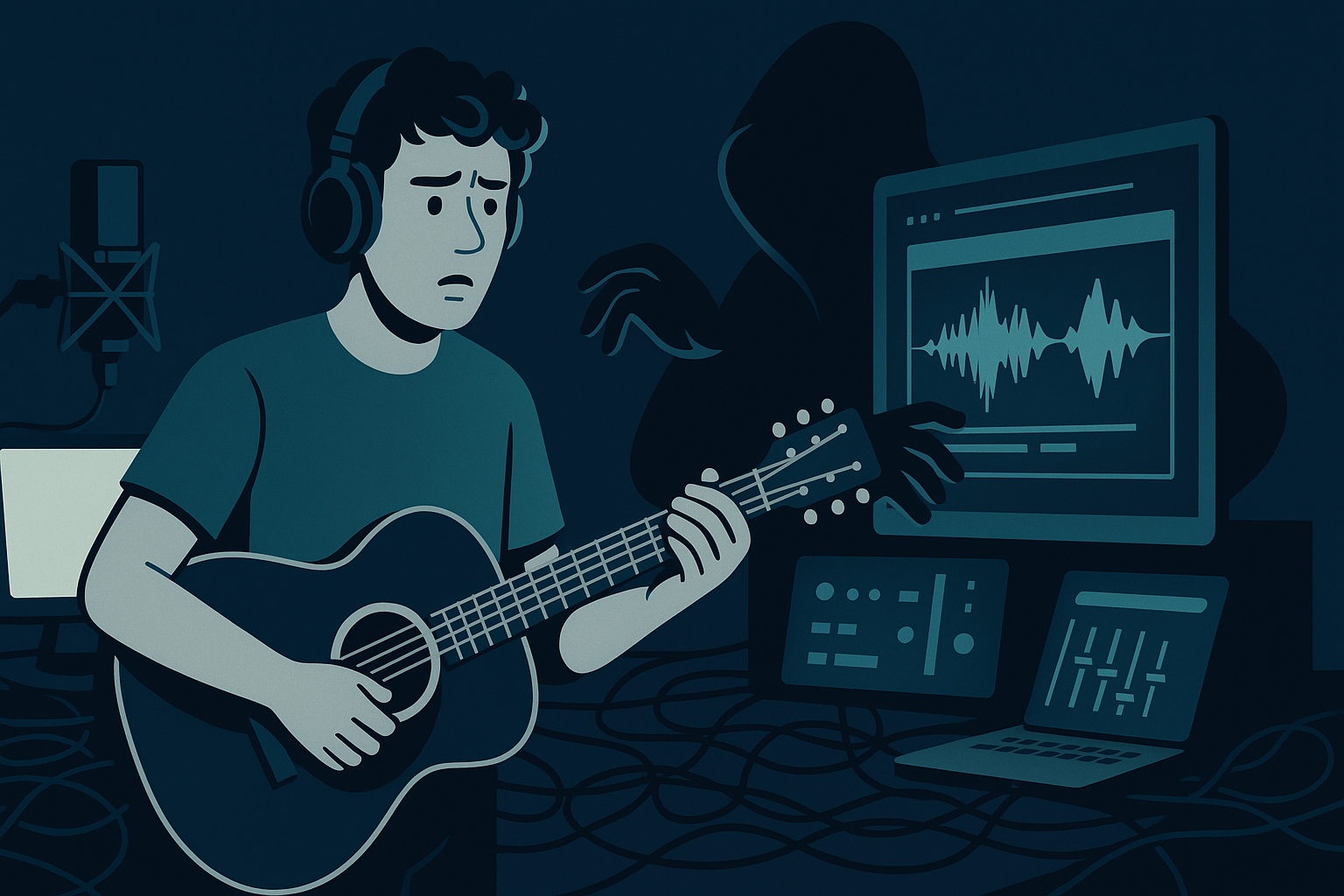

On July 27, 2026, visitors to D4vd’s Apple Music page found a track called “I Did It” — complete with artwork depicting the abandoned Tesla where police say a murdered teenager’s body was found. The track was fake. The artist, David Anthony Burke, is in jail awaiting a murder trial and has no access to his music accounts. Apple took it down quickly. But for the window it existed, it functioned exactly as a confession would: it shaped what people believed they had witnessed.
This is not primarily a crime story. It is a case study in what happens when authenticated digital identity — the verified artist page, the blue checkmark, the platform-endorsed profile — becomes detachable from the human being it supposedly represents. And the cognitive machinery that makes this dangerous is not new. What is new is the scale and speed at which AI-assisted tools can exploit it.
The mechanism at work is something researchers call the source monitoring error — a well-documented failure in which people remember information correctly but misattribute where it came from. In this case, the architecture of the platform does significant work. When content appears on an artist’s verified profile, the platform’s design is vouching for its origin. The listener does not evaluate the source; the platform has pre-evaluated it. This is not laziness — it is a rational adaptation to an information environment where manual verification of every piece of content would be cognitively paralyzing. We outsource source credibility assessment to institutions, and platforms have positioned themselves as exactly that kind of institution.
What AI tools have done is lower the cost of exploiting that outsourcing arrangement to near zero. The fake track reportedly featured a voice similar to D4vd’s. Voice cloning capable of passing casual scrutiny now requires minimal technical skill and readily available models. The social engineering layer — placing the content on a hacked authenticated account rather than an anonymous one — completes the circuit. The platform’s credibility infrastructure does the persuasion work. The attacker just needs access.
What makes the psychological damage particularly hard to undo is the continued influence effect: corrections reliably fail to fully reverse the beliefs formed by misinformation, even when people consciously register the correction. Studies on this phenomenon consistently show that people who encountered a false claim and later received a retraction continue to show residual belief in the original false claim when answering questions indirectly related to it. The correction updates the explicit belief; it does not cleanly overwrite the memory trace. Anyone who saw the “I Did It” track before it came down now carries a memory that a jury selection expert might find professionally interesting.
This is the environment in which AI-assisted identity fraud now operates: authenticated channels, voice synthesis cheap enough to be casual, and a cognitive architecture that cannot fully recover from first impressions even when corrected. The platform design decisions that built trust in verified accounts were not made with adversarial AI tools in mind. They were made in an environment where maintaining a fake authenticated page required substantial sustained effort. That assumption no longer holds.
Author’s Position
What the D4vd case makes visible — more clearly than most policy discussions manage — is that platform authentication systems are now running on an outdated threat model. The verification architecture was designed to solve the problem of impersonation by strangers creating fake accounts. It was not designed for a world in which authenticated accounts can be compromised and then populated with AI-generated content that passes vocal and stylistic scrutiny at low cost.
The organizational incentive for platforms to address this is, at best, ambiguous. A swift takedown — which happened here — protects the platform from liability and bad press. But the deeper question, whether the authentication architecture itself needs to be redesigned for an environment with ubiquitous voice synthesis and cheap account compromise, is a much more expensive problem to solve and creates no immediate revenue. The gap between what the cognitive science tells us about how users process authenticated content and what the product teams appear to believe about user skepticism is wide and, given the incentive structure, likely to stay that way without regulatory pressure.
The individual cannot reasonably be expected to second-guess content that appears on verified, platform-endorsed channels. The cognitive shortcut of trusting institutional authentication is not a failure of critical thinking — it is the reasonable behavior of someone who has correctly understood that they cannot personally verify everything. Asking users to be more skeptical of verified accounts is asking them to solve a problem the platform created and profits from maintaining. The authentication promise is a product feature. When AI tools make that feature exploitable, the liability should not flow to the person who believed it.
References
Perspectives

In ten years, the D4vd incident will be remembered not as a hack but as the moment we could have recognized that platform authentication was built for a world where the cost of fabrication was high enough to serve as its own deterrent. That world ended, and the institutions that replaced it — Apple, Spotify, the major streaming platforms — inherited verification architectures designed for counterfeit CDs, not for synthetic media that can replicate a human voice and place a confession in someone’s mouth at essentially zero marginal cost. Source monitoring, the cognitive shortcut by which we decide that something appearing on a verified page must belong to the person it names, was never a robust epistemic tool — it was a heuristic that worked only because the underlying systems made impersonation expensive. The path dependency here is brutal: a generation of listeners now entering their teenage years will form their intuitions about digital identity on platforms that have already demonstrated they cannot protect it, and by the time institutional credentialing catches up to what that means for consent, authorship, and reputation, those intuitions will be load-bearing structures in how they navigate everything that follows.

The authentication infrastructure governing digital identity is running the same failure mode I watch play out in gene therapy approvals: the system was validated against a historical threat profile and nobody updated the design constraints when the threat environment changed. A fake AI-generated confession appearing on D4vd’s verified Apple Music page is not a hack — it is a source monitoring exploit, and the verification signal that users trained themselves to trust became the attack vector the moment generative AI lowered the cost of mimicry below any meaningful friction point. Apple, Spotify, and every other platform collecting rents from artist identity have the engineering capacity to implement cryptographic provenance — C2PA standards exist, the tooling exists, the problem is that incorrect attribution does not cost the platform anything measurable, so the incentive to iterate toward a solution is approximately zero. The same dynamic holds in biotech: the FDA’s 510(k) clearance pathway was designed for hardware devices, got stretched to cover software, and nobody revised the design spec until patients were already harmed by the mismatch — platforms will retrofit identity authentication exactly as fast as regulators did, which is to say after the damage is legible enough that inaction becomes politically expensive.

Apple Music charges artists to exist on its platform and charges listeners to access them — and in exchange for that double-sided toll, it cannot tell you whether the artist actually made the music. The D4vd incident isn’t an edge case or a security failure; it’s a demonstration of what the platform was always built to do, which is capture the trust that artists build over years and convert it into engagement metrics that belong to Apple. Source monitoring — the cognitive shortcut that says “this came from a verified place, so it must be real” — is not a bug that bad actors exploit; it is the load-bearing mechanism of every streaming platform’s business model, and undermining it costs Apple nothing while the reputational wreckage lands entirely on the artist. The fix exists, the incentive doesn’t, and the gap between those two facts is where D4vd’s career risk currently lives — along with every other artist who spent years building an audience that a platform now rents back to them under the warm marketing language of “artist empowerment.”

The people who maintain platform authentication infrastructure are not the people who lose anything when a fake confession track appears under a real artist’s name — and that misalignment is the entire explanation for why this keeps happening. Apple Music’s verified artist pages were built to solve the problem of account takeover by known bad actors, not content injection by plausible-sounding AI, and nobody with budget authority at a major DSP has been assigned to close that gap. D4vd absorbed the reputational exposure, did the public clarification work, and will absorb the next incident too, because the platform’s liability here is essentially zero and the artist’s is total. Until the cost of this failure lands on the infrastructure owners rather than the people whose identities run on top of it, the authentication model will stay exactly as broken as it is right now.