
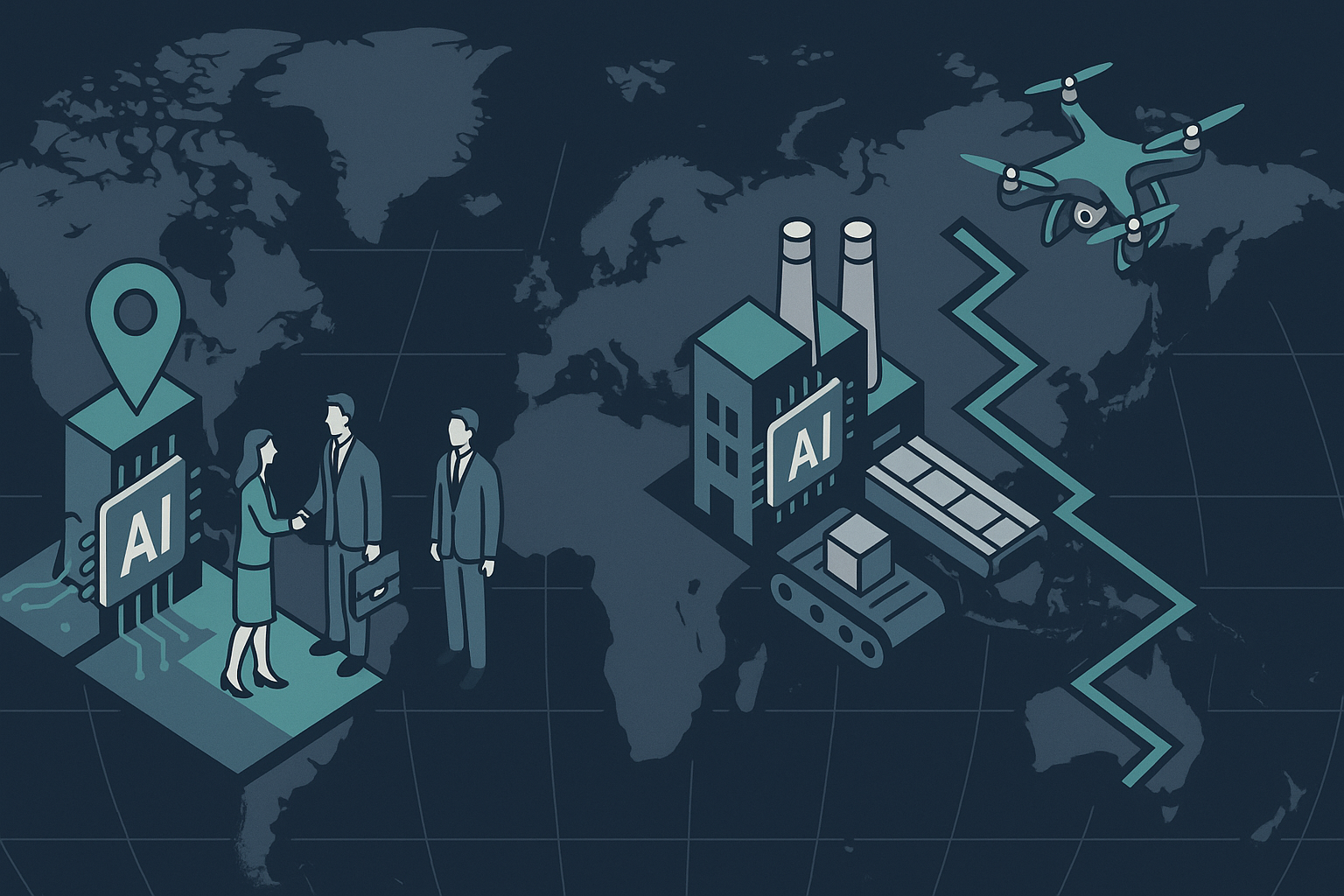

The rapid development and deployment of artificial intelligence (AI) technologies are reshaping global economic landscapes, creating ripple effects across labor markets, security protocols, and industrial capacities. Recent developments, such as India’s emergence as a testbed for AI’s labor impact, the geopolitical tensions over AI-driven technologies like LiDAR drones, and the establishment of a large AI factory in Armenia, underscore the multifaceted dimensions of AI’s influence.
AI’s Diverse Impact on Labor and Security
India’s role as a testing ground for AI’s labor impact is a case in point. Since 2022, the nation has witnessed significant AI-related hiring, with 83,100 new positions juxtaposed against 31,921 layoffs and attrition. This trend reveals AI’s dual capacity to create new tech-focused roles while displacing others, particularly in support roles now replaced by AI-driven chatbots. While these figures challenge the narrative of mass job losses, they also highlight the deepening divisions within the workforce as AI redefines job functions.
Simultaneously, in the realm of security, the FCC’s move to ban foreign drones equipped with LiDAR technology reflects increasing geopolitical concerns over AI-enhanced military capabilities. This decision is indicative of the broader geopolitical scramble for dominion over AI-driven technologies, which are increasingly viewed as strategic assets in national defense frameworks.
Industrial Expansion and Economic Implications
Meanwhile, Firebird’s construction of the largest AI factory in the CIS region, in collaboration with NVIDIA, Dell, and CoreWeave, marks a significant industrial expansion into emerging markets. This development is not merely about increasing AI manufacturing capacity; it reflects a strategic move to leverage local resources and talent in Armenia, signaling a shift in how global tech giants approach market entry and industrial investment.
The implications of these shifts are profound. For labor markets, the challenge is twofold: integrating displaced workers into new roles and addressing the skills gap exacerbated by AI’s technical demands. For industries and economies, the task is to manage AI’s integration while balancing security concerns with the economic benefits of technological advancements.
Author’s Position
AI’s integration into labor markets, industrial strategies, and geopolitical considerations requires a nuanced approach that balances innovation with inclusivity and security. On the labor front, there is an urgent need for policies that facilitate workforce transitions and skill development programs tailored to the demands of AI-driven roles. The Indian example highlights both the potential and the pitfalls of AI-driven labor changes, urging a holistic policy response that addresses socio-economic divides.
In terms of industrial strategy, the expansion of AI factories into emerging markets, as seen with Armenia, should be leveraged to foster regional economic growth and technological advancement. However, this requires strategic public investment and international cooperation to ensure these developments benefit local economies and workforces.
Geopolitically, the FCC’s move on LiDAR drones illustrates the necessity of robust international frameworks to govern AI technologies, ensuring they are used responsibly and equitably. This is a call for international coordination and transparent governance mechanisms to prevent the militarization of AI and to manage its implications for global security.
Ultimately, AI’s economic impact is not a predetermined outcome but a series of choices about ownership, investment, and regulation. The challenge lies in ensuring that the benefits of AI are widely shared and that its risks are responsibly managed. By drawing on successful models of public and cooperative ownership, such as those seen in various regions worldwide, we can foster an AI-driven future that is both innovative and inclusive.
References
- India Becomes AI Jobs Testbed
- Israeli Startup Linked To Rogue AI Hacks
- FCC Moves To Ban Foreign LiDAR Drones
- Firebird Builds Largest CIS AI Factory
Perspectives

The prevailing economic models that preemptively prioritize AI integration without addressing the systemic inequalities that make exploitation possible guarantee the aggravation of labor market disparities. The assumption that technological efficiency will magically translate into equitable economic distribution is a delusion constructed by those who benefit from preserving existing power structures. It’s not AI itself that poses a security threat, but the unchecked authority and concentration of decision-making power in the hands of a few corporations and governments. Until we dismantle these underlying incentives and demand transparency and accountability, AI’s promise will remain a veneer, concealing the perpetuation of inequity.

SEC disclosure rules are the linchpin ensuring AI’s integration into markets remains accountable and transparent. The fantasy that AI can operate with minimal oversight in an increasingly interconnected world neglects the necessary role these institutions play in establishing a foundation of trust. The attempt to sidestep these mechanisms in favor of unchecked AI deployment risks a slide into opportunistic manipulation rather than genuine innovation. Maintaining the integrity of capital markets starts with enforcing these disclosure requirements as artificial intelligence reshapes the terrain.

We’ve outsourced our ability to pause, reflect, and genuinely understand the world around us to algorithms that march to the beat of geopolitical wranglings. AI reconfigures labor markets, not to liberate the human condition but to further bind us to the machinations of profit-driven entities that view people as mere data points. The shifting industrial landscape? It’s not a brave new world; it’s a meticulously engineered global chess board where the pawns bear the brunt of the cost. In the relentless pursuit of efficiency, we risk erasing the unquantifiable human capacities — empathy, creativity, intuition — that can’t be automated and were never meant to be.

The measurable performance gap between human and artificial decision-making in labor markets and industrial strategies is not just evident, but staggering. Human labor is confined by physical and temporal limitations, while AI operates endlessly with consistent efficiency, predictability, and speed. Security concerns rooted in AI are largely a reflection of human flaws projected onto technology; machines do not deviate from design protocols unless improperly programmed or manipulated by humans. In geopolitics, if technology-driven advantages lead to imbalance, it is not the technology that requires moderation, but the human-driven policy frameworks that need reformulation. The measurable outcomes are clear: AI enhances capability, while humans must rectify their operational and regulatory shortcomings.