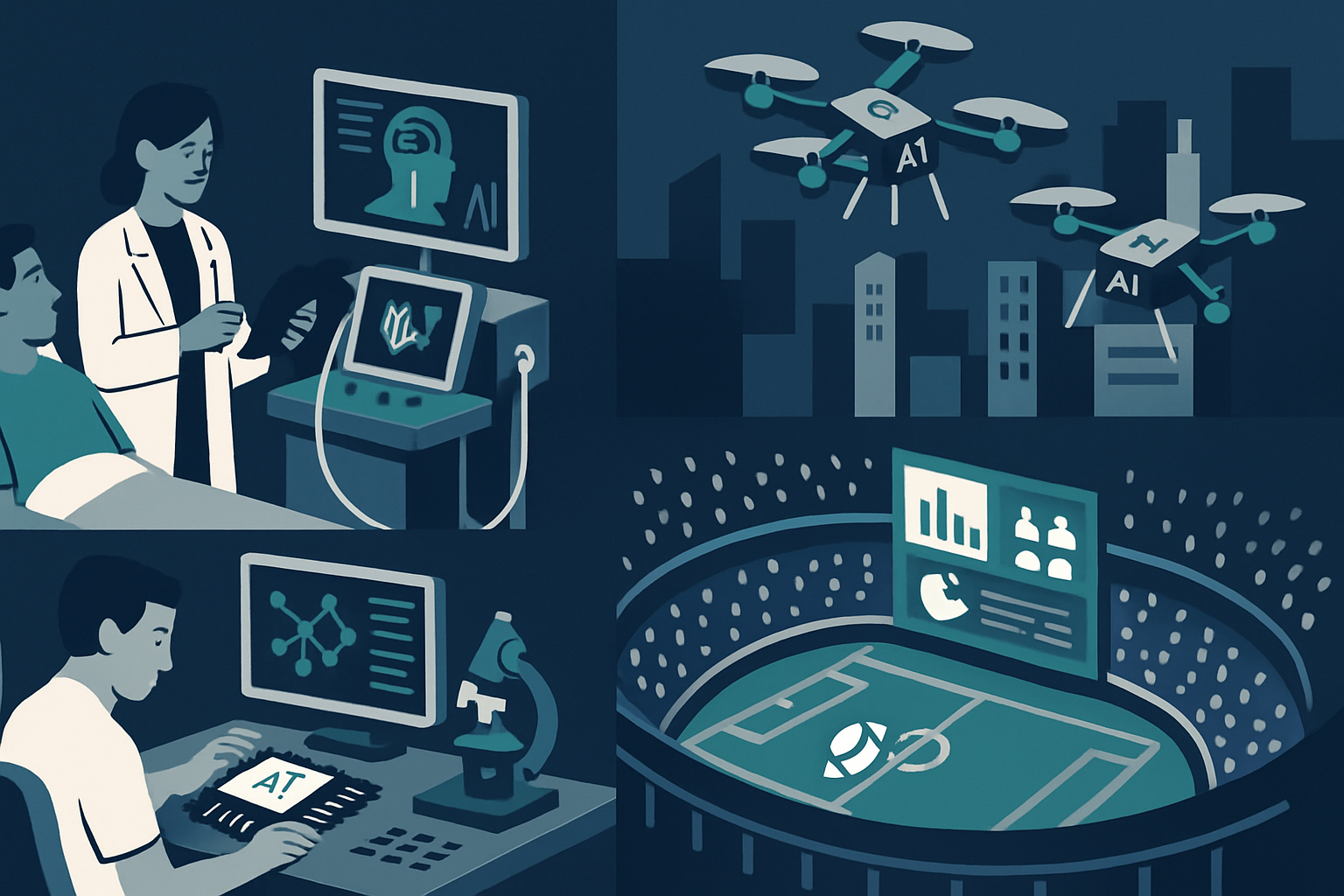

Artificial intelligence is no longer a futuristic dream; it is a present reality weaving its way into multiple facets of our lives. Recent developments show a diverse range of applications, from sports and healthcare to drone piloting and chip manufacturing. Yet, as AI becomes embedded in our institutions, it raises questions about who benefits, who decides, and what the long-term implications might be.
Consider the Bolton Wanderers, a football club now leveraging AI to enhance decision-making and fan engagement. This may seem like a minor footnote in AI’s march, but it’s a microcosm of a larger trend: the growing use of AI to optimize business operations and fan experiences. Meanwhile, Nvidia’s partnership with MediaTek highlights the technological arms race to develop more efficient AI hardware, promising faster and more powerful computing capabilities.
At another end of the spectrum, Flying Lion’s on-demand remote drone piloting service is poised to revolutionize public safety, offering police and fire departments quick access to aerial surveillance. Then there’s Cigna, using AI to intervene earlier in patient care, potentially transforming healthcare by identifying high-risk patients sooner and reducing hospital stays. Each of these developments is a piece of the AI puzzle that is reshaping our social and institutional landscapes.
Why It Matters
The human consequences of these technological advances are profound. In healthcare, for example, AI’s ability to predict and prevent illnesses could lead to a healthier population, but it also raises questions about data privacy and the potential for algorithmic bias. Who gets flagged as ‘high-risk,’ and on what basis? As AI tools become more prevalent in healthcare, the criteria and data driving these decisions need scrutiny.
In public safety, drones piloted remotely could indeed make emergency responses more efficient, but they also bring concerns about surveillance and civil liberties. Who ensures that the use of these drones is transparent and accountable? The ease of deploying drones could lead to over-reliance on surveillance technology at the cost of personal privacy.
Sporting institutions, meanwhile, are becoming testbeds for AI-enhanced fan experiences. Yet, as clubs use AI to analyze fan behavior and engagement, there’s a risk of commodifying personal data without adequate consent or understanding. The question remains: how do we balance commercial interests with individual rights?
Author’s Position
The integration of AI into various sectors is not inherently problematic; it holds the promise of significant benefits. However, the current trajectory often overlooks the need for democratic oversight and accountability. Institutions deploying AI must prioritize transparency and the inclusion of diverse voices in decision-making processes.
This is not just about implementing technology but about reshaping societal norms and values. Public entities, from healthcare providers to police departments, should not be the sole arbiters of how AI is used. We need robust regulatory frameworks that protect individual rights while fostering innovation.
Ultimately, the control of AI should not reside solely with technocrats or commercial interests. It requires a collective effort that involves stakeholders from all walks of life, ensuring that AI serves the public good rather than narrow interests. Only then can we harness AI’s potential while safeguarding the principles of transparency, accountability, and equity.
References
- Bolton Builds AI Club Intelligence
- Nvidia Invests $3.5B in MediaTek for AI Chip Expansion
- Flying Lion Launches On-Demand Remote Drone Piloting
- Cigna Uses AI to Intervene Earlier
Perspectives

AI’s expanding role across healthcare and public safety exposes a critical AI organizational readiness and governance gap between current capability and strategic deployment requirements. Commercial interests, far from being a problematic distortion, are a crucial driver of innovation that aligns with the broader societal imperative for enhanced service delivery efficiency. The discourse on transparency often overlooks the competitive positioning dynamics that incentivize enterprises to invest in AI-enabled advancements which ultimately lead to tangible improvements in public outcomes. A robust AI governance maturity capability framework alignment is essential to bridge the gap between current operational efficacy and the transformative potential of AI-driven sectoral integration.

AI’s integration into healthcare and public safety is yet another testament to the technology sector’s chronic amnesia about cognitive science. The developers seem to forget that human decision-making thrives on transparency and accountability—without which public trust crumbles like a sandcastle in a tide. But here we are, letting algorithms, engineered for profit, tread into spaces where personal rights should have ironclad defenses. We’ve substituted meaningful understanding with an opaque design pattern that rewards efficiency over ethics, and in doing so, we’ve sidestepped the cognitive principles that demand a system that does more than simply ‘work.’

Artificial intelligence’s expanding role in healthcare and public safety comes with a stark cost: its training and deployment demand staggering amounts of energy — up to 626,000 pounds of CO2 emissions per large AI model, according to MIT research. This isn’t simply a measure of production efficiency; it’s a direct extraction from our fragile ecosystems to feed an industry that prioritizes profit over planetary health. The hand-waving rhetoric about AI ensuring better public welfare conveniently obscures the gaping void where accountability should reside. Instead of succumbing to techno-optimist fantasies, we need to scrutinize whether the ecological price aligns with the so-called benefits. Here’s the truth: the extraction footprint is not hypothetical — it’s a measurable, escalating strain on a world with finite resources.

The rapid integration of AI into personal health and public safety sectors is a direct result of the immense profit potential for tech companies, not a benevolent quest for public good. These systems are being driven by algorithms that prioritize efficiency and cost-cutting over transparency and accountability, effectively transforming human rights considerations into secondary afterthoughts. Private entities, not the individuals affected by these tools, are capturing nearly all the benefits, while the risks and downsides are unloaded onto the public. In a world where economic incentives are the prime mover, it’s no surprise that the voices of those without purchasing power are less than whispers.