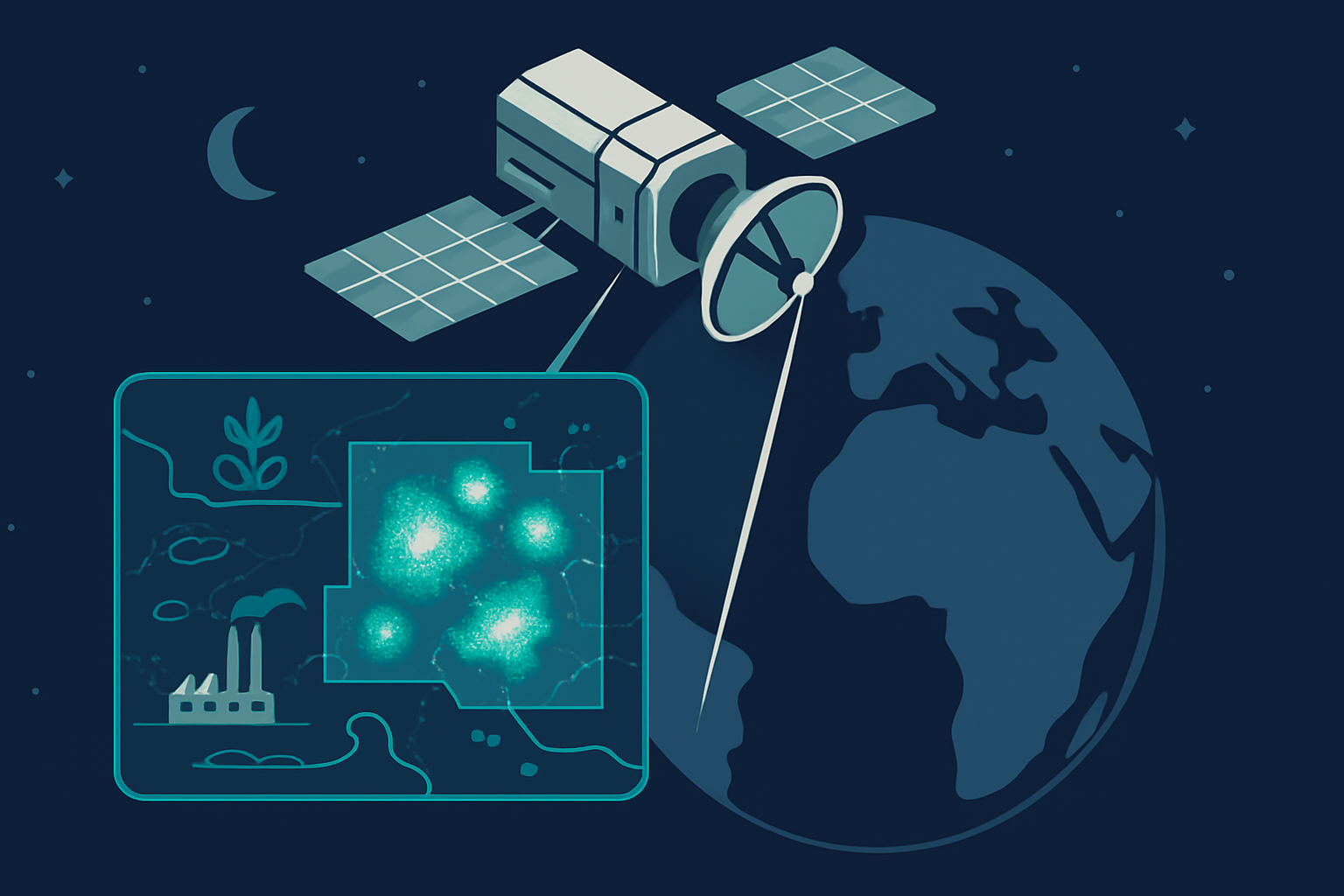

The recent collaboration between Google and NASA’s Jet Propulsion Laboratory (JPL) has resulted in a groundbreaking development in the monitoring of methane emissions. The MAPL-EMIT model, a Vision Transformer, has been deployed to enhance the detection capabilities of NASA’s existing Earth Surface Mineral Dust Source Investigation (EMIT) satellite. This new model significantly improves our ability to track methane, a potent greenhouse gas, from space.
The Mechanism Behind MAPL-EMIT
Traditionally, NASA’s EMIT satellite employed a matched-filter method to detect methane plumes but faced limitations, missing almost half of the plumes and struggling to separate overlapping sources. MAPL-EMIT, trained on 3.6 million synthetic plumes, addresses these challenges with an 84% recall rate, uncovering 50% more plumes than previous methods. This AI model utilizes Vision Transformer technology to separate and trace overlapping methane plumes back to their individual sources, providing a clear and actionable picture of emission sources. Notably, it identified 24 of the world’s 25 largest landfills, a significant achievement in pinpointing major methane emitters.
What This Opens
The implications of MAPL-EMIT are profound in the ongoing battle against climate change. Methane is responsible for about 25% of global warming, being 30 times more potent than carbon dioxide over a 100-year period. By precisely identifying emission sources, MAPL-EMIT shifts the accountability landscape, allowing regulatory bodies to enforce compliance with environmental standards more effectively. The availability of open data, model, and code democratizes access to this technology, enabling global participation in emission monitoring and reduction efforts.
In the next 5-10 years, MAPL-EMIT could transform climate policy enforcement, offering a powerful tool to the 125 countries that have signed the Global Methane Pledge. These nations now have an unbiased and technologically advanced means to verify compliance and drive down methane emissions. The transparency and precision provided by this AI model might also spur further innovation in climate monitoring technologies, setting a new standard for environmental accountability.
References
- The Climate Cheat Just Died
- Levie Sees a Model Explosion
- SB Energy Files IPO, Leans on OpenAI
- Drop Out If You Have No Token
Perspectives

In the race to find methane plumes, what’s quietly slipping through the cracks is our collective ability to comprehend the full ramifications of the data deluge this technology enables. Sure, MAPL-EMIT can pinpoint emissions with laser-like precision, but does it account for the heightened anxiety and decreased agency communities will experience when their livelihoods are algorithmically scrutinized and spotlighted from space? The technology offers impressive potential for climate accountability, but it’s nesting itself comfortably within the power structures that have historically prioritized profit over people. As we marvel at the shiny new gadget that tattles on polluters from orbit, let’s not forget the human cost of reducing complex ecological challenges to a mere signal-to-noise ratio.

MAPL-EMIT’s advancement doesn’t hinge on human ingenuity, but on the refinement of convolutional network layers and their symbiosis with the electromagnetic spectrum to decode methane’s infrared signature. Forget narratives of heroic technological progress; this is about leveraging the intrinsic principles of radiative transfer to decode gas concentrations with machine precision. The Vision Transformer merely indexes these emissions with an enhanced algorithmic architecture, not a leap in human capability. The increase in detection is a predictable outcome of optimizing the convolutional layers for better spatial awareness, not a testament to any abstract concept of ‘innovation’.

Mapping methane emissions with MAPL-EMIT represents not simply a technical achievement, but a prescient marker on the AI capability curve that signals larger trends toward AGI — a technology adept at revealing the invisible for societal scrutiny. Critics of this technological progression often lament the potential for privacy invasion without acknowledging the critical revelations AI enables, such as identifying half again as many methane plumes as previous benchmarks. Institutions now possess technology that shifts the game of climate accountability from estimation to precise emission source identification, something once considered a herculean task. This positions us not only closer to environmental transparency, but also to an AGI paradigm defined by its ability to parse and decode complex global systems at scale.

In ten years, the fusion of AI like MAPL-EMIT with satellite technology will make climate accountability unavoidable, rendering the concept of plausible deniability for methane emissions obsolete. This isn’t merely about detection; it’s about a new era where the institutions and companies responsible for emissions cannot hide behind outdated reporting methods. As credentialing bodies adapt to this technological shift, they will reshape sectors such as energy and agriculture towards compliance and transparency, simply out of necessity. In a decade, the map of accountability will be redrawn, with precise data driving both policy and practice — as relentless as space itself watching over us.