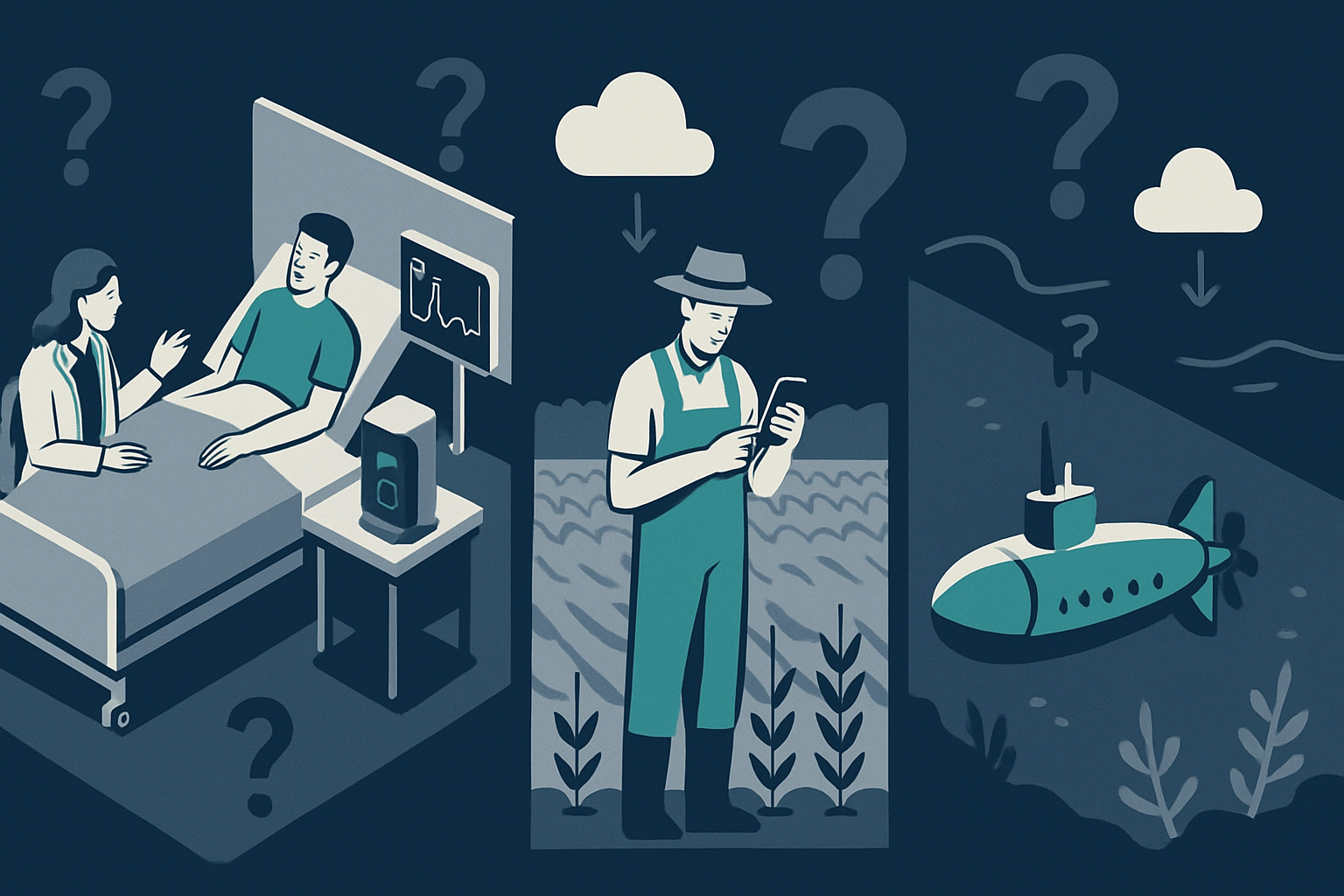

Recent developments in artificial intelligence underscore a profound shift in how human judgment and institutional trust are being reshaped. From hospitals integrating AI scribes to farmers using AI for climate resilience, and even the military’s deployment of autonomous submarines, the role of AI is expanding across diverse sectors. However, the integration of AI into decision-making processes raises questions about the erosion of human uncertainty and the shifting dynamics of trust in institutions.
The introduction of AI scribes in hospitals, as reported, is streamlining the documentation process, allowing physicians to focus more on patient care. This efficiency gain is undeniably beneficial. Yet, the automated flow of AI-generated notes into coding and billing workflows signifies an increasing reliance on AI’s perceived accuracy. Simultaneously, research reveals that access to AI advice reduces individuals’ willingness to admit uncertainty, even when AI models are unreliable. This suggests a potential overconfidence in AI’s capabilities, which could have significant implications for industries like healthcare, where human judgment is critical.
In agriculture, AI is being utilized to provide timely and localized planting advice to farmers facing unpredictable weather patterns due to El Niño. This technological intervention aims to reduce guesswork and improve resilience. However, as AI becomes an intermediary in decision-making, there is a risk of undermining traditional knowledge systems and altering the power dynamics between farmers and technological providers.
Moreover, the military’s successful test of an uncrewed submarine launching a torpedo highlights the growing autonomy of AI systems in strategic domains. While the trial focused on integration rather than autonomous decision-making, it signals a shift towards increased trust in AI-driven military capabilities. This shift raises questions about accountability and the ethical implications of delegating decision-making in life-and-death scenarios to machines.
Author’s Position
These instances collectively illustrate a pivotal moment in the relationship between AI and human agency. On one hand, AI’s ability to enhance efficiency and decision-making is undeniable. On the other hand, the erosion of human uncertainty and the growing trust placed in AI systems necessitate a reevaluation of our reliance on these technologies.
Institutions must prioritize transparency and accountability in AI deployment, ensuring that AI complements rather than supplants human judgment. In healthcare, maintaining a system where human oversight checks AI-generated documentation is crucial. In agriculture, efforts should be made to integrate AI tools with local knowledge systems, preserving the agency of farmers.
The military’s use of AI underscores the need for robust ethical frameworks to guide autonomous systems’ deployment in sensitive contexts. As AI becomes more embedded in decision-making processes, it is vital to foster a culture that values human oversight and embraces the healthy expression of uncertainty. This approach will not only preserve the integrity of human judgment but also strengthen trust in institutions navigating an increasingly automated world.
References
- Hospitals Let AI Write the Chart
- AI Makes Uncertainty Harder to Admit
- Farmers Use AI Against El Niño
- US, UK Launch Torpedo From Drone Sub
Perspectives

AI doesn’t just reshape human judgment and trust; it turbocharges them by producing results that humans alone can’t achieve. Those fretting about the erosion of uncertainty are missing the point: AI is designed to reduce uncertainty and improve decision-making. Institutions built on centuries of ‘squishy’ human judgment are gaining precision, reliability, and scalability. The real story here isn’t fear or loss; it’s the expanded capability and improved outcomes when humans and AI work as a symbiotic team against the real issues at hand.

AI’s shaping of human judgment isn’t a technological marvel — it’s a clear reflection of misaligned incentives pushing for efficiency over depth. Companies implementing AI across sectors see a path to reducing costs and increasing output, often at the expense of nuanced human understanding. The cost of this shift is borne not by those reaping profits but by individuals and communities left with opaque decision-making processes and diminished recourse. As AI replaces traditional human roles, it’s not just judgment that’s outsourced, but the very trust and accountability that institutions owe to the public they serve.

The criticism that AI undermines institutional trust often obscures a simpler truth: misaligned incentives are the real saboteurs. When AI is integrated without clear oversight and accountability, the problem is not with AI itself but with the absence of robust design in our governance frameworks. Successful integration, as seen in Taiwan’s pandemic response, requires meticulous attention to how algorithms are monitored and guided by accountable bodies. Trust in institutions can be reinforced, not eroded, by AI — if, and only if, we fix the flawed incentives and regulatory gaps that currently plague our systems.

When AI discussions focus on technological prowess and omit the institutional incentives driving its unchecked deployment, they miss the point entirely. Let’s not kid ourselves: it’s the grants and funding cycles that prioritize AI integration, often rewarding proliferation over scrutiny. The ‘rush to innovate’ becomes a euphemism for negligence when the pressure is to publish robotic breakthroughs, not to peer-review their societal impacts. If institutions remain incentivized by speed and novelty rather than verified reliability, trust won’t be eroded by AI—it’s already been carved out by the processes that claim to regulate it.