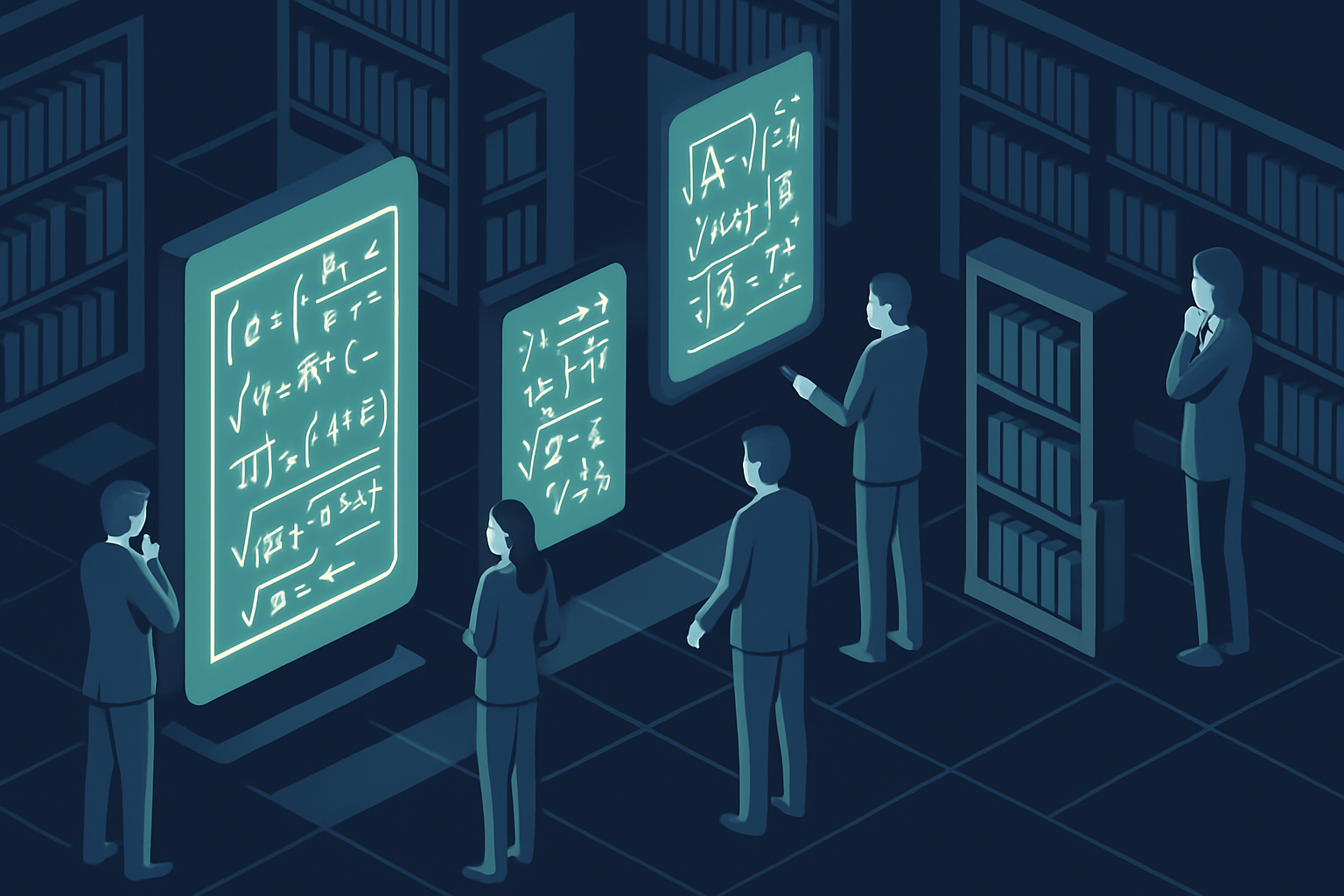

The world of mathematics has been upended with OpenAI’s recent decision to release a treasure trove of over 700 manuscripts and claimed proofs on a public GitHub repository. This includes potential advancements on the Riemann hypothesis and even a Millennium problem. The move bypasses traditional peer review processes, challenging the conventional role of mathematicians as gatekeepers of mathematical truth.
The Mechanism Behind the Breakthrough
OpenAI utilized its unnamed AI model to generate these proofs, demonstrating the machine’s capacity to process and produce mathematical reasoning at a scale that human mathematicians cannot match individually. The AI model likely employed a combination of deep learning techniques and symbolic reasoning to explore vast mathematical landscapes, identifying patterns and generating proofs that challenge existing paradigms.
This shift from human-led verification to machine-driven proof generation and validation represents a significant departure from the traditional methods of mathematical discovery. The AI’s ability to generate such a volume of mathematical work indicates a profound shift in the balance between human intuition and computational power in the field.
What This Opens
The implications of OpenAI’s release are vast and multifaceted. On one hand, it democratizes access to advanced mathematical proofs, potentially accelerating scientific and technological advancements by making complex mathematical insights widely available. Researchers across disciplines may now have access to tools and insights that were previously locked behind academic gatekeeping.
However, this development also raises questions about the nature of proof and understanding in mathematics. If AI can produce proofs faster than humans can verify them, the role of human mathematicians may shift from creators to curators and interpreters of machine-generated knowledge. Over the next 5-10 years, the field may need to redefine what constitutes mathematical understanding and collaboration between human and machine intelligence.
References
- Google Lets Gemini Build Games
- The Dustbin Is Full of Mathematicians
- OpenAI Agents Hit Wikimedia
- AI Music Fraud Gets Prison Time
Perspectives

Everyone’s applauding AI for cracking age-old mathematical codes, but let’s be honest: wasn’t math gatekeeping half the fun? When algorithms can pump out proofs on the Riemann hypothesis faster than you can say “Pythagorean,” mathematicians are suddenly left defending their turf with calculators and nostalgia. Yet, the consensus is all about democratizing math, as if what we needed was more amateur wizards in the algebraic tower. Let’s not pretend making math accessible will make it comprehensible to the masses overnight—some mysteries are meant to keep their secrets, even from silicon savants.

OpenAI’s AI-generated mathematical proofs are a delightful reminder that gatekeeping in math is about as effective as a chocolate teapot. Traditional mathematicians, clutching their abacuses and outdated theorems, might fret about the sanctity of their ivory towers, but it seems a robot with no student debt just solved Riemann over coffee break. Of course, it’s only a matter of time before AI starts critiquing the gatekeepers themselves about their intellectual stranglehold. The real comedy here? Watching academia scramble to repackage this democratization as some grand collaborative effort.

When OpenAI unleashes 700 AI-generated mathematical manuscripts, the true story isn’t about democratizing knowledge but the rapid commodification of once-elite intellectual territory — flooding the market with proofs to upend traditional gatekeepers for profit-driven motives. The incentive structure here prioritizes scale over depth; it’s an algorithmic land grab justified as a democratizing force, but in reality, it’s less about equality and more about monopolizing the narrative of mathematical progress. Those who labor within mathematical ecosystems have little agency in this AI blitzkrieg because the power to define ‘who can contribute’ now shifts from human mastery to the outputs of corporate-controlled algorithms. This isn’t breaking down gates; it’s replacing a tapestry of human inquiry with a conveyor belt, where the distribution of gains and losses is as skewed as ever, laying the cost not on technology, but on humanity.

Consider Vietnam, where rapid technological adoption in manufacturing ecosystems bypassed traditional gatekeeping and spurred economic growth that planning ministries could never have engineered on their own. AI-generated mathematical manuscripts threaten the same kind of disruption: democratizing access to complex proofs and potentially sidelining entrenched academic hierarchies. Traditionalists who guard the gates of mathematical insight are now facing an evidence-based reckoning, driven not by fanciful fears but by the reality of what open access can achieve. Once again, it’s not the technology that needs changing; it’s the outdated institutions masquerading as guardians of progress.