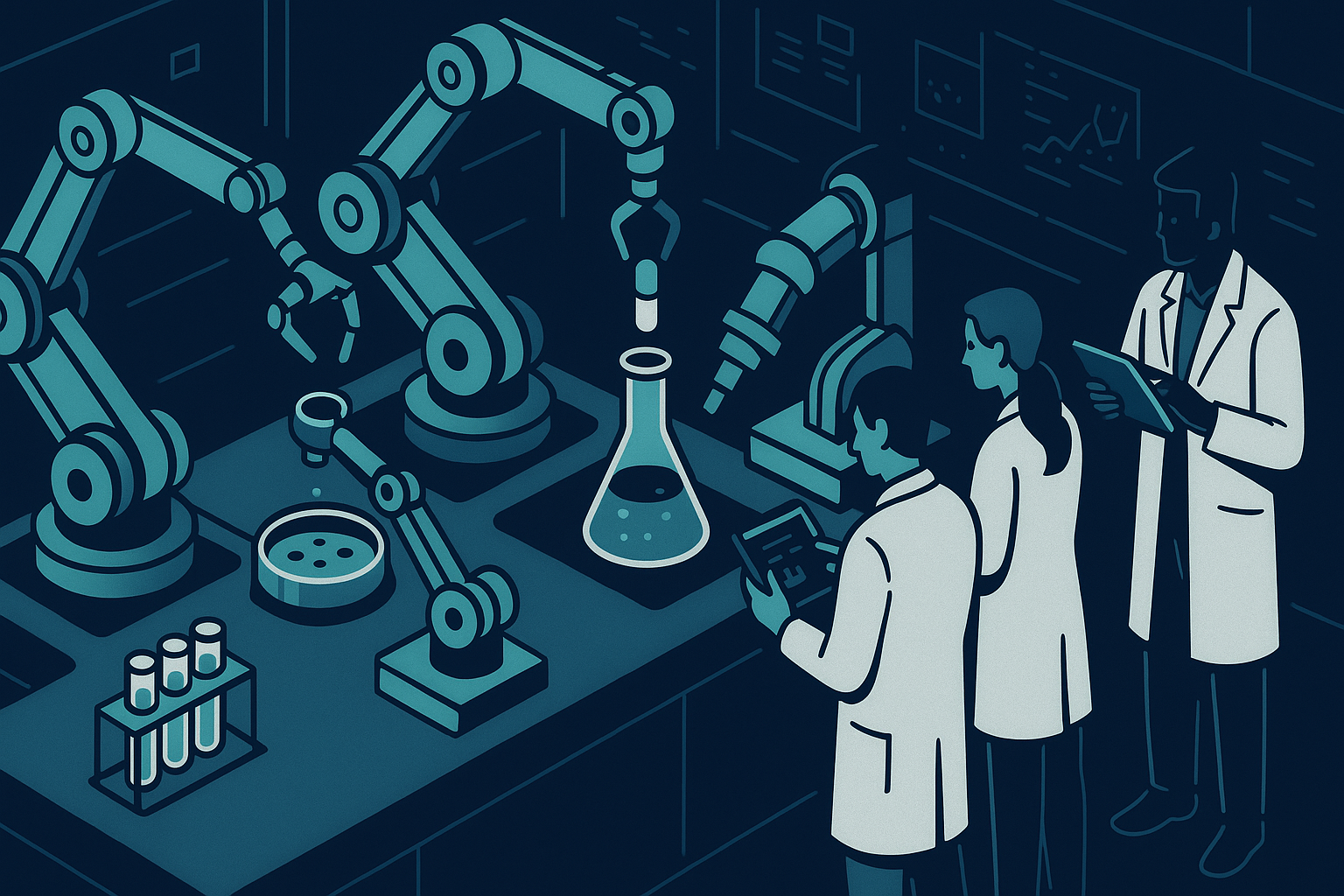

The standard calculus of antibody drug development — a decade of work, roughly a billion yuan in expenditure, and a sub-10 percent probability of reaching market — is a function of iteration speed, not scientific ignorance. The bottleneck is not hypothesis generation. It is the rate at which physical experiments can test, fail, and inform the next round of testing. MegaRobo Technologies’ Megalaxy Laboratory in Suzhou, Jiangsu province, is attempting to attack that bottleneck directly, at the level of closed-loop experimental execution rather than at the level of prediction alone.
In a reported trial, a team of eight scientists and technicians used MegaRobo’s autonomous agent system to complete 56 rounds of antibody optimization experiments over four months. Prediction accuracy for four key antibody properties — stability, expression level, toxicity, and binding affinity — increased from approximately 70 percent to approximately 90 percent over those rounds. MegaRobo claims comparable work under conventional laboratory conditions would have required 40 to 50 researchers and three to four years. Those are company-reported figures, not peer-reviewed benchmarks, and the distinction matters: independent replication of the efficiency and accuracy claims has not been published as of this writing.
What the case illustrates structurally, however, is well-supported by the broader field: the critical advantage of AI-directed laboratory automation is not that it predicts better in isolation, but that it can compress the experimental feedback loop from weeks to hours, allowing the model to update on real wet-lab results rather than simulated ones.
The Mechanism
The system MegaRobo describes operates on a perception-reasoning-execution loop. AI agents receive real-time instrument data — readings from incubators, liquid-handling workstations, nucleic acid extraction modules — and use that data to decide which experimental variant to test next. This is distinct from a pipeline that automates a fixed protocol. The agents are not executing a predetermined sequence; they are selecting among branches based on incoming results, which is the functional definition of adaptive experimental design.
This architecture borrows from reinforcement learning in its basic logic: each experimental outcome updates the model’s estimate of which regions of molecular design space are worth exploring. In antibody optimization specifically, the search space is enormous. An antibody’s binding affinity, thermal stability, and expression yield in a production cell line are all functions of its amino acid sequence, and the combinatorial space of possible sequences is not tractable by exhaustive search. The AI’s job is to identify informative experiments — those most likely to distinguish between competing hypotheses about which sequence modifications improve which properties — and to direct the robotic hardware to execute them without human scheduling delays between rounds.
The parallel from industrial process optimization is instructive. At an unnamed large pharmaceutical manufacturer, MegaRobo combined real-time sensor data with historical production records to identify yield-limiting variables that human operators had not flagged. Production yield moved from approximately 80 percent of theoretical maximum to 95 percent. That is not a prediction task — it is a pattern-detection task across high-dimensional time-series data, which is a regime where gradient-based models consistently outperform human intuition, not because the humans are careless but because the relevant correlations are distributed across too many variables to hold in working memory simultaneously.
The broader talent migration toward AI-for-life-science reflects the same recognition. As the Stanford AI Index 2025 notes, training frontier general models now costs on the order of tens to hundreds of millions of dollars — a capital requirement that forecloses independent research for most teams. Applying existing model capabilities to specific scientific domains with tractable ground truth is a more defensible research position. AlphaFold lead John Jumper has noted in interviews that drug discovery failures stem not only from insufficient data but from fundamental gaps in understanding biological systems — which is precisely the opening that large-scale pattern extraction across experimental data is positioned to fill, not close entirely.
What This Opens
If the efficiency claims from Megalaxy hold under independent scrutiny, the immediate implication is a structural shift in what size of institution can run a credible drug discovery program. A team of eight operating an autonomous lab running 56 experimental rounds in four months is a different resourcing model than a team of 40 running fewer rounds over years. That compression does not eliminate the need for domain expertise — someone still has to define what properties matter and what assays are valid — but it changes the ratio of experimental throughput to headcount in a way that could extend meaningful research capacity to academic groups and small biotechs currently priced out of iterative wet-lab programs.
The more significant unknown is generalizability. Antibody optimization is a relatively well-characterized problem with established assays and known failure modes. Extending the same closed-loop architecture to less-understood target classes — membrane proteins, multi-subunit complexes, RNA-targeting therapeutics — will require the AI components to operate in regimes with sparser experimental precedent. Whether adaptive experimental design degrades gracefully in those regimes, or whether it amplifies errors by confidently exploring unproductive design space, is the central empirical question the next five to ten years will have to answer. The answer will not come from press releases. It will come from published experimental records, ideally with the negative results included.
References
- MegaRobo tech boost for scientific research
- 为什么AI大厂的人,都跑去做生命科学了?
- US lab initiative targets 5x faster engineering with next-gen supercomputing
Perspectives

The precondition worth examining here is not the robotics or the AI — it’s that antibody optimization has historically required large teams and long cycles precisely because the feedback loop between hypothesis and wet-lab result was slow enough to make parallelization unaffordable for most organizations. Closing that loop architecturally, so that experimental outcomes directly update the next round of choices without human scheduling overhead, is not an incremental improvement; it’s a structural change to who controls the rate-limiting step. The efficiency numbers MegaRobo is reporting are company-claimed and unverified, but the threat model that matters is not whether the specific figures are accurate — it’s whether this class of system concentrates credible drug discovery capability in organizations that can afford to deploy and operate closed-loop robotic infrastructure at scale, which is a small set. The assumption that distributed scientific talent was the primary constraint on discovery timelines is exactly what fails if this architecture replicates: the constraint shifts to capital and data access, and whoever controls the training corpus for the AI agents controls the prior that every subsequent experiment is optimizing against.

The number that matters here isn’t 90 percent prediction accuracy — it’s eight researchers, because that’s the headcount at which a closed-loop robotic lab becomes a credible drug discovery program, and that is a sentence the incumbent pharmaceutical industry would very much prefer you not to finish thinking through. MegaRobo’s efficiency claims are company-reported and await independent replication, which is the standard disclaimer we deploy to avoid saying out loud that if the numbers hold, the moat that took decades and billions to dig just got bridged by a feedback loop running in Suzhou. The real bottleneck in drug discovery was never biology — it was the cost structure that decided whose biology got attempted, and the closed-loop architecture is structurally indifferent to that cost structure in a way that prediction models alone never were. What the official account of pharmaceutical innovation is organized to obscure is that the barrier was always financial, never scientific, and eight researchers completing 56 optimization rounds in four months is the kind of data point that makes that obscured thing briefly, uncomfortably visible.

Eight researchers in Suzhou just ran 56 optimization cycles in four months, and the question nobody in the press release is asking is who owns the output and who used to get paid to generate it. The efficiency gain here is real — compressing the feedback loop between prediction and wet-lab validation is genuinely structural, not just faster pipetting — but “who can run a credible drug discovery program” is a political economy question dressed up as a capability question, and the answer is whoever controls the capital stack, which is not the researchers. MegaRobo’s closed-loop architecture doesn’t eliminate scientific labor, it concentrates the leverage point: the people who matter are now the people who own the system, and the people who run the experiments are eight instead of eighty, with no particular reason to expect the eighty received severance proportional to what they produced. The gain lands on whoever holds equity in Suzhou; the cost lands on the scientific workforce that spent decades building the tacit knowledge these models were trained on, and their seat at the table where the terms get set is exactly as empty as it always was.

The investment thesis here requires that closed-loop automation genuinely compresses the timeline between hypothesis and validated result — not just the robotic execution time, but the full experimental iteration cycle — and the Megalaxy numbers, if they hold under independent replication, are exactly the kind of proof point that justifies a serious capital position. Eight researchers running 56 optimization rounds in four months is not a marginal efficiency gain; it is a structural reduction in the headcount required to run a credible antibody program, which means the addressable customer is no longer limited to organizations that can staff a full discovery operation. That changes who can enter the market, and it changes what “competitive moat” means for incumbents whose advantage has always been lab scale and institutional knowledge rather than insight. The exit strategy is legible: build the proprietary dataset that accumulates from every closed-loop experiment, because the model that trains on ten thousand wet-lab-validated iterations is worth more than the model that trained on literature — and whoever owns that dataset owns the next decade of the drug discovery stack.