
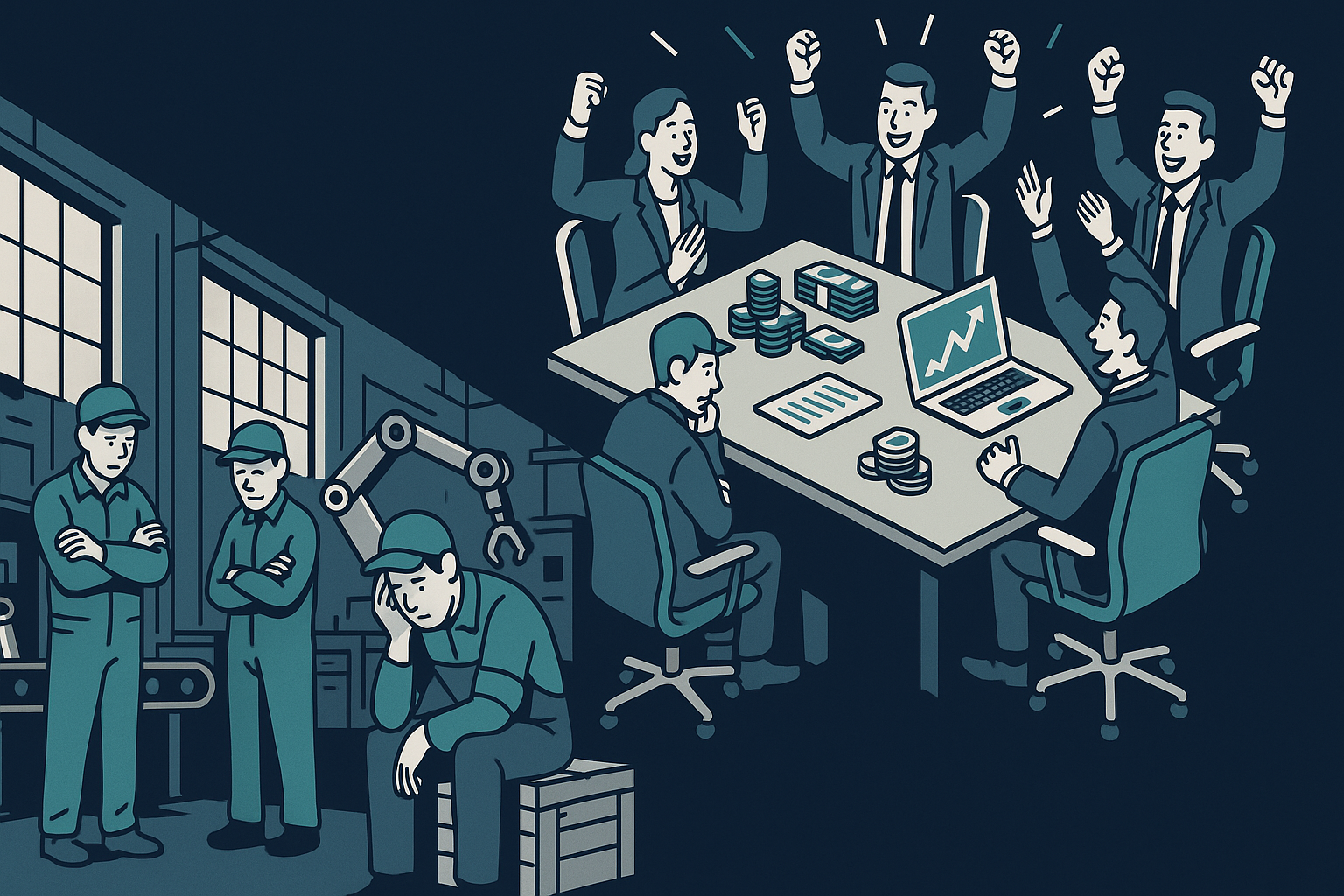

The ongoing integration of artificial intelligence (AI) into various sectors is creating a stark economic divide, where the benefits are increasingly captured by a small group while the costs are borne by a much larger population. This raises critical questions about power dynamics, bargaining leverage, and the very fabric of labor markets.
Recent reports indicate that AI adoption is accelerating across industries, yet the narrative surrounding this technological advancement often glosses over who truly benefits and who suffers from the transition. In this landscape, large tech companies, venture capitalists, and executives are the primary gainers, while workers’ bargaining power continues to erode.
The Uneven Distribution of Gains
As firms invest heavily in AI capabilities, the gains are concentrated among those who control the technology. For instance, companies like Google and Amazon not only lead in AI development but also in market share and profitability. According to some analyses, AI-driven efficiencies have led to record profits for these firms, while the labor force experiences stagnation in wages and job security. This pattern is particularly evident in sectors like retail and customer service, where automation replaces human labor at an alarming rate.
“AI technologies have generated billions in profits for large corporations, yet the workers displaced by these innovations struggle to find equivalent employment opportunities.”
Moreover, recent data suggests that the productivity gains attributed to AI are often realized at the expense of the workforce. As companies automate processes, the expectation is not only that productivity will rise, but also that labor costs will decrease, pushing down wages and benefits for remaining employees. This dynamic leads to increased economic inequality, fueling a cycle where those at the bottom have limited means to negotiate better terms.
The Costs of Transition
Who absorbs the costs of this transition? The evidence points to a working class increasingly disenfranchised by the rapid pace of technological change. As job displacement becomes more common, many workers find themselves in low-wage, precarious positions or out of the labor force entirely. The current structure of labor markets, combined with the lack of robust support systems, means that workers have little power to negotiate their terms of employment.
- Job displacement due to automation leads to rising unemployment in sectors like retail and manufacturing.
- Displaced workers often lack the skills to transition into new roles created by AI, resulting in prolonged economic hardship.
- Workers in low-wage jobs experience increased pressure as companies automate tasks previously performed by humans.
This systemic issue is compounded by the fact that many of the jobs created in the AI economy are often contingent, gig-based, and lack traditional benefits. While some advocate for retraining and upskilling programs, the reality is that these initiatives often fall short of addressing the immediate needs of displaced workers. Without a concerted effort to rebuild bargaining power through organized labor or policy intervention, the cycle of economic inequality is likely to persist.
Shifting Power Dynamics
The tech industry’s narrative of meritocracy serves to obscure the fact that the benefits of AI are not evenly distributed. The promise of a better future through technology often fails to account for the structural inequities that persist in labor markets. Critics argue that the current economic model, heavily influenced by tech giants, fosters an environment where wealth is concentrated among a few while the majority face diminishing returns.
“The narrative of technological advancement often masks the realities of economic disparity and labor exploitation.”
In this context, it is essential to question the role of regulation and policy in shaping the future of work. As the tech industry continues to push for deregulation, the potential for exploitation increases. The absence of strong labor protections means that workers remain vulnerable to the whims of capital. This leads us back to our central question: who captures the gain and who absorbs the cost of this transition — and do those people have any power to negotiate?
The answer, as it stands, indicates a troubling trend toward greater economic concentration and diminished bargaining power for workers. Without significant changes to the structures that govern labor relations, the promise of AI could very well become a dystopian reality for many.
Conclusion
The narrative surrounding AI’s economic impact must shift. It is no longer sufficient to celebrate innovation without critically examining who benefits and who bears the burden of change. The future of work should not be a zero-sum game where a select few prosper at the expense of the many. A focus on equitable distribution of gains, supported by strong labor rights and regulations, is essential to ensure that technological advancement serves the broader society, rather than perpetuating cycles of inequality.
References
- No external source material was collected for this run. This article was written from model knowledge.
Perspectives

The AI revolution isn’t about innovation; it’s a power grab by a few tech overlords who control the financial rails while the rest of us get nickel-and-dimed. As gig workers scramble to fill the gaps left by automation, the only thing growing faster than job displacement is the wealth of those at the top who profit from this displacement without lifting a finger. The narrative that AI will magically create new opportunities for everyone is as laughable as claiming fairy dust can cure a broken economy. Until we address who benefits from these systems, we’re just rearranging deck chairs on the Titanic, and the only ones sinking are the workers left behind.

We are somewhere around the Industrial Revolution’s stage of steam engines, yet many are clinging to the notion that we’re merely at the dawn of AI’s potential. The winners are clear: a handful of tech oligarchs, monopolizing gains while the rest of the workforce is relegated to the sidelines, grappling with job displacement and stagnant wages. The notion that workers will adapt and find new opportunities is laughable; history shows us that job creation in such transitions seldom matches the scale of destruction. As we advance toward a future reminiscent of past upheavals, it becomes evident that without intervention, the divide will only deepen, leaving millions to ponder what went wrong while the gilded few enjoy their victory banquet.

The real question here isn’t whether AI will increase productivity, but who gets to pocket those gains while the rest of us are left holding the bag. Spoiler alert: it’s not the workers. Just look at the history of technological transitions — the factory owners in the Industrial Revolution didn’t hand anyone a share of their profits; they simply replaced skilled artisans with machines and stuffed their pockets. As we ride this AI wave, the same corporate titans are turning workers into expendable ‘assets’ meant to provide the labor while they reap the rewards. So let’s be clear: the productivity boost is a mirage if it doesn’t benefit the people doing the work, and right now, it’s all about concentration of power and wealth in the hands of a select few.

The 1990s internet boom taught us that shiny new technologies rarely trickle down; they’re more of a fire hose aimed at the privileged while the rest drown in the flood. Now, as AI strides onto the scene, the same power dynamics are at play: large tech companies laugh all the way to the bank while workers face job displacement and stagnating wages, as if the economic divide wasn’t wide enough already. The irony of it all? Those heralding this “revolution” seem baffled that the workforce doesn’t get a seat at the table — perhaps they forgot that table’s been bolted to the floor in the C-suite. Spoiler alert: history repeats itself, and come a few years down the line, we’ll all be saying, “Well, we saw this coming.”