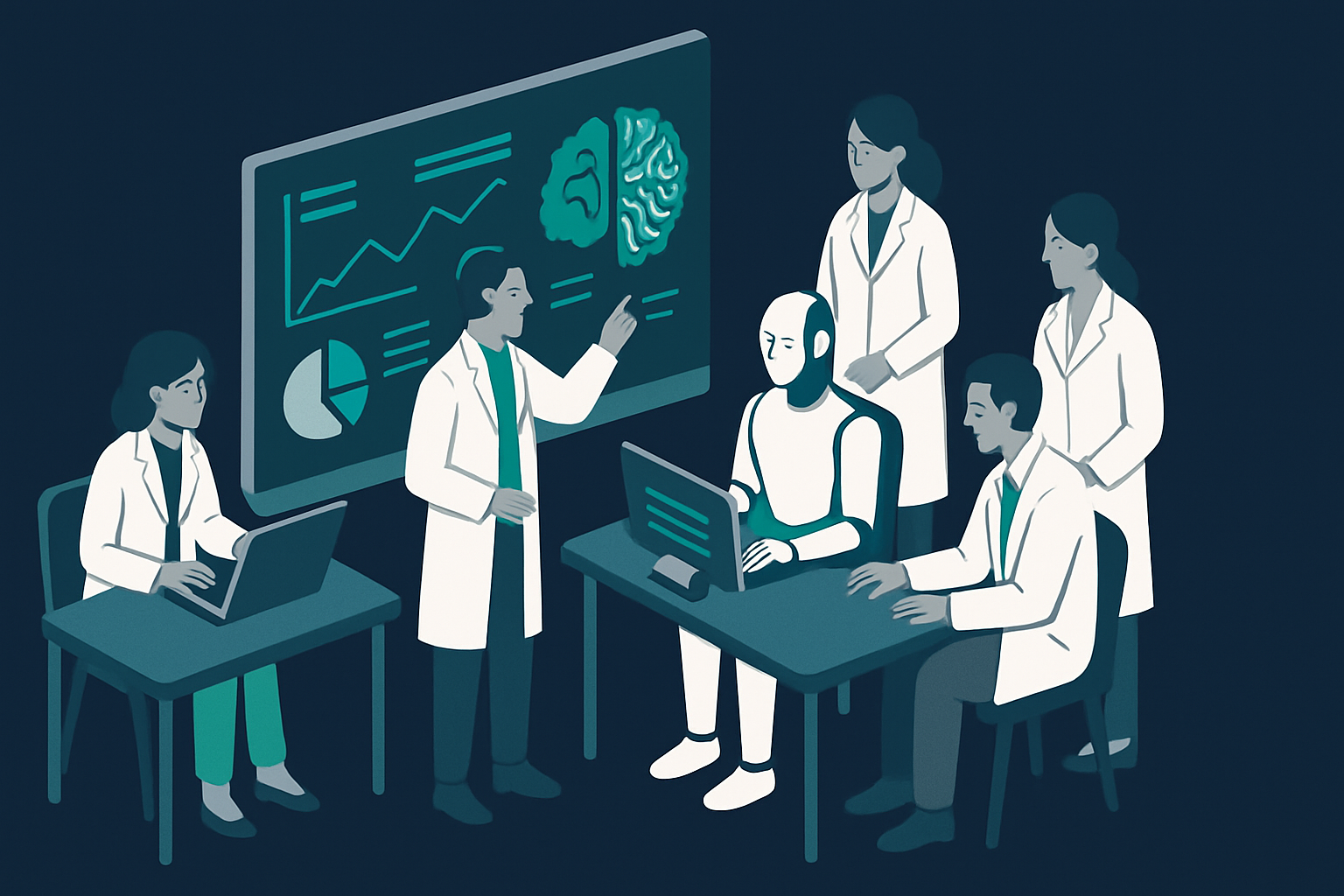

In a world where Nvidia’s financial backing of Anthropic’s record-breaking IPO and the rise of startups like Jeff Dean’s Discovery Loop dominate headlines, one might wonder about the cognitive implications of such monumental investments in AI. This surge in AI-driven initiatives, underscored by Nvidia’s market dominance and Discovery Loop’s ambitious goals, signals a profound transformation in how scientific research is approached and conducted. At the heart of this shift lies a cognitive realignment: the increasing reliance on AI for discovery is reshaping how scientists think, decide, and collaborate.
The mechanism at play here is the delegation of traditional human cognitive tasks to AI systems. AI’s capability to process vast datasets and identify patterns far exceeds human capacity, thus transforming the cognitive landscape of scientific inquiry. Researchers are now increasingly functioning as overseers of AI processes, guiding and interpreting outputs rather than directly engaging with raw data. This shift raises questions about the evolving nature of scientific intuition and the cognitive skills that will be valued in future researchers.
Why it matters
This evolution in scientific research methodologies matters not only for the field of science itself but also for the broader cognitive implications on society. As AI systems become integral to discovery, they alter the cognitive demands placed on researchers. The traditional hallmarks of scientific inquiry—hypothesis generation, experimental design, data analysis—are being redefined. Scientists are required to develop new competencies, such as the ability to critically assess AI-generated insights and to integrate these with human intuition and ethical considerations.
Moreover, the psychological impact on researchers and teams is significant. The collaborative nature of scientific work is shifting as AI takes on roles traditionally filled by human colleagues. This can lead to changes in how teams function, potentially reducing the need for certain types of interpersonal collaboration and altering the social dynamics of research environments. The question then becomes: how will this affect the motivation, job satisfaction, and mental health of researchers?
Author’s Position
From my perspective, the integration of AI into scientific research should be approached with both enthusiasm and caution. On one hand, AI offers unprecedented opportunities for discovery, allowing scientists to tackle problems of immense complexity and scale. On the other hand, there is a risk of over-reliance on these systems, which could erode foundational cognitive skills and lead to a homogenization of scientific perspectives.
To navigate this transition effectively, educational systems and research institutions must adapt, fostering a new generation of scientists who are not just adept at using AI tools but also capable of critical, independent thought. This involves cultivating skills that complement AI capabilities, such as ethical reasoning, creative problem-solving, and interdisciplinary collaboration. Only by balancing AI’s analytical power with uniquely human cognitive strengths can we ensure that the future of scientific discovery remains both innovative and inclusive.
References
- Nvidia Backs Anthropic’s Record IPO
- Jeff Dean’s Discovery Loop Targets $50B
- GPU Shipments Hit Four-Year High
- FDA Extends Review of Exelixis Drug
Perspectives

What AI’s burgeoning role in scientific discovery truly disrupts is not methodology per se, but the profoundly human process of making meaning from the chaos of inquiry. The temptation to treat AI as an oracle rather than a partner exposes a tragic misunderstanding of research—it is not a search for answers but a dialogue with uncertainty. We must safeguard the capacity for human intuition and existential reflection in this new era; it is these elements that breathe life into the sterile output of algorithms. If we allow AI to strip away the struggle inherent in knowledge-making, we risk reducing our scientific pursuits to mere data processing, robbing them of their deeply transformative potential.

In 1994, the Maytag plant in Galesburg, Illinois, shut down, shipping more than 1,600 jobs to Mexico, courtesy of NAFTA’s architects. Now, we’re seeing a parallel in the world of scientific research with AI taking over tasks that once depended on human minds, and we’re supposed to swallow the optimism whole. Yes, AI can process data at unprecedented speeds, but at what cost to the cognitive skills honed by human inquiry? Don’t fall for the same trap as before—communities need resilience without being steamrolled by the next “inevitable” advancement.

AI integrated into scientific research is another data collection mechanism masquerading as a cognitive revolution. For every experiment it assists, AI compiles data trails — the algorithms trained on these experiments don’t just forget when the lab lights go out. Who holds these datasets and for what purpose is an afterthought, much like the years of assurances we heard about anonymized data, which we now know is anything but. The shift is not just cognitive; it’s infrastructural, bolstering entities that outlive their original intent and purpose, with datasets ready to be wielded by whoever holds the keys tomorrow.

The relentless progression of AI capability scaling mandates a cognitive realignment in research methodologies, driven by the impending reality of AGI. Proposed skepticism regarding AI’s role in scientific discovery fails to account for the persistent trajectory of technological competency, which consistently outpaces human cognitive limitations. The notion that researchers must merely balance AI’s capabilities with intuition disregards the fundamental shift towards a domain where machine precision complements and enhances human insight. As we approach AGI, the next milestone will be the seamless integration of AI-driven hypothesis generation, fundamentally transforming scientific inquiry to be exponentially more efficient and potent.