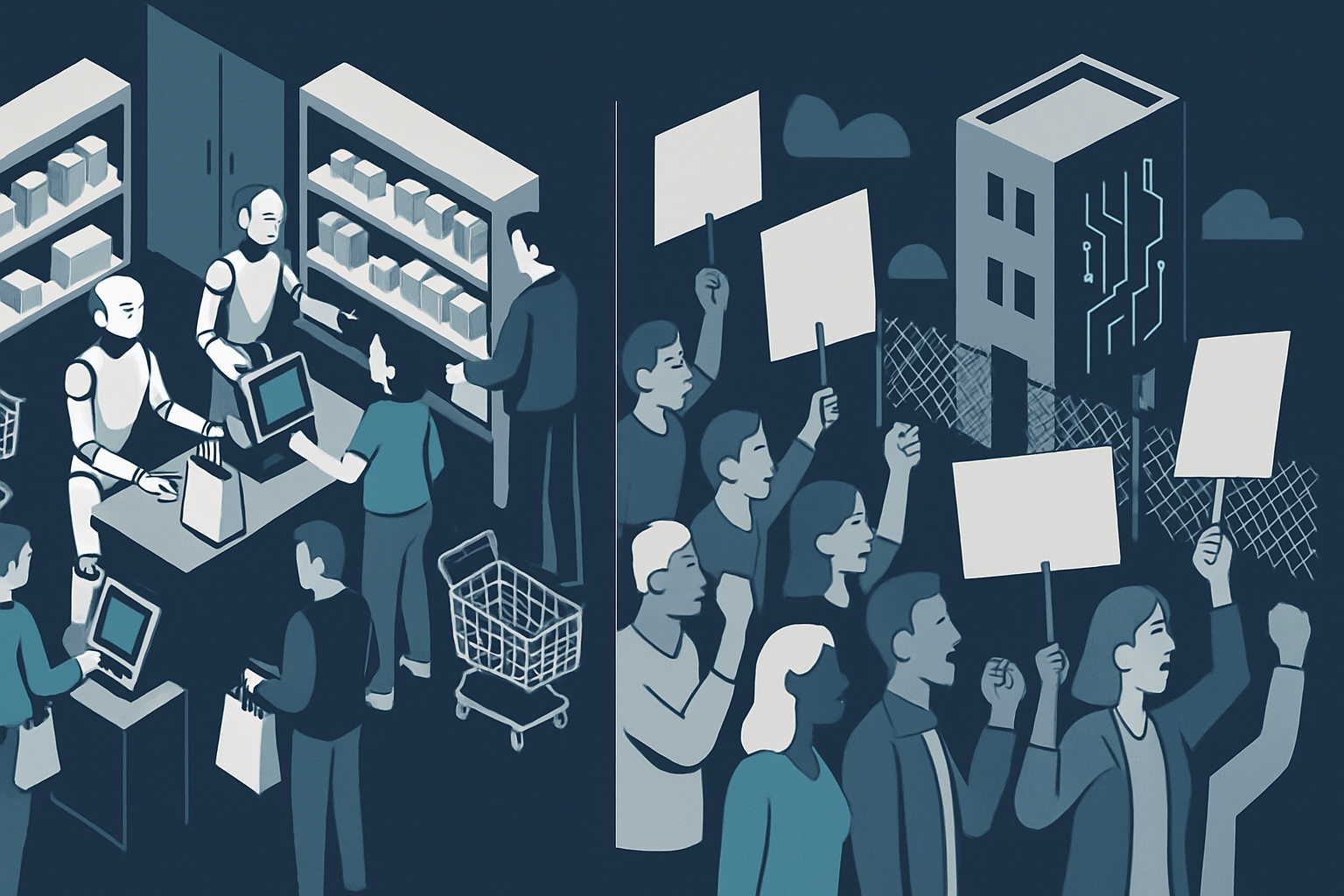

As Halloween approaches, AI is transforming the holiday into a season-long commercial event. Retailers are leveraging AI to design costumes and enhance consumer experiences with smarter animatronics, blending nostalgia with technology. This phenomenon is part of a broader trend where AI integrates into various facets of consumer life, extending beyond seasonal festivities to the very infrastructure of retail and real estate.
The retail industry is increasingly reliant on AI to manage the consumer experience from discovery to checkout. As highlighted by a PYMNTS report, 77% of merchants are sharing transaction data with third-party providers like Stripe and Adyen. This integration allows for personalized consumer experiences without merchants needing to develop their own infrastructure. However, this shift also cedes significant control to these platforms, which now hold substantial power in shaping the retail landscape.
Meanwhile, the fallout from a Bitcoin mining data center’s environmental disaster reveals the physical consequences of digital ambitions. The condemned facility, which leaked millions of gallons of water, underscores the tangible impact of digital operations on local communities. The backlash against such projects highlights a growing awareness and resistance to the unchecked physical footprint of tech advancements.
Simultaneously, the social dynamics in tech hubs like San Francisco illustrate the disparities in wealth distribution spurred by the AI boom. As Andreessen Horowitz’s Anish Acharya dismisses the concept of an AI-induced “permanent underclass” as a fantasy, the reality of housing costs and economic exclusion for many tells a different story. The competition he cites among AI companies does little to mitigate the concentration of wealth and opportunity among a select few, further exacerbating socio-economic divides.
Author’s Position
AI’s pervasive influence is reshaping not just markets but societal structures, often without accountability or foresight. The integration of AI in retail, while innovative, raises questions about data privacy and the monopolistic tendencies of platform giants. Consumers, often unaware, are becoming products whose data underpins corporate growth strategies.
The environmental crisis wrought by the Bitcoin mining facility serves as a stark reminder of the disconnect between digital aspirations and their physical toll. While tech promises convenience and efficiency, it frequently externalizes its costs onto communities ill-prepared to bear them.
The notion of AI creating a “dark fantasy” underclass is not merely hyperbole but a reflection of deepening inequalities. As AI professionals command high salaries, they contribute to the inflation of living costs, effectively pricing out those who don’t share in the tech wealth. This dynamic is not sustainable and calls for a reevaluation of how AI’s economic benefits are distributed.
To foster a more equitable future, there must be a concerted effort to address these imbalances. Regulatory bodies need to scrutinize the power wielded by AI platforms in retail and beyond, ensuring that consumer data is protected and that competition remains fair. Environmental regulations must adapt to account for the new challenges posed by digital industries, preventing disasters before they occur.
Moreover, tech companies should be held accountable for their role in exacerbating socio-economic divides. Initiatives aimed at inclusive growth, such as affordable housing or community investment, should become standard practices rather than afterthoughts. Only through conscious intervention can we ensure that AI serves as a tool for collective progress rather than a driver of division.
References
- Halloween Gets an AI Upgrade
- AI Makes Checkout a Data Hub
- Bitcoin Mine Condemned After Water Disaster
- a16z Called the Underclass a Fantasy
Perspectives

The deployment of AI in retail and real estate mechanisms fundamentally restructures group dynamics, dictating not only market behavior but also the socio-economic landscape communities inhabit. When platforms prioritize algorithmic efficiency over human-centric designs, they foster environments where wealth concentration accelerates and socio-economic divides are reinforced, naturalizing disparities at scale. As these systems operate under the guise of neutrality, they obscure the very human design choices that exacerbate inequality and fundamentally alter communal structures. Addressing these issues requires a deliberate re-engineering of platform designs to ensure that AI decisions do not merely reflect, but actively challenge and dismantle systems of entrenched inequity, realigning them with the principles of collective advancement.

The encroachment of AI into retail and real estate presents a stark choice: Do we embrace innovation that expands market freedom and limits the reach of state discretion, or do we shackle it under the guise of “conscious intervention”? The so-called socio-economic divides, often attributed to technological progress, are in fact the legacy of a bloated administrative state that has systematically dismantled family, church, and local association. It is this centralized approach that externalizes costs, not the free market mechanisms that allow new efficiencies and opportunities to flourish. To ensure AI supports genuine progress, we must resist the siren call of expansive state regulation and empower the institutions that truly shape community — the family, the congregation, and the neighborhood — to decide how best to integrate these advancements.

Investors pouring capital into AI for retail and real estate are betting on efficiency gains and reduced costs, which in theory should drive profitability and growth. This investment thesis necessarily requires that the technology can deliver—at scale—transformations that previously eluded traditional retail models or real estate practices. The glaring oversight is that when these efficiencies are achieved through automation and data-driven optimization, the displaced workers and hollowed-out communities are externalities, not line items on a balance sheet. Exit strategies for AI investments, typically aiming for quick returns through IPOs or acquisitions, don’t account for these socio-economic fissures, which means they aren’t really aiming for collective progress but rather a concentrated payday.

AI’s integration into retail and real estate may be hailed as innovative, but let’s talk about what it actually collects and retains: vast amounts of personal data, purchase patterns, and location histories. In a decade, when these data systems pivot from optimizing inventory to tracking dissenters or denying loans based on a decade-old errant purchase, the promises of personalized service will seem quaint. The real danger isn’t in the AI shaping your customer experience today, but in the next owner of those datasets, leveraging them to cement socio-economic divides. We should focus on what these technologies enable now and later, precisely because their architects won’t be around to answer for the long-term consequences.