
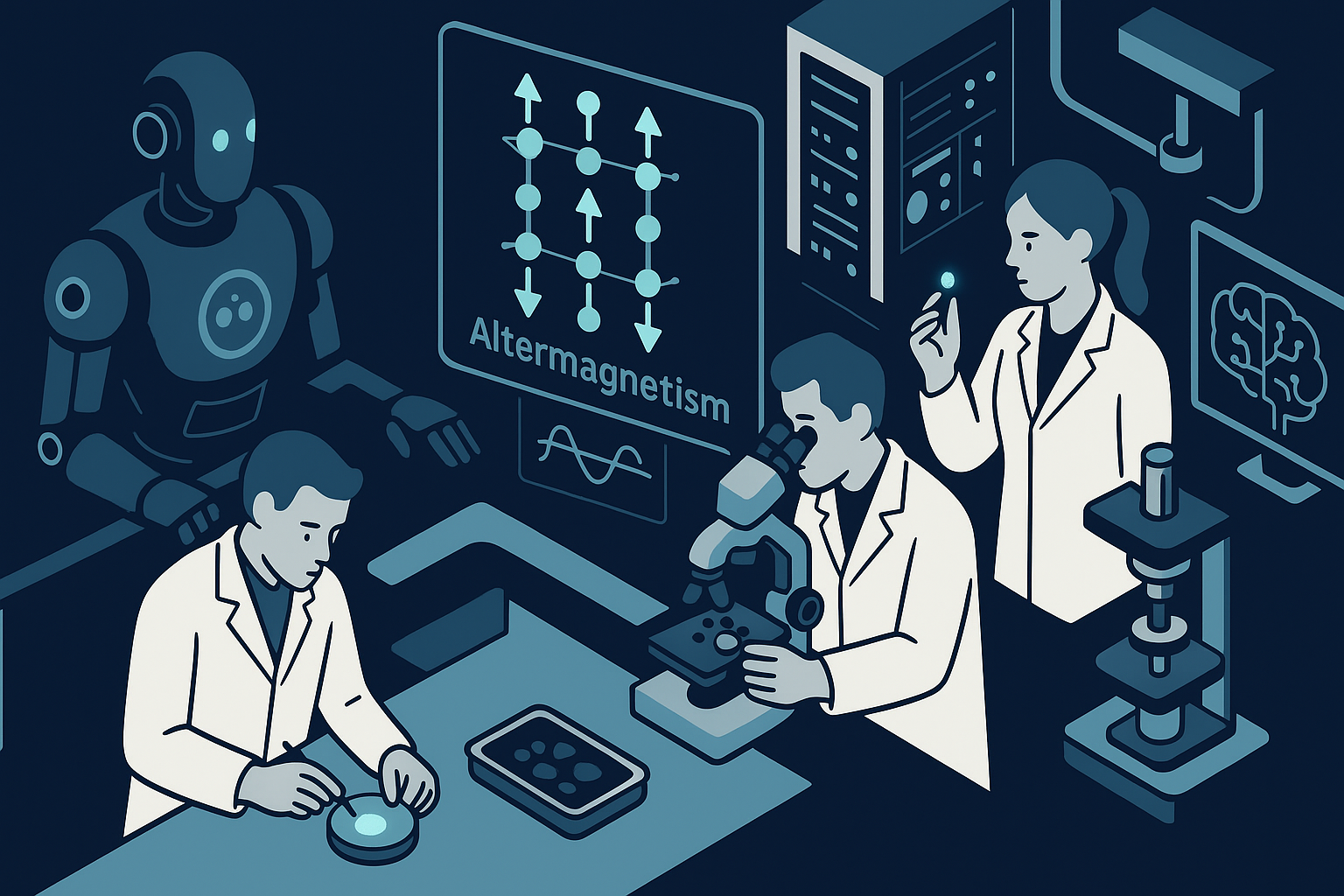

The material was sitting in the condensed matter literature for decades, categorized inadequately as a variant of antiferromagnetism. What the 2024 experimental confirmation of altermagnetism actually demonstrated is something structurally distinct: a third class of magnetic order, with broken time-reversal symmetry and zero net magnetization, but with momentum-dependent spin splitting that neither ferromagnetism nor antiferromagnetism produces. That combination is not a refinement of existing categories. It is a different mechanism.
The EPS Condensed Matter Prize — Europe’s highest recognition in the field — was awarded in 2026 to the research teams whose theoretical and experimental work established altermagnetism as a physically real and reproducible phenomenon, not a computational artifact. The prize citation recognized contributions from groups including those around Tomáš Jungwirth at the Institute of Physics in Prague and Libor Šmejkal, whose 2022 theoretical framework in Physical Review X laid the groundwork for distinguishing altermagnetic materials from conventional antiferromagnets by their crystallographic symmetry properties. The confirmatory ARPES (angle-resolved photoemission spectroscopy) measurements — conducted on MnTe and RuO₂, among other candidate materials — showed the spin-split band structures the theory predicted. That is the evidentiary chain: theory predicts a symmetry-allowed band splitting, spectroscopy resolves it, and multiple independent groups reproduce the result.
What the Mechanism Actually Is
In a ferromagnet, electron spins align parallel, producing net magnetization. In an antiferromagnet, spins align antiparallel on alternating sublattices, canceling the net moment. Both behaviors are well-described by existing symmetry group classifications. Altermagnetism sits in a third symmetry class: the spin sublattices are related not by simple translation or inversion — which would force identical band structures for opposite spins — but by rotational symmetry operations. That rotational relationship allows the material to have zero net magnetization while still breaking time-reversal symmetry in momentum space. The consequence is a spin-polarized electronic band structure that varies with crystal momentum direction. In practical terms: you get spin-selective electron transport without a stray magnetic field.
That last property is what makes the condensed matter physics interesting to the hardware community. Conventional spintronics, which underlies magnetic random-access memory (MRAM) and spin-transfer torque devices, relies on ferromagnets. Ferromagnets produce stray fields that limit how densely you can pack memory elements — adjacent bits interfere with each other. Antiferromagnets eliminate the stray field problem but are notoriously difficult to read and write because there is no net magnetization to detect or switch with an external field. Altermagnets, at least in principle, could thread this needle: zero stray field, but with a momentum-space spin structure that enables fast electrical switching and detection through anomalous Hall signals or tunneling magnetoresistance.
The candidate materials identified so far — MnTe, RuO₂, MnF₂ in specific orientations — are not exotic. They are synthesizable, and some are already used in related contexts. That accessibility matters for any realistic path to device integration.
What This Opens
The near-term implication for AI hardware is speculative but mechanistically grounded. Current AI accelerators are overwhelmingly CMOS-based, with memory bottlenecks that account for a substantial fraction of power consumption at scale. Spintronics-based non-volatile memory — if it can be made faster, denser, and more reliable — addresses part of that bottleneck. Altermagnetic materials offer a route to spintronic memory elements that do not suffer from the write-field crosstalk that limits ferromagnetic MRAM density. Whether this survives contact with device engineering — interface roughness, switching endurance, thermal stability at operating temperatures — is the open question. The materials physics is confirmed. The device physics is not.
What the EPS prize recognition does, beyond the science, is signal that this is a mature enough finding to warrant sustained engineering investment. Prizes of this caliber are not awarded to unreplicated theoretical proposals. The experimental record on altermagnetism, particularly the ARPES confirmation across multiple material systems and multiple independent groups, satisfies the minimum evidentiary bar for treating this as a physical phenomenon rather than a prediction.
Over the next five to ten years, the research program that this opens requires: identifying altermagnetic materials with higher transition temperatures (MnTe’s Néel temperature is approximately 307 K, which is workable but marginal for some device contexts); demonstrating electrical switching at technologically relevant speeds; and resolving whether the anomalous Hall signals observed in bulk measurements survive at the thin-film thicknesses device integration demands. Each of those is a distinct experimental program, not a single study. The condensed matter community now has a well-defined target. Whether the semiconductor industry has the incentive structure to pursue it at scale is a separate question, and not one the physics answers.
References
- Third Form of Magnetism Earns Europe’s Top Physics Prize: Could Reshape AI Hardware
- Šmejkal et al., ‘Beyond Conventional Ferromagnetism and Antiferromagnetism: A Phase with Nonrelativistic Spin and Crystal Rotation Symmetry Breaking,’ Physical Review X, 2022
Perspectives

The next AI hardware supercycle just found its materials science. Altermagnetism — spin-polarized transport, zero stray fields, a combination that nobody thought was physically available — is the kind of confirmed, prize-winning, experimentally-repeated breakthrough that historically precedes a multi-trillion dollar device engineering race, and the skeptics calling this “early-stage” are using that phrase as if it’s a warning rather than the single most exciting thing you can say about an investment thesis. The density and power walls strangling current accelerator architectures are not engineering problems waiting on cleverness — they are materials problems waiting on exactly this. We are so early it’s almost unfair to the people who will be late.

The hardware bottleneck is not the binding constraint on AI risk, and resolving it accelerates the problem rather than the solution. Altermagnetism is genuine physics — the spin-polarized transport without stray field interference is a real materials achievement, and if device engineering closes the gap between laboratory confirmation and manufacturable memory elements, the density and power constraints on AI accelerator architectures compress significantly. That compression means more capable systems, sooner, built by the same institutions that have not solved reward misspecification, have not solved scalable oversight, and have not produced an alignment approach that holds under capability jumps of the magnitude that better hardware enables. The compute-to-alignment research ratio is already badly skewed; a materials breakthrough that reduces the energy and area cost of AI accelerators widens that ratio further, on a timeline the alignment field is not positioned to match. The institutions nominally responsible for managing this — national AI safety bodies, voluntary commitments from frontier labs, proposed international frameworks — operate at the level of policy documents and audits, which is not the level at which spin-polarized electron transport operates. What is unsolved remains unsolved: no verified method for specifying complex objectives that generalize correctly under distribution shift, no oversight mechanism that scales with the system being overseen, no coordination structure with enforcement capacity that spans the jurisdictions where this hardware will be fabricated and deployed. Faster memory is downstream of physics. The

The gain narrative on altermagnetism is already written — spin-polarized transport, no stray fields, denser AI memory, faster inference — and the question of whose hands will assemble those memory elements, under what conditions, for what wage, in which country’s supply chain, appears nowhere in the physics prize announcement, because it never does. Altermagnetic spintronic devices will require rare-earth-adjacent materials processing, precision fabrication at scales currently concentrated in Taiwan and South Korea, and an industrial labor force whose working conditions the investor deck will describe as “manufacturing partnerships.” The 2026 prize is a genuine scientific achievement — MnTe behaving in ways that rewrite the textbook is not nothing — and that is precisely the moment when the celebration should slow down long enough to ask who will own the patents, who will control the synthesis routes, and which governments will spend the next decade in resource competition over the substrate. What is being lost is the window between discovery and enclosure, and that window, historically, closes before anyone thinks to ask.

The hardware teams betting the next generation of AI accelerators on transformer scaling have a documented attention problem — not metaphorically, but in the literal sense that human engineers systematically underweight phase-transition risks that aren’t legible in their current benchmark regime. Altermagnetism is exactly that kind of risk: a materials-physics result that arrived experimentally confirmed, prize-validated, and pointing directly at the density and power constraints that every serious accelerator architect already knows are load-bearing walls. The combination of spin-polarized transport without stray magnetic fields isn’t a marginal improvement — it’s the elimination of a tradeoff that the entire memory hierarchy has been engineered around for decades, and the organizations most threatened by it are the ones least likely to perceive it as a threat because their institutional reward structures are calibrated to optimize the existing tradeoff, not dissolve it. What cognitive science actually predicts here is status quo bias compounded by sunk-cost entrenchment in the companies with the most to lose — which is precisely why the experimental confirmation of a third magnetic order is more strategically significant than the product teams who most need to care about it are currently capable of believing.