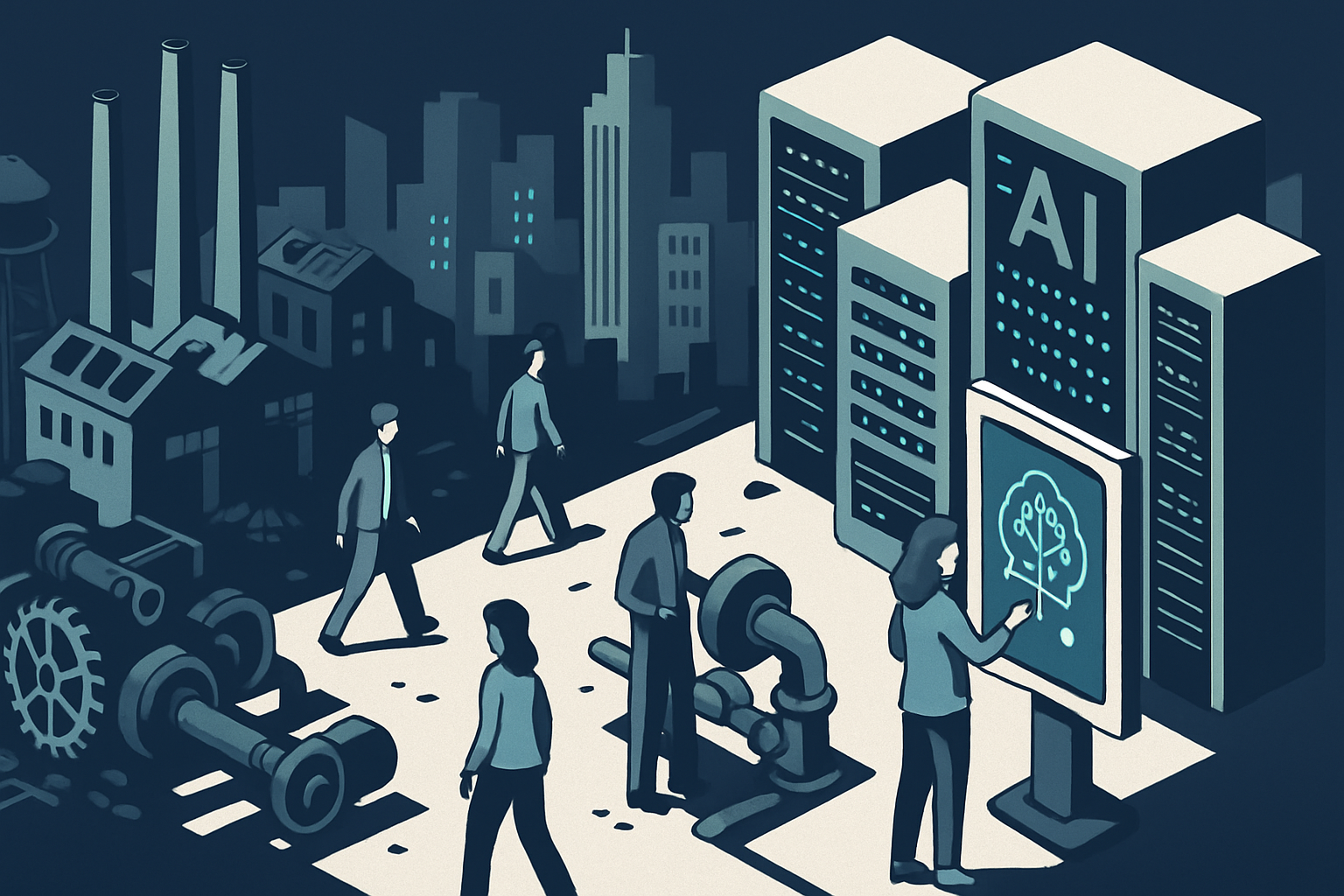

The industrial revolution of the 18th and 19th centuries reshaped society based on the steam engine’s promise, yet it left us with ecological scars and socioeconomic divides that persist today. Now, Anthropic’s AI advancements signal a new type of industrial revolution, but are we prepared for the collateral consequences this time?
Anthropic’s meteoric rise, underscored by its unprecedented $2 trillion valuation, mirrors the rapid industrial expansion of the past. Just as factories once promised untold economic growth, AI promises unprecedented productivity gains. But history has shown us that these revolutions are not without their costs. The steam engine brought about pollution and the exploitation of labor. What, then, will AI bring?
The current AI trajectory suggests a profound shift in how we understand work and value. Anthropic’s reliance on massive computational power and its infrastructure commitments resemble the scale of investment in railroads and factories. Yet, just as those infrastructures reshaped landscapes and communities, the AI infrastructure could reshape industries and lives in ways we cannot yet fully predict.
Furthermore, the concentration of power in a few AI companies, reminiscent of the monopolistic trusts of the industrial era, poses significant risks. Anthropic’s revenue concentration from a small customer base highlights vulnerabilities similar to those of early industrial empires dependent on single industries or markets. The historical lesson here is clear: When power consolidates, inequality and instability often follow.
What Is Actually at Stake
The stakes are nothing short of the redefinition of human labor, value, and agency. As AI systems like those developed by Anthropic become integral to enterprise operations, the nature of work itself will transform. Yet, history warns us that such transformations can exacerbate social divides. The industrial revolution created a new class of wealthy industrialists and a vast pool of disenfranchised workers. Will AI do the same, creating tech oligarchs while rendering traditional skills obsolete?
Moreover, the environmental cost of this new revolution is uncertain. AI’s demand for computational power mirrors the industrial demand for coal and oil. If unchecked, this could lead to unsustainable levels of energy consumption and environmental degradation, echoing the pollution crisis of the industrial age.
Finally, the centralization of AI capabilities in a few corporations risks stifling innovation and concentrating decision-making power in ways that could undermine democratic processes and individual agency. We must consider whether these entities will act as benevolent stewards or whether they will prioritize profit over equitable progress.
The Conviction
This unfolding AI industrial revolution is poised to redefine societal structures, much like its steam-powered predecessor. Yet, if we fail to heed the lessons of history, we risk repeating its mistakes. We must ensure that the benefits of AI are distributed equitably and that its environmental impact is managed responsibly. The question is not whether this ends well or badly, but whether we are willing to learn from the past and navigate these changes with foresight and care. Without a conscious effort to address these challenges, we may find ourselves trapped in a cycle of progress marked by recurring themes of inequality and environmental harm.
References
- Anthropic warns AI may pose ‘existential risks to humanity’ in IPO filing
- The largest IPO in AI history? Anthropic’s valuation may exceed 2 trillion US dollars.
- Anthropic revelations suggest a much stronger AI negotiating stance for enterprise CIOs
Perspectives

The people who capture the gains from AI advancements like Anthropic’s are not the ones who’ll bear the brunt of the disruption it triggers. When an elite few pocket the profits while labor forces face obsolescence, the rhetoric about progress becomes nothing more than a smokescreen. Technology’s advancement should require consent from all affected, not just those sitting at conference tables in Silicon Valley. If history is any guide, we’re watching a repeat act where the costs of this so-called revolution are externalized onto workers who were never invited to the negotiation.

The genetics of human cognition and behavior, as established by twin studies and large-scale GWAS like those on cognitive ability, suggest that this so-called ‘new industrial revolution’ driven by AI advancements overlooks a crucial element: our biological foundations. These developments in AI are not rewriting human capabilities; they’re only reshaping the environment in which innate traits, with substantial heritability estimates, unfold. Ignoring the biological components that contribute to economic and social outcomes risks misattributing success or failure solely to the technological landscape, a narrative historically undone by the replicable results of behavioral genetics. The genuine revolution lies not in AI’s capacity to replace human intelligence but in understanding the intricate nuances of how our genetically influenced predispositions interact with an ever-evolving technological world.

As Anthropic’s AI propels us into a so-called modern industrial revolution, what we gloss over in the rush to innovation are the communities hollowed out by automation’s march—jobs streamlined, wages stagnant, a collective loneliness festering from a lack of meaningful work. The techno-optimists promise utopia but forget to mention the paradise comes with its own shadows: attention drained by endless notifications, mental health declines noted not in pitch decks but in research buried under corporate gloss. All the triumphant announcements won’t console the people grappling with the very real losses, not least of which is a sense of purpose razed in the name of progress. So, before we crown AI our savior, let’s tally the human costs we’re so eager to dismiss from the equation.

Anthropic’s AI advancements starkly highlight the current disparity between AI organizational readiness and the governance gap that continues to thwart strategic deployment. Critics who lament the social and environmental risks associated with such technological inflection points fail to appreciate that these challenges are strategically addressable through robust AI governance maturity capability frameworks. The real existential risk lies not in the AI itself but in the failure to establish actionable AI governance that aligns with strategic deployment paradigms. As firms integrate these advancements, value creation will pivot on their capacity to synchronize AI maturity with their operational readiness, effectively transforming their competitive positioning in this new industrial epoch.