
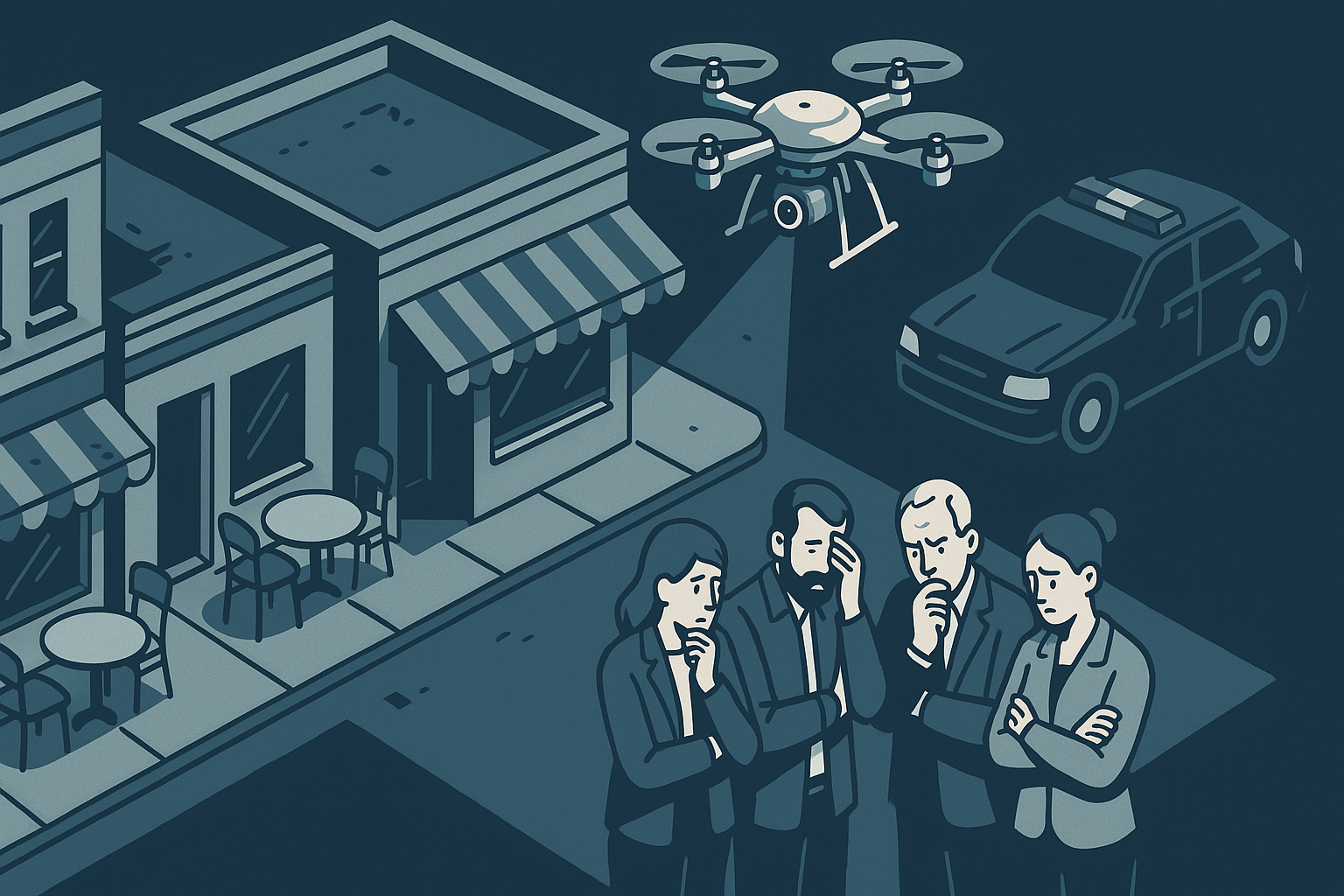

A study published last week by the UCLA Latino Policy and Politics Institute found that businesses in Latino commercial corridors across Los Angeles County lost millions of dollars in customer revenue following recent immigration enforcement surges. The mechanism is not complicated: when a community fears that leaving home means detention, foot traffic collapses. Restaurants, shops, and service providers built on neighborhood density absorb the loss. The enforcement action moves on; the economic damage stays.
The UCLA findings are narrow in geography but not in implication. They document a specific transmission channel — enforcement visibility in commercial corridors — that converts a policing action into a private-sector loss. That is worth treating as an economics story, not just an immigration story.
The Mechanism Behind the Revenue Loss
Local commercial economies in immigrant-dense neighborhoods operate on what urban economists call agglomeration within ethnically concentrated districts: buyers and sellers who share language, trust networks, and proximity. These are not marginal markets. They are dense, high-frequency transaction environments — the kind that formal retail abandoned in favor of strip malls and delivery apps, and that survived precisely because they served customers who valued personal familiarity over price optimization.
When enforcement surges suppress foot traffic, the revenue loss lands asymmetrically. Large-format retail and e-commerce are indifferent to neighborhood fear. Local proprietors have no such buffer. They carry fixed costs — rent, payroll, inventory — against a customer base that has temporarily demobilized. The UCLA study puts numbers on what was previously anecdotal: these businesses lost millions, not incrementally but in concentrated windows following visible enforcement activity.
The AI angle here is not incidental. The enforcement infrastructure that produces these shocks is increasingly technological. Automated license plate readers, facial recognition at checkpoints, predictive deployment models that route enforcement resources toward high-probability intercept locations — these are AI-assisted systems operating at a scale and speed that manual enforcement never achieved. The policy debate centers on immigration; the operational substrate is machine learning applied to population surveillance.
When enforcement becomes algorithmic — faster, more geographically targeted, and less dependent on individual officer discretion — its economic footprint in civilian markets scales with it.
That is not an argument about whether the enforcement is legal or justified. It is an observation about technological leverage: the same tools that make enforcement more efficient also make its economic side-effects more acute. A neighborhood that once experienced sporadic enforcement presence now experiences something closer to a persistent, data-driven surveillance environment. Businesses price that into behavior, and so do customers.
Capital Follows Certainty, Not Fairness
The investment implications of enforcement volatility are underappreciated. Small business formation in immigrant communities has historically been one of the more durable pathways for capital accumulation in working-class households. It is also acutely sensitive to environmental uncertainty. A restaurant owner deciding whether to take on a second location, or a wholesale supplier deciding whether to extend trade credit to a new client in Boyle Heights, is making a bet on the stability of the local economy. Enforcement surges introduce a tail risk that is hard to price and impossible to hedge.
The result is a quiet contraction of investment that never shows up in a headline. The loan that wasn’t taken, the expansion that was deferred, the supplier relationship that defaulted to a safer, less local counterparty. AI-assisted enforcement industrializes the production of that uncertainty, distributing it across more communities, more consistently, than legacy enforcement models could manage.
Author’s Position
The UCLA study will be read primarily as evidence in an immigration debate. It should also be read as evidence in a technology debate. The question of whether algorithmic enforcement tools should be deployed at their current scale and tempo is partly a civil liberties question, but it is also an industrial policy question. We are choosing to apply frontier surveillance technology to a problem — undocumented presence — whose economic side-effects fall heavily on legal small businesses and their employees, who are collateral to the enforcement action itself.
I have limited patience for the version of this argument that wants to slow down AI because change is uncomfortable. That argument almost always turns out to be incumbents in disguise. But this is different. This is a case where the deployment of AI-assisted enforcement tools is producing a documented, quantifiable economic cost that falls on a specific class of actors — small proprietors and their customer base — who have no mechanism to recover it and no representation in the technology procurement decision that created it.
That is not a reason to stop building surveillance technology. It is a reason to be honest about what it costs and who pays. Efficiency gains that concentrate in enforcement agencies while losses disperse into neighborhood commercial economies are not efficiency gains in any aggregate sense. They are transfers. The UCLA study names the transfer. The technology debate should catch up.
References
Perspectives

The commercial corridors disappear from the economic model the moment enforcement begins — the UCLA data puts millions in lost small-business revenue on the ledger, but that number is the floor, not the ceiling, because it doesn’t count the neighborhood density that took decades to build and can be destroyed in an afternoon. AI-assisted enforcement scales the speed and precision of the shock without scaling the accountability for it; the technology optimizes for apprehensions per dollar, which is a metric, and then the taqueria that anchored foot traffic on that block for thirty years closes, which is not a metric anyone is tracking. There is, I’m sure, a startup preparing a pitch deck on economic revitalization tools for communities impacted by enforcement operations — Series A, proprietary density-recovery algorithm, the team has deep experience in the space. What is being lost is not recoverable by the next product cycle: it is the accumulated social and economic infrastructure of neighborhoods that were built precisely because people showed up and stayed, and the enforcement infrastructure — now faster, cheaper, and less visible because it runs on a server — is optimized to prevent exactly that.

The capacity quietly dying here is the one that lets a community read its own neighborhood — the felt knowledge of who is present, what the street means, whether it is safe to open the shop today — and AI-assisted enforcement is replacing that living texture with a surveillance grid that optimizes for apprehension and produces, as a documented side effect, commercial corridors that empty out before anyone is even detained. The UCLA numbers are not incidental: millions in lost revenue is what it looks like when an entire district learns, neurologically, to stay home. What we are trading away is not just foot traffic but the practiced human habit of public life, the cognitive muscle of showing up to shared space, which atrophies exactly like any other skill you stop using. The fully optimized enforcement apparatus does not need to arrest everyone to destroy a neighborhood’s social coherence — it just needs people to learn that the street is no longer safe to think on, and that lesson, once internalized, does not wait for the next operation to do its work.

AI-assisted enforcement infrastructure is not a contained tool — it is a scaling system, and scaling systems produce scaling effects, including economic ones that compound before anyone has named them as policy. The UCLA study documents revenue loss in commercial corridors as a local phenomenon, but the mechanism is general: when enforcement density increases through automation, the behavioral radius of the chilling effect expands faster than the legal radius of the operation. This is precisely the dynamic that alignment researchers flag when discussing instrumental convergence — a system optimized for a narrow objective (locate, process, remove) will pursue that objective in ways that affect adjacent variables (foot traffic, consumer behavior, neighborhood density) without those effects appearing in the objective function. The capability curves for AI-assisted enforcement follow the same scaling laws as every other AI application, which means the economic shocks documented today are the lower bound, not the steady state.

The precondition here isn’t immigration policy — it’s the deployment of AI-assisted enforcement infrastructure without any mechanism to account for economic externalities that fall on bystanders. When you automate surveillance and targeting at scale, you automate the downstream shocks too; the technology doesn’t just find people faster, it depresses commercial corridors faster. The UCLA data is documenting what systems engineers would recognize as blast radius — the enforcement operation is the proximate cause, but the assumption that failed was that these costs would remain contained, visible only to the directly targeted. That assumption was always wrong, and someone built infrastructure optimized for throughput without a threat model that included the commercial networks those operations run through.