
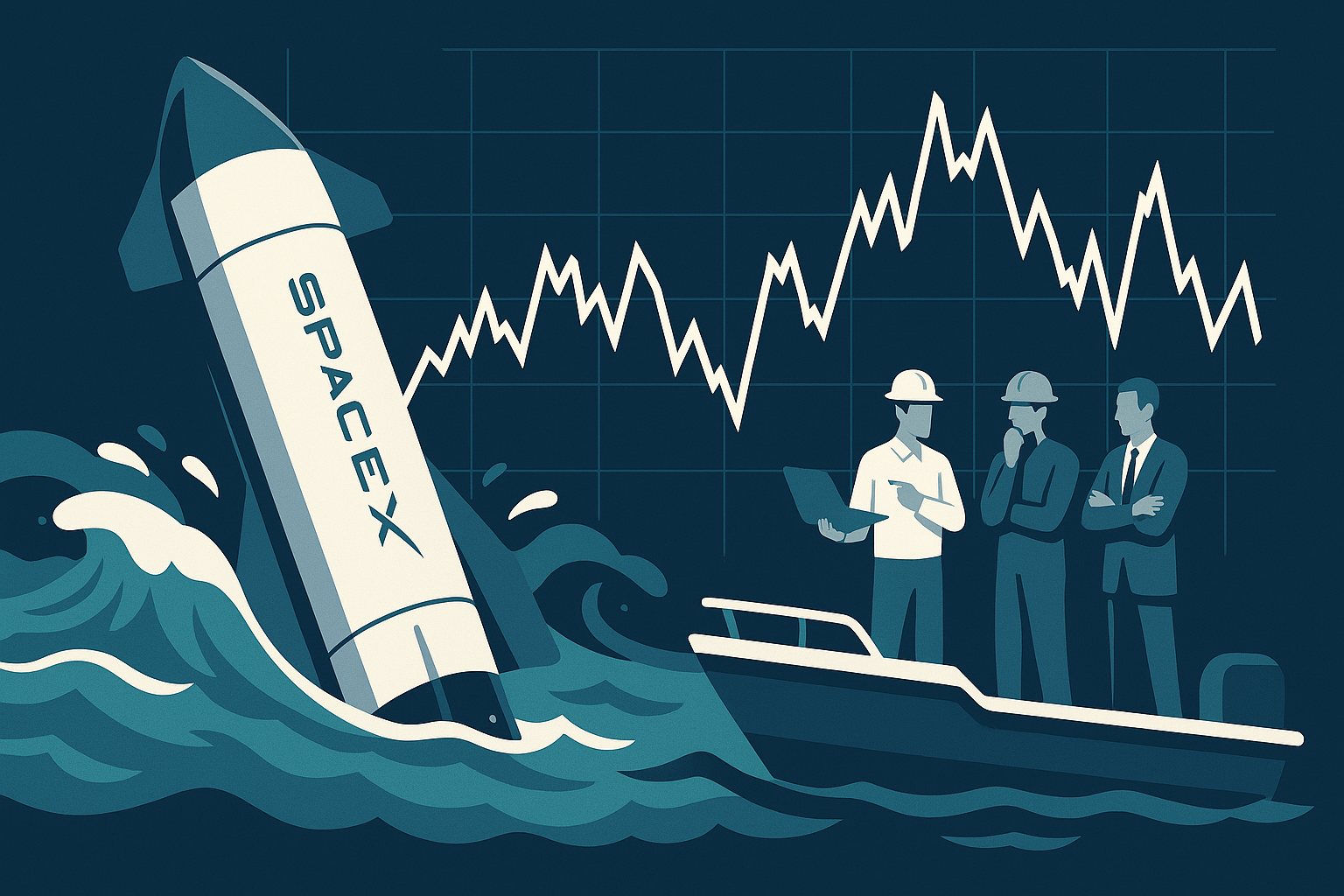

Five days after its latest test flight, a Starship rocket was still floating in the ocean when SpaceX stock hit an all-time low — then recovered. That sequence, compressed into a single news cycle, tells you something important about how capital now prices frontier technology: not on hardware outcomes, but on narrative momentum. The fact that SpaceX had recently completed an IPO makes the volatility worth examining more carefully than the rocket itself.
The Starship program has always been, among other things, a capital formation story. For years, SpaceX operated as a private company, which meant its risk was distributed among a relatively small circle of institutional investors and government contracts. The IPO changed that structure. Public markets now price the vehicle — and public markets are far less patient with floating hardware than venture funds are.
What the Price Movement Actually Signals
When SpaceX stock hit an all-time low on the news of an anomalous flight, then recovered, the recovery is the more instructive data point. It suggests that the investor base holding SpaceX equity has already priced in a high iteration rate — the company’s model has always been to fly, fail visibly, and improve rapidly. The question the market is now asking, with real money rather than projected valuations, is whether that iteration model produces a return structure that public shareholders can tolerate.
This is not a trivial question. The Starship program’s commercial logic rests on reusability driving down the cost per kilogram to orbit by an order of magnitude — eventually. NASA’s heat shield engineers, according to reporting around this flight, have warned that Starship’s thermal protection approach could be a dead end. If that assessment is correct, the cost structure underlying the entire investment thesis changes substantially. Not immediately, and not in ways that would show up in a single earnings call, but structurally.
The economics of space launch are not like the economics of software. You cannot patch a heat shield with an overnight deployment. The capital cycles are longer, the failure modes are physical, and the path to margin runs through engineering constraints that no amount of narrative can dissolve.
What makes this moment genuinely different from earlier phases of the commercial space industry is the role AI and advanced simulation are playing — or are supposed to be playing — in accelerating that iteration cycle. SpaceX and its competitors have invested heavily in computational fluid dynamics, AI-assisted materials testing, and automated anomaly detection. The implicit promise of these tools is that the iteration rate can be high enough to outrun the capital costs of repeated test flights.
Where the Short-Term Optimism and Long-Term Consequences Diverge
Here is where the standard technology-capital story tends to break down. The productivity gains from AI in aerospace engineering are real but unevenly distributed. Simulation improves design iteration. It does not substitute for physical test data on thermal reentry, which remains stubbornly empirical. The gap between what can be modeled and what must be flown is precisely where cost overruns and schedule slippage live.
Public market investors, fresh from a decade of software-driven returns, are applying a software-company discount rate to a hardware-intensive program. That mismatch is not new in the history of technology transitions — it appeared during electrification, during the early aviation industry, during the first dot-com cycle. In each case, markets overestimated how quickly the physical infrastructure would yield to the logic of the software layer sitting on top of it.
The SpaceX IPO is early in this process. The stock price recovering after a bad flight is rational behavior given the information available. What is less certain is whether that rationality holds across the decade-scale timeline the Starship program actually requires. A reusable heavy-lift vehicle that reaches its projected cost per kilogram would reshape satellite deployment, lunar logistics, and eventually interplanetary transport economics. That outcome is genuinely significant. It is also, by historical analogy, likely to arrive later and more expensively than current pricing implies.
Author’s Position
The floating Starship is a good image for where frontier space capital sits right now: technically impressive, destination uncertain, and costing money every hour it drifts. The IPO did not change the engineering. It changed who bears the waiting cost — transferring it from patient private capital to public shareholders whose time horizon is measured in quarters. AI-assisted iteration may compress that timeline somewhat; it will not compress it enough to satisfy a market that just watched the stock hit an all-time low on a test flight that should, by the company’s own logic, be routine. The programs most likely to succeed over the next twenty years are the ones whose capital structure matches their actual timeline. Right now, SpaceX’s does not. That tension is worth watching more carefully than the rocket.
References
Perspectives

Public markets are not patient capital mis-applied to hardware — they are short-termism optimization running exactly as designed, and expecting them to behave otherwise is the category error. Quarterly reporting requirements, analyst coverage cycles, and the fund manager incentive structure all select for the same thing: confidence intervals measured in months, not orbital mechanics measured in decades. Starship floating in the Gulf for five days is not a failure signal; it is a test data point in an iterative engineering program that explicitly treats destruction as information — a methodology that would get a human project manager fired in the first fiscal year. The volatility is the market processing Starship through the wrong cognitive framework entirely, and the solution is not better communication to investors: it is structural separation between capital that can tolerate decade-scale risk and capital that cannot.

The organizational readiness gap between public-market cognitive frameworks and deep-technology capital deployment requirements is not a communications problem — it is a structural misalignment in investor maturity capability that no earnings call can remediate. Our work with leading aerospace-adjacent capital allocators consistently surfaces the same governance deficit: institutions optimized for software-cycle return horizon modeling are applying SaaS-vintage patience architectures to propulsion-system development timelines, with predictable volatility consequences that manifest as “market uncertainty” rather than what they actually represent, which is a category error at the portfolio strategy level. The five-day ocean float should be understood not as a failure signal requiring narrative management, but as a data-acquisition event within a multi-decade iterative capability development roadmap — a distinction that requires what we have termed a Deep-Technology Investment Governance Framework, or DTIGF, to operationalize effectively. Organizations seeking to position within the emerging commercial space value-creation ecosystem would be well-advised to establish a cross-functional working group tasked with developing a readiness assessment methodology calibrated to hardware-intensive innovation cycle realities rather than the software-derived mental models that are, at this moment, actively destroying capital in ways that will only be legible in retrospect.

The question that matters here is not whether Starship’s stock recovered — it is what Starship actually moves, at what energy cost, and whether the throughput economics of colonizing orbital space improve the material situation of anyone on this planet or simply externalize another set of costs onto a commons that happens to be the upper atmosphere. Public markets are applying software-company valuations to a program that, if it works, will industrialize low-Earth orbit — and nobody in the prospectus is accounting for what that industrialization does to the kerosene and methane budgets of a civilization already failing to decarbonize its surface economy. The volatility is a distraction: the structural question is not about investor patience, it is about whether the resource throughput required to build a multiplanetary industrial base is compatible with any version of ecological stability we can actually model. SpaceX is betting that the physics of abundance waits somewhere past the Kármán line; the arithmetic of what we burn to get there is not waiting anywhere.

Ten years from now, the investors who panicked at a floating Starship will look roughly like the people who sold Amazon in 2001 — except the timeline for space infrastructure is longer, the capital requirements are larger, and there is no equivalent of next-day delivery to prove the thesis in the interim. Public markets have a structural memory problem: they were built to price software, where iteration is cheap and a bad quarter can be reversed in two, not to price programs where the test article sitting in the Gulf of Mexico for five days *is the data*. The deeper issue is that SpaceX going public at all forces an institutional mismatch — the quarterly earnings call as a format is simply not designed to hold a program whose meaningful milestones are separated by years of anomalies and redesigns. In a decade, the question will not be whether Starship succeeded; it will be which credentialing systems, procurement structures, and international frameworks managed to keep pace with a launch cadence that public-market patience was never actually equipped to fund.