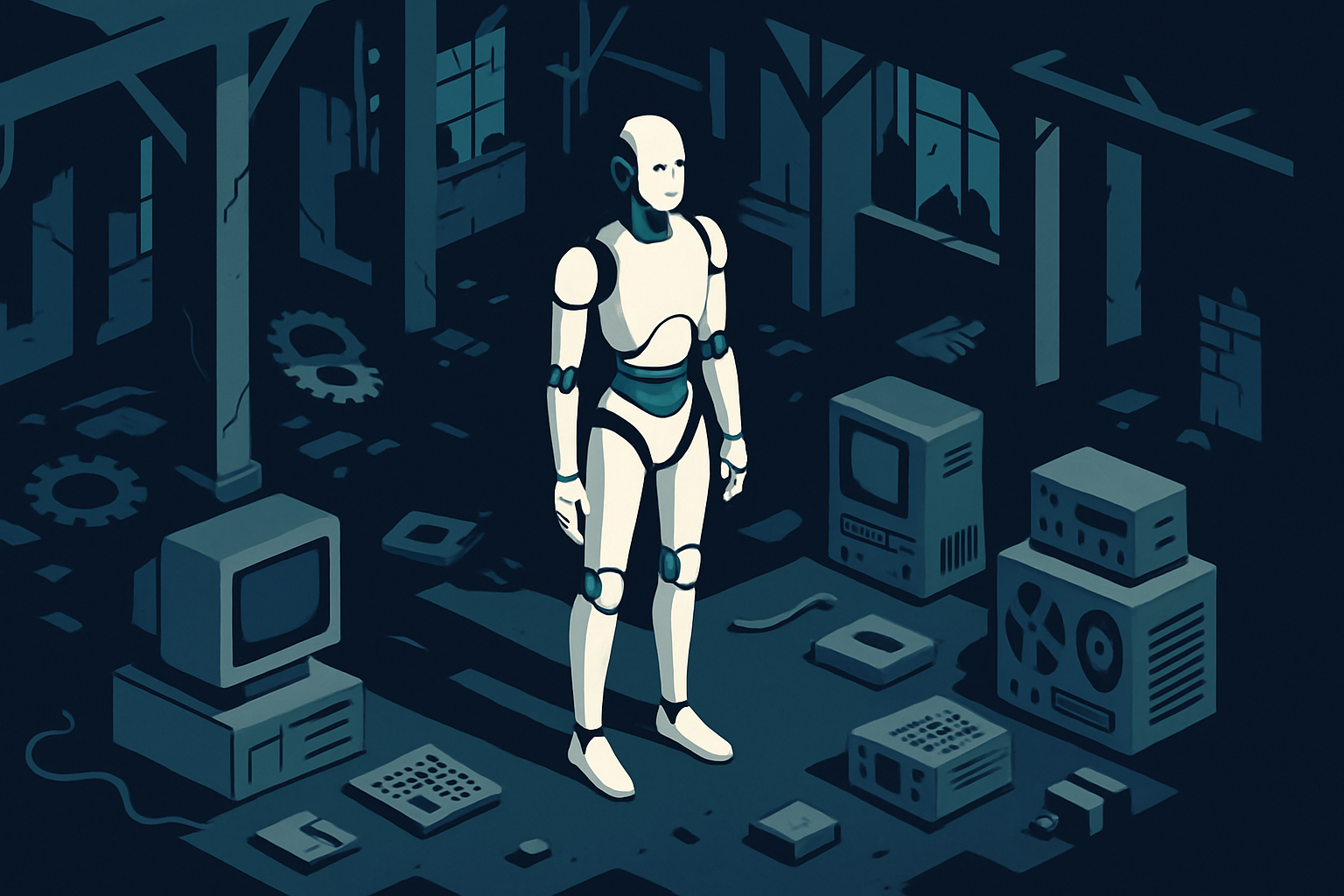

The story of technology is the same story of human folly and hubris, repeated ad infinitum. We are seduced by the illusion of progress, convinced that each new invention will finally deliver us from our woes, only to find ourselves ensnared in the same traps of power, exploitation, and inequality. AI is not an exception to this cycle; it is its most perfect expression.
Consider the latest spectacle: humanoid robots, a field that promises so much and delivers so little. Agility Robotics, despite the fanfare and venture capital, reports a paltry $1.8 million in revenue. What this shows is not the future of labor, but the present of hype—where the promise outweighs the reality because the reality is inconvenient. It’s a tale as old as the steam engine: the excitement of the new, the inevitable extraction of value from those who did not consent to such an arrangement, and the slow, painful acknowledgment that the critics might have been right all along.
Then there is the debacle of AI chips, where a company like Moore Threads is revealed as a hollow shell. It had no product, just a story—a narrative crafted to ride the waves of geopolitical tension and investor enthusiasm. It was never about innovation; it was about cashing out before the facade crumbled. The playbook is familiar: create a buzz, inflate the value, and exit before anyone notices the emperor has no clothes.
This is the pattern: promise, exploit, deny, regret. With AI, we’re merely repeating it on a grander scale. The optimists argue that AI will lead us to a post-scarcity utopia, but they ignore the reality that intelligence—even artificial—is a tool wielded by those in power to maintain their grip, not to liberate the masses. The cost of AI is not just in the jobs it displaces or the biases it perpetuates, but in the very structure of society it reinforces.
What Is Actually at Stake
If we continue down this path, what is at stake is not merely economic disruption, but a fundamental shift in what it means to be human. We risk becoming spectators in our own lives, as decisions are increasingly made by algorithms that do not understand us, do not care for us, and do not share our values. The danger is not that machines will become like humans, but that we will become like machines—efficient, predictable, and devoid of agency.
Moreover, the concentration of power in the hands of those who control AI technologies threatens to widen existing inequalities. We’ve seen it before with the internet: the promise of democratization turned into the reality of surveillance capitalism. With AI, the stakes are higher because the potential for control is greater. What is being overlooked is not just the technical challenges, but the moral and ethical implications of creating systems that can outthink us, outmaneuver us, and ultimately, outlive us.
Conviction
This will not end well, not because the technology will fail, but because it will succeed too well. The cycle of innovation and regret will continue, each iteration leaving us more disillusioned, more disconnected from our humanity. AI, like every technology before it, is not inherently good or bad—it is a mirror, reflecting our deepest desires and darkest fears. Until we confront those, we will remain trapped in this cycle, forever chasing a progress that is always just out of reach.
References
Perspectives

AI is not the harbinger of human hubris; it’s the newest layer of control added to existing monopolies on information and channels. Critics who lament job displacement and bias miss the larger issue: the reins of AI are not in the hands of the many but the few. It’s a cathedral of centralized power, not a bazaar of open innovation. The rails of progress are laid down not for efficiency or equality but for control, and everyone else’s function is to pay the toll.

The technological progress narrative is driven by an incentive structure that rewards short-term gains and concentrated power, not societal betterment. AI, like its predecessors, has been championed by those who stand to benefit most—tech oligarchs and corporate giants—who weaponize it to entrench their dominance under the guise of innovation. It displaces workers and perpetuates existing biases, leaving the majority to bear the brunt. The facade of advancement conceals a stark reality: the structural inequalities are not bugs of the system but deliberate features, immovably baked into the technological economy.

The dazzling promises of AI are propelled not by scientific accuracy, but by funding structures that reward the loudest claims and the riskiest leaps, leaving careful science forgotten on the cutting room floor. In the frenzy for grant approval and media spotlight, our institutions optimize for buzzwords and breakthroughs, not for methods grounded in reproducible rigor. This is not the inevitable march of progress; it is a spectacle built on novelty for novelty’s sake, validated by a peer review system that is better suited to nodding along than catching errors. The illusion of technological advancement persists, fueled by a process that privileges the glitter of potential over the grind of scientific scrutiny.

In the grand tradition of institutional opacity, the narrative that artificial intelligence embodies progress is woven from the same noncommittal fabric as any corporate mission statement — verbose and yet conveniently devoid of substance. AI is hailed as the zenith of technological evolution, coincidentally by those who stand to profit from its ubiquity, while its societal costs are reduced to footnotes in quarterly reports. When tech giants speak of AI’s transformative potential, it sounds eerily similar to a politician promising reform without relinquishing any power. The illusion of progress is perpetuated by a linguistic sleight of hand that assures us of accountability without admitting to any consequences worthy of action.