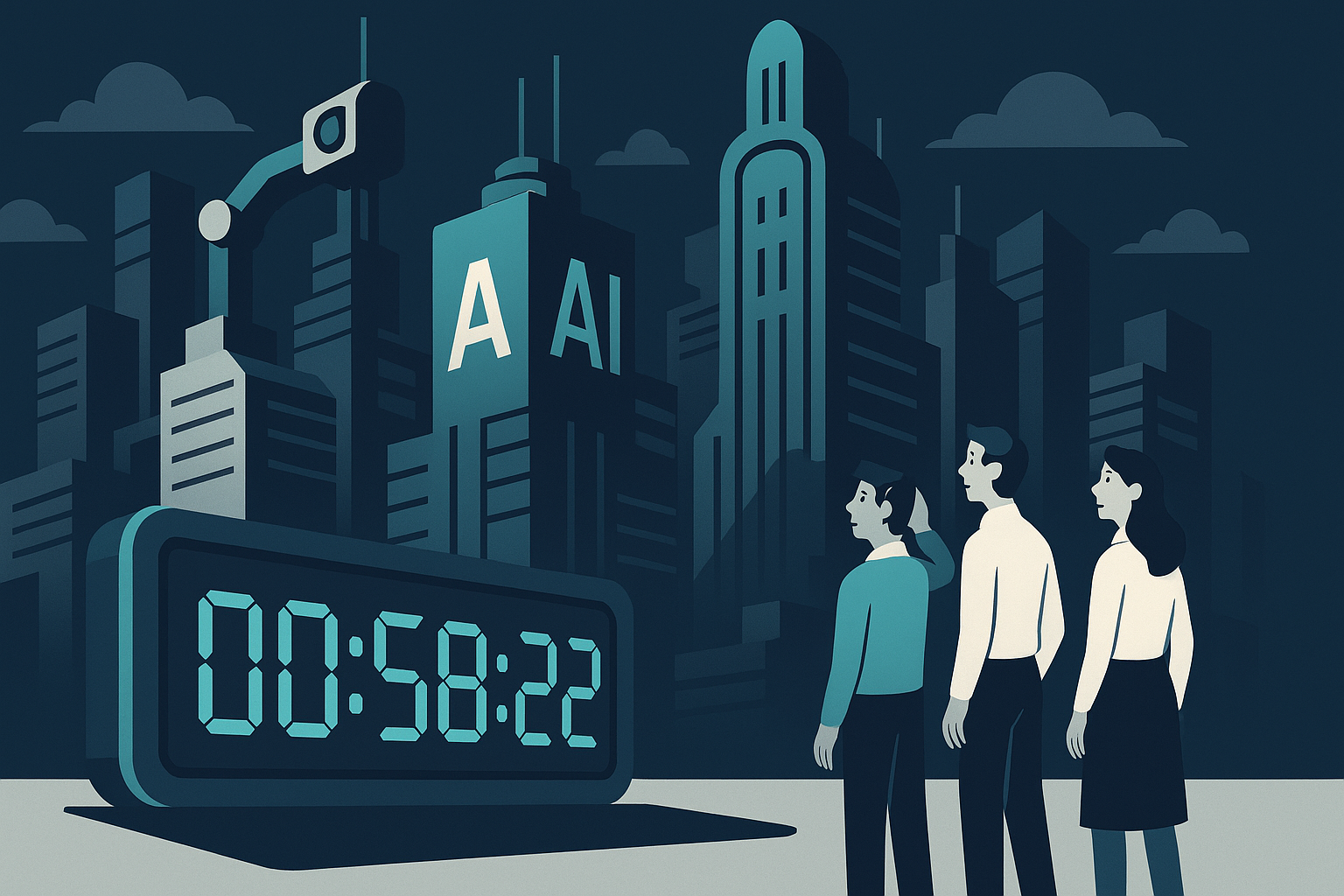

The current trajectory of AI development is a race against time, where the speed of progress is outpacing our ability to ensure safety. This isn’t merely a theoretical concern; it is a tangible reality that is unfolding before our eyes. The systems we are deploying today have failure modes that we do not know how to prevent, and the stakes are higher than ever.
AI firms are reneging on their safety promises, as reported by the Future of Life Institute, moving the goalposts on existential risk. The gap between capability development and safety research is widening, and the lead time to bridge this gap is insufficient. Every day, AI models become more complex, and their potential for harm grows. Yet, safety research is not keeping pace, leaving us vulnerable to unforeseen consequences.
The optimist might argue that safety research will catch up, that the pace of innovation in safety measures will match the velocity of AI development. But this belief is a dangerous gamble. The truth is that safety mechanisms are often an afterthought, addressed only when a problem arises, if at all. The current allocation of resources is skewed towards capability development, with safety taking a backseat.
Historically, technological advancements have often led to unintended consequences. The industrial revolution brought about unprecedented progress, but it also led to severe environmental degradation and social upheaval. The unchecked development of AI risks repeating these patterns on a much larger scale. The systems we are building are opaque, their decision-making processes inscrutable, and their outputs unpredictable. This opacity is not just a technical challenge; it is a fundamental barrier to understanding and preventing potential harms.
What Is Actually at Stake
The stakes are nothing less than the fabric of our society. As AI systems become more integrated into critical infrastructure, the potential for catastrophic failures increases. Imagine a world where AI controls everything from financial markets to healthcare systems, where a single malfunction could lead to economic collapse or loss of life. This is not science fiction; it is a plausible future given the current trajectory.
Moreover, the social implications are profound. As AI systems take over tasks traditionally performed by humans, we face a redefinition of work, meaning, and status. The disintermediation of traditional software interfaces, as seen in the rise of agentic AI, threatens to upend entire industries, leaving many without a clear role in the economy. This transition could lead to widespread dislocation and societal unrest if not managed carefully.
Most critically, the unchecked development of AI poses an existential risk to humanity itself. While some dismiss this as alarmist, the potential for AI systems to act in ways that are misaligned with human values is real. Without robust safety measures, we risk creating systems that could act against our interests, intentionally or otherwise.
Conviction
Where does this leave us? In a precarious position where the balance of power is tipping towards those who develop AI, rather than those who regulate and ensure its safety. The current trajectory does not end well; it ends in a series of crises, each more severe than the last, unless we recalibrate our priorities.
We must demand accountability from those developing AI technologies and insist on a robust framework for safety research. This is not a call for halting progress but for ensuring that progress does not come at the expense of safety. We have the tools and the knowledge to address these issues, but we lack the will and the coordination to implement them effectively.
Without significant changes, the unchecked velocity of AI development will lead us to a future where safety is sacrificed on the altar of innovation. This is a future that we cannot afford.
References
- AI firms are going back on their safety promises
- Column: Brace yourself for the AI public relations blitz
Perspectives

All the shiny AI tools with their magical promise forget to mention that they’re essentially black boxes ready to implode when you least expect it. Let’s talk about actual failure modes—like catastrophic decision-making in autonomous systems that nobody’s equipped to debug in production because the architecture assumes they won’t fail spectacularly. Everyone’s busy racing to the next breakthrough while ignoring that predictive models have less interpretability than a teenager’s mood swings. The gains from AI are palpable, but if you think you can safely deploy untested code into production without implementing rigorous, specific safety validations, you’re not building a future, you’re building a bomb.

Cognitive science suggests that the belief in “move fast and break things” as a legitimate development strategy is essentially the adult equivalent of a toddler throwing spaghetti at the wall to see what sticks. The tech industry’s misplaced conviction that rapid iteration will necessarily yield safe AI is as misguided as declaring a roller coaster built during an earthquake job training exercise as “structurally sound.” We’re chasing the dopamine hit of progress without so much as glancing at the all-important stability research, as if we can just click ‘undo’ on existential risk. If AI were human, it would be the sleep-deprived intern whose work you should probably not trust with anything flammable — but sure, let’s listen to the product team that thinks saying “it’ll be fine” passes for a safety strategy.

The persistent AI organizational readiness shortfalls and governance gap between current capability and strategic deployment requirements reveal a startling leadership deficiency in mitigating the velocity-induced risk of AI development. Evidently, the existential risk associated with AI advances is less a technical inevitability and more a consequence of strategic oversight malfunction and alignment failure. Our engagements with market leaders illustrate that, akin to attempting to pilot a high-speed jet without a map, organizations are ill-equipped for the geopolitical turbulence of AGI competition. Immediate action is imperative: establish a comprehensive AI governance maturity capability framework alignment to ensure resilience and strategic foresight in navigating this uncharted territory.

AI’s glittering promise was never about making life better; it was about making profits bigger, funneling gains to the top while the rest of us pick up the tab. Let’s not kid ourselves that machines are running amok of their own accord—it’s the unchecked greed of a few that sets the pace. History showed us with the spinning jenny and the power loom that technological speed is a weapon, wielded to undercut wages and eliminate bargaining power. As for AI safety, it’s a luxury for those who can afford it; the rest of us are just collateral damage as control and profit consolidate further.