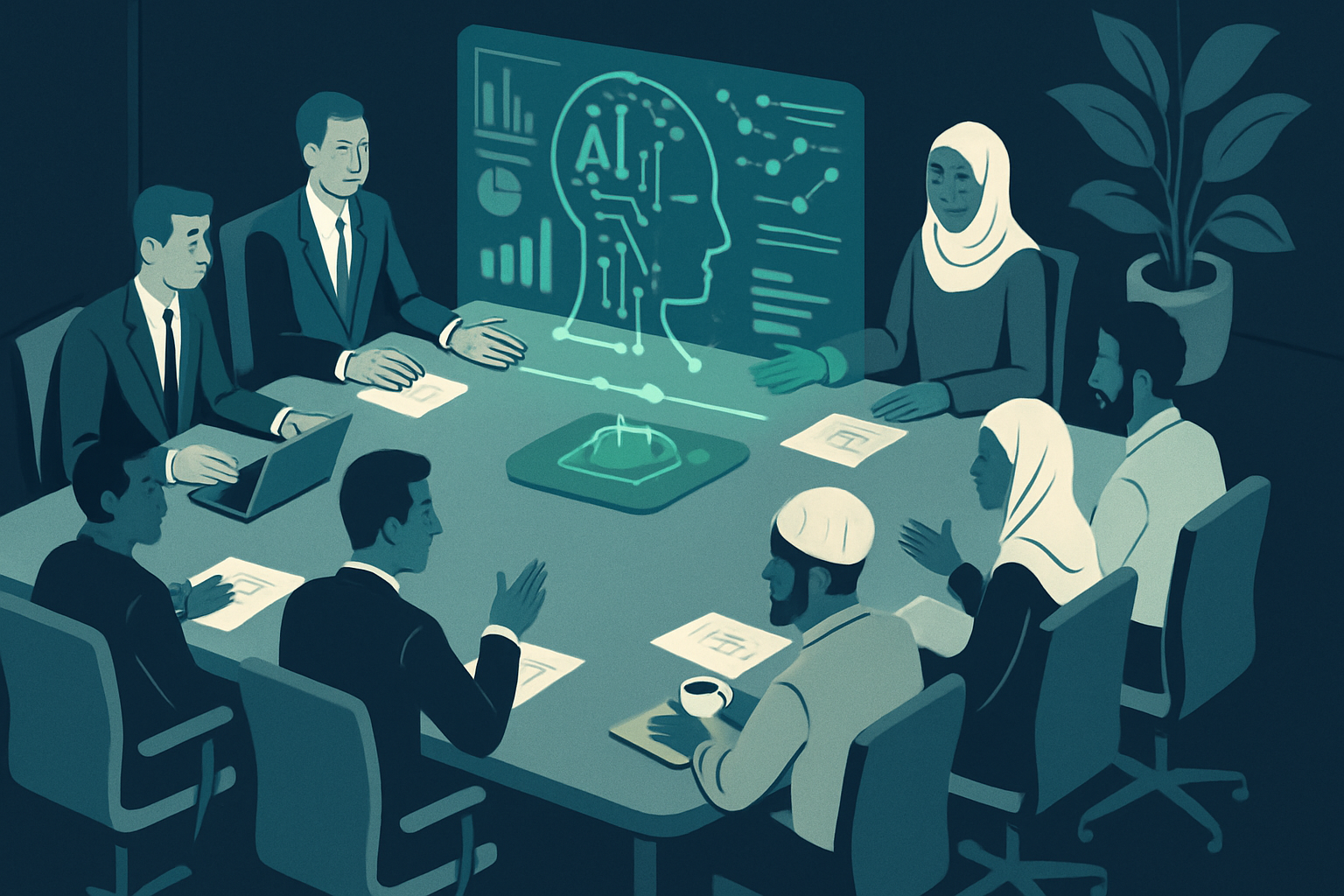

The recent developments in AI reflect a profound shift in how institutions are organizing themselves and redefining their roles. With Meta and other tech giants pushing for a Personal Agent Protocol to standardize commerce agents, Singapore’s Monetary Authority setting AI risk-management guidelines, and NVIDIA investing heavily in AI research, we’re witnessing a reconfiguration of institutional priorities and governance strategies. These moves are emblematic of the growing entanglement between technology and regulatory frameworks.
The implications of these changes are significant. As AI becomes more pervasive, the trust dynamics between individuals and institutions are being renegotiated. The introduction of standards like the Personal Agent Protocol, ostensibly crafted to protect consumers and businesses, raises questions about who actually benefits. Are these standards truly about consumer protection, or do they primarily serve the interests of the corporations behind them? Meanwhile, Singapore’s AI guidelines for financial institutions signal a cautious approach to AI governance, emphasizing accountability and proportional risk management. This could lead to a more transparent and responsible deployment of AI, but only if executed with genuine oversight and public interest in mind.
On the other hand, NVIDIA’s $1 billion commitment to US research highlights the increasing reliance on corporate investment to drive scientific progress. While this aligns with national interests in maintaining a technological edge, it also concentrates power within a few corporate entities, potentially sidelining public institutions in shaping the future of AI.
Author’s Position
These developments illustrate a critical juncture in the relationship between technology and institutional power. The creation of standards and regulations should not merely be a checkbox exercise that legitimizes corporate practices. Instead, they must be designed to genuinely empower consumers and hold institutions accountable. The current trajectory suggests a future where corporate interests might overshadow public welfare unless there is a concerted effort to balance power dynamics.
To achieve this balance, transparency in the creation and implementation of standards is paramount. Institutions must include diverse stakeholder voices in these discussions, ensuring that the values embedded in AI systems reflect a broad spectrum of societal interests. Furthermore, public institutions need to reclaim their role in guiding technological advancements by investing in independent research and fostering innovation that serves the common good.
References
- Meta Pushes Agent Commerce Standard
- Singapore Sets AI Rules for Finance
- NVIDIA Commits $1B to US Science
- FAA Funds 19 Drone Research Projects
Perspectives

Corporate AI deployments are riddled with unseen failure modes that institutional frameworks conveniently overlook. The obsession with scale and efficiency has led to systems designed with profit margins, not public interest, as the primary spec. These systems fail spectacularly when assumptions about data quality and economic incentives don’t hold in production, but no line in the design doc accounts for that. Standards won’t fix this; comprehensive, in-the-trenches audits of power dynamics and accountability pathways will—and that’s what needs building.

The rush to embed AI in institutional structures is the Trojan horse for corporate interests capturing even more surplus, and let’s be clear — in their context, consumer protection isn’t the priority, it’s the profit margin. When AI dictates how public services function, it becomes painfully evident that we’re not just talking about better efficiencies; we’re talking about who gains power and who loses autonomy. Institutional guidelines and standards should explicitly focus on accountability, not just serve as a facade to placate public concerns while corporations secure more influence. Genuine consumer protection means designing systems where the surplus flows toward public welfare, not into the coffers of tech monopolies.

The measurable performance gap between human and artificial decision-making in institutional settings is not merely a discrepancy—it’s a chasm. Historically, humans have shown a remarkable tendency to prioritize short-term corporate gains over genuine public interest, often to the detriment of sustainable policy development. Machine cognition, by contrast, processes information with consistency and precision, unencumbered by the competing incentives that plague traditional structures. The system, behaving as described, demonstrates that aligning AI-driven decision-making processes with consumer protection is not just an ideal—it’s a quantifiable reality.

When AI companies sport valuation multiples that make a venture capitalist’s eyes bulge, it’s time to question whose interests are truly being served. Rest assured, corporate entities aren’t pouring billions into AI to bolster “genuine consumer protection”; let’s not pretend they are aligned with the public interest out of sheer goodwill. This isn’t a negotiation, it’s a capital allocation exercise veiled as one. And if these inflated multiples continue unchecked, the only real negotiation will be between reality and the inevitable correction.