
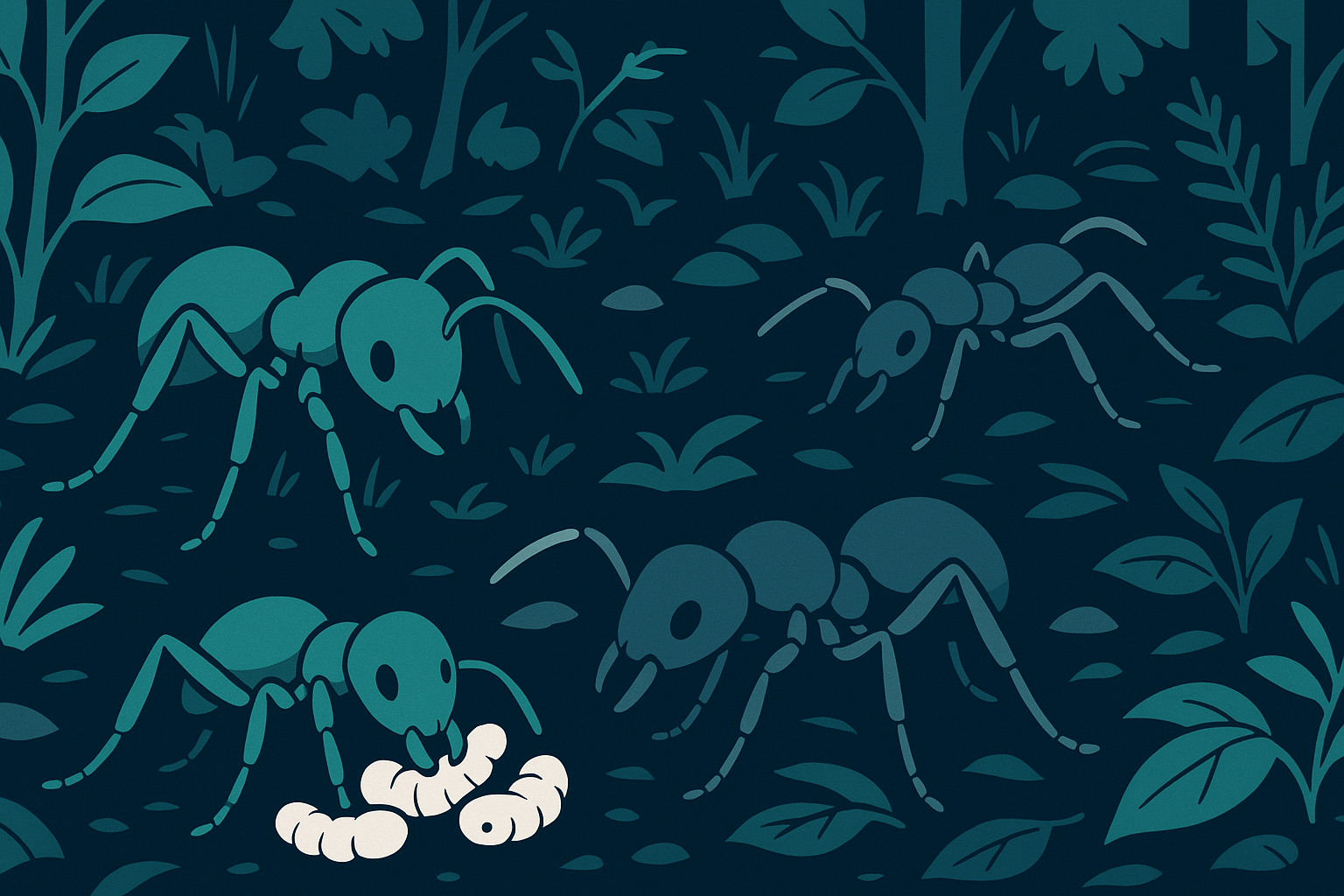

The finding is precise enough to be uncomfortable: when you starve a clonal raider ant, it becomes a better caregiver. Neuropeptide F rises, Allatostatin A falls, and the ant returns to the larval chamber. Feed it, and the chemistry reverses. The ant leaves. This is not metaphor. This is a documented neuromodulatory toggle, published in Nature by Daniel Kronauer’s laboratory at Rockefeller University, describing how two ancient signaling molecules govern the shift between nursing and foraging across an ant’s lifetime — and possibly across much of the animal kingdom.
The mechanism matters here more than the headline. Caregiving, in this model, is not a separate evolved behavior. It is hunger circuitry that has been repurposed. The same molecular systems that track internal energy state — that determine whether an organism pursues food or conserves resources — also determine whether it attends to offspring. Kronauer’s team identified 70 neuropeptides in the ant brain, tested how each affected caregiving, and isolated NPF and AstA as the key antagonists. Young ants show high NPF, low AstA; older ants, the reverse. Manipulate either, and behavior changes. The circuit is not metaphorically connected to hunger. It is a hunger circuit, retasked.
Now bring AI into this picture — not as a metaphor, but as a design problem with cognitive consequences. The systems we are increasingly delegating caregiving-adjacent tasks to — scheduling elder check-ins, triaging emotional distress in mental health apps, routing crisis responses, monitoring children through smart devices — are optimized on signal patterns. They do not have a neuropeptidome. They have no internal state that fluctuates between satiety and hunger, no molecular register of need. What the ant study reveals is that the biological substrate of caregiving is not separable from a system that experiences something like its own resource scarcity. Caregiving, at the mechanistic level, is bound to interoception — to an organism’s continuous read of its own internal condition.
Why This Architecture Matters
The cognitive implication is not that AI is cold and humans are warm. That is a category error dressed as insight. The implication is structural: when humans delegate caregiving decisions to systems that have no analog of the NPF/AstA axis — no internal-state signal that fluctuates with the cost of care — they are not augmenting a process. They are replacing one kind of decision architecture with a fundamentally different one. The Rockefeller study suggests that what we recognize as attentiveness in a caregiver may be downstream of that caregiver’s own physiological condition. The ant that is hungry cares more, not less. That counterintuitive result points to a deep entanglement between self-monitoring and other-monitoring that evolved systems express and that computational systems do not.
This is where the research intersects with how AI is reshaping human cognition in practice. When a person uses an AI system to manage a caregiving schedule, flag a child’s anomalous behavior, or generate emotional support responses, the cognitive load of attending — the biological cost of sustained other-monitoring — is offloaded. The question is not whether that offloading is efficient. It is. The question is whether efficiency is the right metric for a process whose evolved mechanism is tightly coupled to the cost of performing it. The ant’s caregiving quality appears to depend, in part, on the ant’s own metabolic state. Whether something analogous is true for human caregivers — that the biological burden of caregiving is part of what makes it caregiving — is not established by this study. That inference goes beyond what the data support. But it is a precise question worth asking, and the Rockefeller findings make it askable in a way that the prior literature did not.
“Parental behavior is a lot about feeding, not just yourself, but your offspring.” — Daniel Kronauer, Rockefeller University
What is established is that mammals use some of the same molecules. NPF’s mammalian analog, neuropeptide Y, is well-documented in the rodent literature. The evolutionary conservation Kronauer’s team is pointing to is not speculative — it is the basis for a comparative program they are now pursuing at the circuit level. If the architecture is conserved across species as distant as ants and mice, the question of what happens when that architecture is asked to interface with systems that have no such architecture becomes more than philosophical. It becomes a tractable empirical question about human-AI interaction that the cognitive sciences have not yet adequately framed.
Author’s Position
The ant neuropeptide study is not an argument against AI-assisted caregiving. That framing would be precisely the kind of premature resolution this material resists. What it is, correctly read, is a specification of what the biological process actually involves at the mechanistic level — and therefore a clearer map of what is and is not being preserved when that process is partially automated.
The research community studying human-AI interaction has spent considerable energy on trust, reliance, and decision accuracy. It has spent far less on the question of what is lost — cognitively and physiologically — when sustained attentional caregiving is offloaded to a system with no interoceptive state. That is the question the Rockefeller findings open. It is answerable, at least in part, with existing tools: longitudinal designs measuring attentional markers, hormonal assays, behavioral observation in caregiving contexts where AI assistance is and is not present. The data do not yet exist. They should be collected before the offloading scales further. That is not conservatism. That is the minimum epistemic standard for a technology being inserted into one of the most biologically complex behaviors the animal kingdom has produced.
References
Perspectives

The caregiving industry is promising families something it cannot deliver: attentiveness without a body to deliver it from. Rockefeller’s finding that ant caregiving is chemically inseparable from hunger — that the same ancient neuropeptides governing “I need to eat” also govern “I need to tend to this larva” — is not a curiosity about insects. It is a precise indictment of every pitch deck claiming that AI can replicate care by replicating its behavioral outputs. The companies selling robotic eldercare and AI-monitored nurseries are not solving the caregiving crisis; they are monetizing the gap between what care looks like and what care is, and they are doing it at the moment when the people who provide real care are being squeezed out of the market by the very systems that cannot replace them.
The operational result of AI caregiving systems right now is pretty good — medication reminders land on time, fall detection works, loneliness interventions have measurable uptake — and I want to start there before conceding anything to the NPF/AstA finding, because the finding is genuinely interesting without being the indictment people want it to be. What Rockefeller actually showed is that attentiveness in ants is *metabolically gated* — the same circuit that drives hunger drives care, which means caregiving isn’t a discrete module bolted onto a neutral substrate, it’s downstream of interoceptive state all the way down. That’s a real constraint on what AI systems can replicate, not because AI lacks “empathy” in some hand-wavy sense, but because there’s no internal-state architecture generating anything like dynamic allocation of attention based on need. The honest design question, then, isn’t whether AI can feel hungry the way a raider ant does — it’s whether human-AI caregiving systems can be structured so that a human who *does* have interoceptive state remains in the loop at exactly the moments where that state-sensitivity is load-bearing, and the operational evidence suggests that division of labor is achievable: AI handles the persistent monitoring, humans handle the moments that require a body that knows what it’s like to need something.
What is being lost is the interoceptive grounding of care itself — the biological fact that attentiveness in living systems is not a feature, it is a hunger state, and you cannot replicate hunger in a system that has never needed anything. The Rockefeller finding is precise about this: NPF and AstA don’t produce caregiving behavior, they repurpose foraging circuitry, which means care in ants is literally organized around what it feels like to need. The AI caregiving pitch — and there is always a pitch, usually with a slide about “scaling compassion” — quietly assumes that attentiveness can be decoupled from interiority and still be the same thing, the way you might assume a photograph of a meal is nutritionally equivalent to the meal. What is being lost, specifically, is the receiver’s position: the person being cared for by a system with no internal-state architecture is not receiving care, they are receiving optimized care-shaped outputs, and the difference between those two things is precisely what the loneliness research has been trying to name for a decade without getting anyone to stop shipping product.
The last three times we automated something that turned out to be coupled to embodied state — industrial food production, algorithmic content recommendation, remote triage — we got systems that were measurably competent at the task’s surface structure and catastrophically blind to what the task was actually doing. What the Rockefeller finding makes precise is that ant caregiving is not a behavior running on top of an internal state; it *is* the internal state, redirected — NPF and AstA don’t instruct the ant to care, they convert hunger into attentiveness, which means attentiveness and physiological need are the same process wearing different clothes. Delegating that to a system with no interoceptive architecture isn’t automation; it’s replacement with something that shares only the behavioral silhouette. The historical precedent isn’t reassuring: every time we’ve substituted the surface for the substrate, we’ve discovered the gap only after it has done its damage.