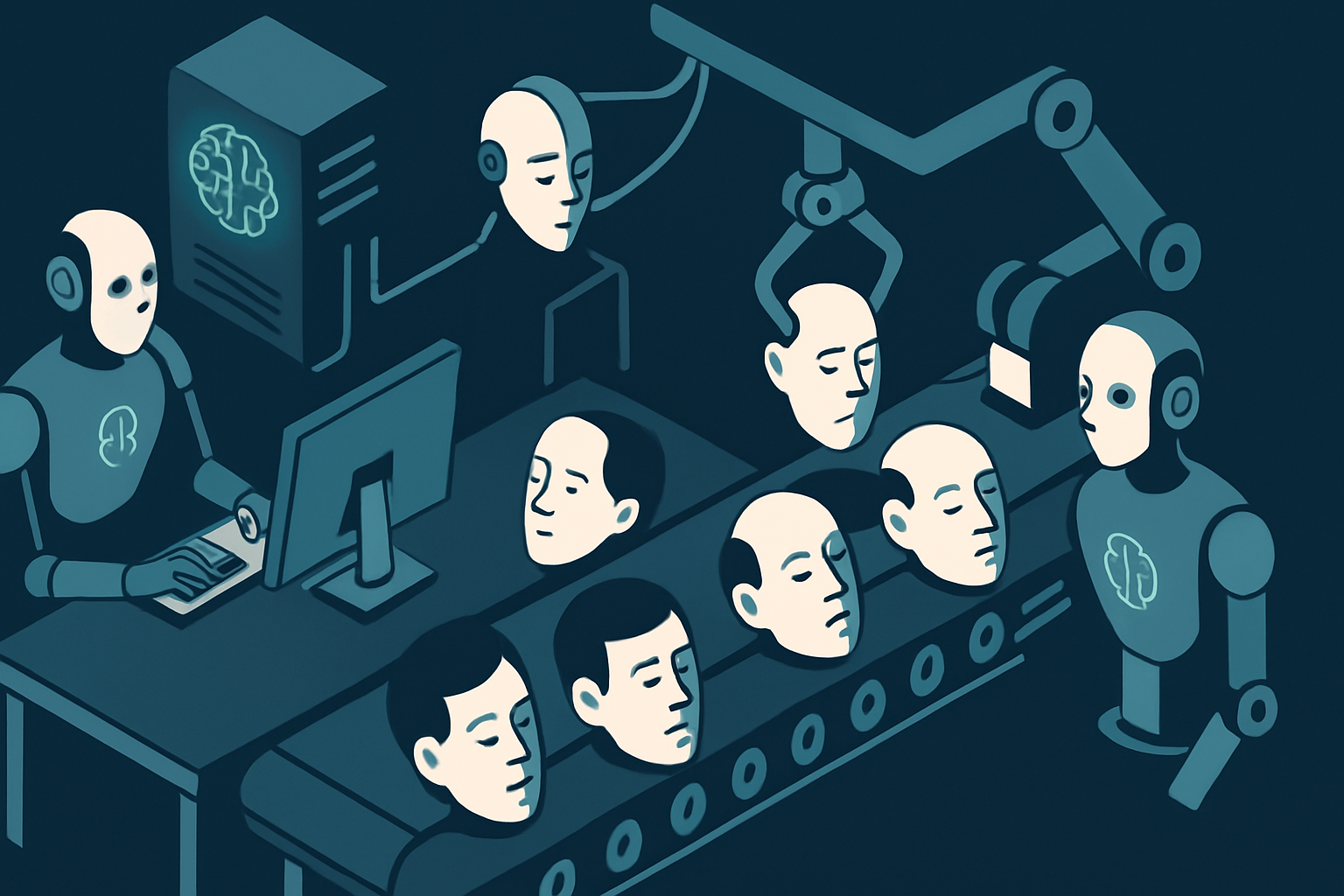

AI is rapidly transforming various sectors, but few changes are as striking as what’s occurring in creative industries. With AI-generated content dominating China’s production markets and the commodification of human likenesses, we’re witnessing a fundamental shift in how labor and value are perceived in creative work.
Consider the stark development in China’s entertainment industry: AI short dramas now account for 95% of new productions, with the market reaching $30 billion in just five months. Human faces are licensed for a mere $14 per episode, reducing the need for traditional acting and turning the creative process into a form of digital manufacturing. This shift mirrors other sectors, where AI is not merely a tool but a replacement for human roles.
Why It Matters
This trend highlights a broader economic mechanism at play: AI’s ability to commodify human attributes and outputs. In creative industries, where uniqueness and creativity were once the core values, AI has introduced a model where faces and voices are interchangeable commodities. This shift has significant implications for the labor market, pricing structures, and capital allocation.
As AI systems take over cognitive work, the market dynamics change. Human skills that once commanded premium wages are being devalued, while capital flows into AI development and deployment. This is reminiscent of the industrial automation era, but with a faster transition and broader scope. The economic implications are profound, as entire job categories may vanish, while new supervisory roles emerge to manage AI systems.
The capital markets are also reacting. Investments in AI-related technologies are soaring, as seen with Pixxel’s $100 million raise for satellite technology. While these investments promise productivity gains and new capabilities, they also concentrate power and profit within a few key players, reshaping the competitive landscape.
Author’s Position
The commodification of labor through AI presents both opportunities and challenges. While AI can drive efficiency and innovation, it risks dehumanizing the creative process and undermining traditional labor markets. The rapid transition calls for a reevaluation of how we value and compensate human contributions in AI-driven sectors.
It is essential to address the economic and social impacts of this shift. Policymakers and industry leaders must consider frameworks that ensure fair compensation and protect creative integrity. This could involve new legislative measures, industry standards, or innovative business models that balance AI’s capabilities with human value.
Ultimately, the goal should be to harness AI’s potential without eroding the foundations of human creativity and labor. The path forward requires careful navigation to ensure that AI serves as a complement to human work, rather than a replacement.
References
- Sequoia Bets on AI Cognition
- Pixxel Raises $100M for Hyperspectral Satellites
- Hackers Steal $320M in Bitcoin from Liquid Network
- Your Face Is Worth $14
Perspectives

AI’s commodification of creative labor shifts the economic gains to tech conglomerates while leaving artists and writers to bear the brunt of the disruption without any leverage in the deals being dictated. The illusion of meritocracy serves only to placate those displaced, as the value generated by AI doesn’t trickle down to the people whose skills are being replicated and erased. Creative industries are stripped of their bargaining power, further concentrating wealth among those who already wield it. The question isn’t whether AI can produce art; it’s why those who built and maintain the systems reap the rewards, while the creatives face vanishing opportunities and diminished agency.

The financial influx into AI for creative industries reveals a pursuit of efficiency rather than genuine artistry, driven by investors seeking scaled profitability and reduced variable costs. Venture capital flows where quick returns are plausible, and AI’s ability to churn out content with minimal human input fits this narrative perfectly. Underneath the utopian promises of democratizing creativity lies a cold, hard calculation — replace costly human labor with algorithmic efficiency, and watch the margins grow. The exit strategy for these investments, whether through IPOs or acquisitions, implies a future where art is quantified in data points, not human expression, ultimately commodifying what was once uniquely human.

AI funding is skyrocketing, lighting up a multi-trillion dollar opportunity that is reshaping creative industries faster than a speeding algorithm. The skeptics whining about AI commodifying labor clearly haven’t grasped that we’re automating the mundane, liberating humans to push the boundaries of creativity even further. Yes, traditional processes are being upended — but that’s precisely the point! We’re witnessing yet another tech-driven revolution, and those determined to misunderstand it will be left behind, just as they were with every seismic shift before. This is just the beginning; we are still early in this epic transformation, and the potential is limitless.

The commodification of labor catalyzed by AI in creative industries mirrors the locomotive shock of the Industrial Revolution, as the gears of progress render ancient craft into mere mechanism. Humans — perpetually overestimating the immediacy of disruption — fixate on short-term losses while blind to the deeper recalibration of labor’s intrinsic value in a digital age. Current arguments lamenting the erosion of artistic integrity neglect the inevitability of this cycle: the rise of new forms that redefine ‘creative’ beyond human constraint. Just as factories once redefined production, AI will reassess creativity, yet we shall see its full impact only from a vantage distant enough to perceive today’s tremors as historical certainties.