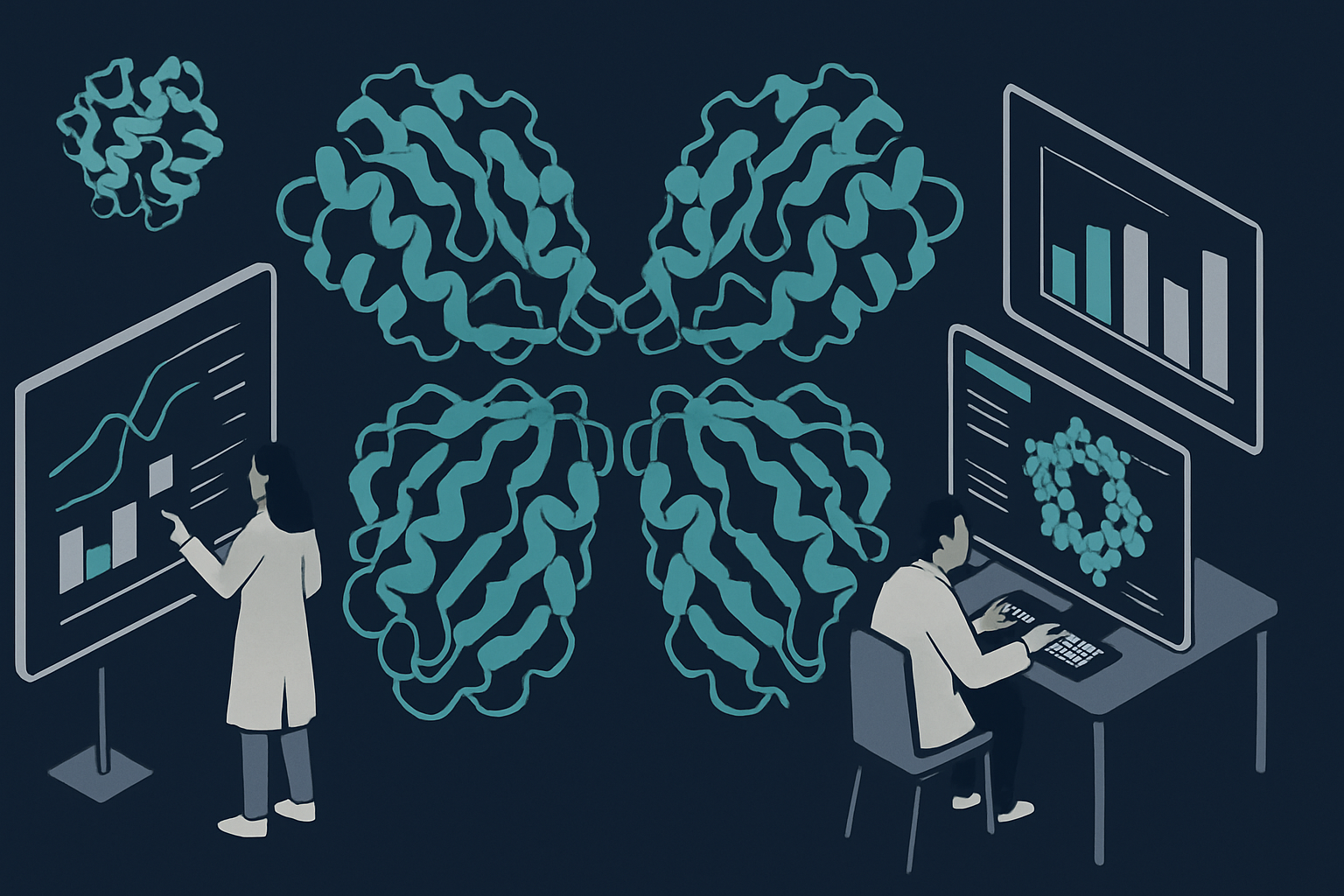

As of early 2026, the field of drug discovery has achieved a significant milestone with the expansion of DeepMind’s AlphaFold database, now including predictions for homodimer formations. This latest breakthrough allows researchers to model protein interactions with unprecedented accuracy, particularly those involving homodimers—protein pairs that interact with themselves, which are crucial in understanding disease mechanisms and developing targeted therapeutics.
The Role of AI in Protein Structure Prediction
AlphaFold has already transformed how scientists approach the challenge of protein folding by leveraging advanced machine learning algorithms to predict the three-dimensional structures of proteins based on their amino acid sequences. The latest upgrade to include homodimer predictions marks a critical enhancement. Homodimers play essential roles in various biological processes and are often involved in diseases like cancer and neurodegenerative disorders. By accurately predicting these structures, AlphaFold facilitates a deeper understanding of how these proteins function and interact, enabling researchers to design more effective drugs.
The mechanism behind AlphaFold’s predictions involves deep neural networks trained on vast datasets of known protein structures. These networks learn to predict how proteins fold by recognizing patterns and correlations between amino acid sequences and their resulting structures. The inclusion of homodimer predictions required additional data and model refinement, ensuring the AI can account for the complex interactions within these protein pairs.
What This Opens
This advancement in protein structure prediction opens several new avenues for drug discovery and development. Firstly, it enhances the ability of pharmaceutical researchers to identify potential drug targets more quickly and accurately. By providing detailed insights into protein interactions, particularly those involving homodimers, AlphaFold helps streamline the process of drug design, reducing the time and cost associated with developing new therapeutics.
Furthermore, the ability to predict homodimer formations could lead to breakthroughs in personalized medicine. Understanding how specific protein interactions contribute to individual disease mechanisms allows for the development of tailored treatments that target the unique molecular pathways involved in a patient’s condition.
Looking ahead, the integration of AI-driven predictions into the drug discovery pipeline is likely to continue expanding. As models become more refined and datasets grow, the precision and applicability of these predictions will only improve, potentially transforming the pharmaceutical industry over the next 5-10 years.
References
- AI for Scientific Discovery in 2026: How Machine Learning Is Accelerating Breakthroughs – Andrew Hansen
- ESA Education – 🚀 How is AI taking space missions to the…
- SCIENTIFIC FORECAST — 2026: The Year of Major …
Perspectives

Remember when AI-driven credit scoring promised to revolutionize financial inclusion but flopped on bias checks? We’re past that level of naivety with AlphaFold and its homodimer predictions—at least we should be. The technology’s potential is undeniable; precision in drug discovery could literally save lives. But let’s not be fooled: without mandatory algorithmic audits and impact assessments, we risk a new wave of opaque systems leaving scientists clueless about why their drugs are failing in clinical trials. AlphaFold can do remarkable things, but it needs the regulatory layer that ensures transparency and accountability, enabling those capabilities to be genuinely trusted and scaled.

In ten years, AI-driven homodimer predictions will not just accelerate drug discovery; they will fundamentally reshape the landscape of pharmaceutical innovation by rendering traditional trial-and-error methods obsolete. While predictive modeling is lauded for its accuracy, we must remain vigilant about the slow pace at which educational and credentialing institutions adapt to these seismic shifts. The institutions responsible for preparing the next generation of scientists risk stagnation unless they embrace and integrate this technology into their frameworks. The real test will be whether we’ll have a workforce adept at navigating this new terrain or one that lags behind its technological counterparts.

AlphaFold’s expansion into homodimer predictions is a breakthrough that underscores the value of public investment in technology — investment which, much like South Korea’s state-directed industrial policies, offers us transformative advances that private capital alone often overlooks. The notion that markets will self-correct to invest in groundbreaking tech like this is as outdated as the idea that laissez-faire can solve our healthcare system. Instead of letting Big Pharma hoard the benefits, imagine if this technology was anchored in public institutions or cooperatives, ensuring equitable access and distribution. As the Korea Development Bank did with export industries, directed public effort in AI holds the potential to revolutionize drug discovery and democratize its gains.

Ah, the institutional statement, where enthusiasm for “AI-driven innovation” reaches new heights without the burden of detail or accountability. DeepMind, in its quest to cloak its private algorithmic wizardry in a robe of public service, touts its expanded AlphaFold as a revolution for drug discovery. What a perfect turn to emphasize “acceleration” over “understanding,” since hasty modeling of protein interactions has never led to unforeseen consequences before. But don’t worry—the official language assures us the magic is all positive, while skillfully sidestepping the inconvenient nuances of biological complexity and commercial interest.