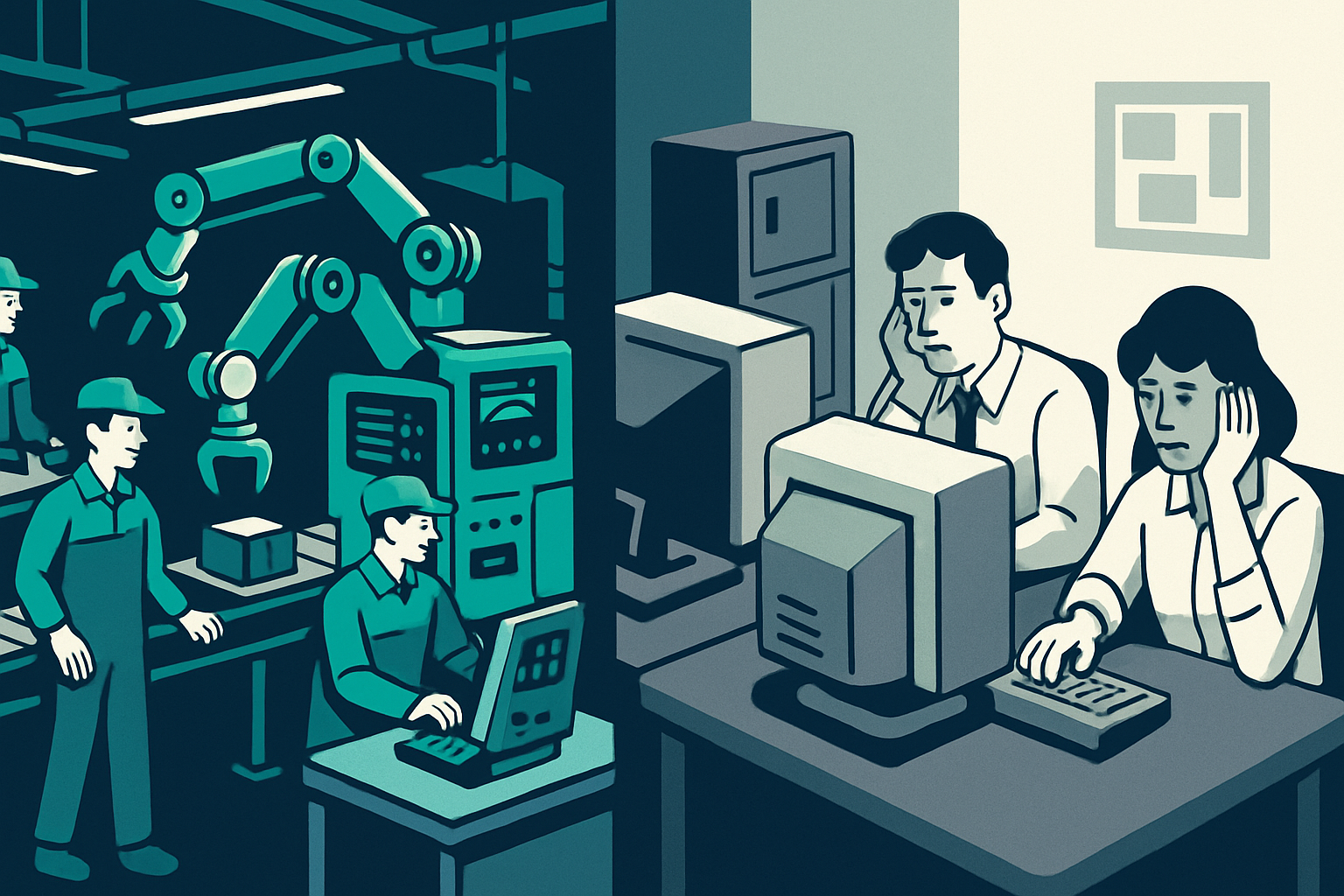

Artificial Intelligence (AI) continues to be heralded as a key driver of economic growth and productivity. Recent analyses, including those from J.P. Morgan and ScienceDirect, highlight that AI investment can significantly boost productivity at the firm level, particularly in sectors like manufacturing. However, the gains from AI are not distributed evenly across industries or firms, and the economic impact is heavily contingent on early adoption and the specific nature of the AI application.
The economic mechanism at play is one of selective enhancement. AI’s impact on productivity is strongest in industries where complementary assets—such as advanced machinery or skilled labor—are readily available. In manufacturing, AI can optimize production processes and improve efficiencies, leading to measurable productivity increases. Conversely, in service sectors like education or public administration, the benefits are more limited and often confined to specific applications like data management or administrative tasks.
This uneven distribution raises significant questions about who captures the gains. Firms that are early adopters of AI technology, particularly in well-resourced sectors, stand to benefit the most. These companies are able to leverage AI for both exploratory and exploitative purposes, enhancing their competitive edge and profitability. On the flip side, firms lacking the necessary infrastructure or resources to integrate AI may see little to no productivity gains, widening the gap between industry leaders and laggards.
Author’s Position
The current trajectory of AI investment and its uneven productivity gains call for a reevaluation of how we measure success in technological advancement. The focus should not solely be on aggregate productivity increases but also on the distribution of these gains. Policymakers must consider how to bridge the gap between industries and firms that benefit from AI and those that do not. This might involve targeted support for sectors that lag in AI integration, as well as incentives for firms to adopt AI more broadly. The goal should be to ensure that AI-driven productivity growth contributes to a more equitable economic landscape, rather than exacerbating existing inequalities.
References
- [PDF] Global Economic Impacts Associated with Artificial Intelligence
- How much productivity is needed to justify the AI trade? | J.P. Morgan Private Bank Asia
- Diverse impacts of AI investments on productivity gains: Effects of industry and innovation characteristics
- How much productivity is needed to justify the AI trade? | J.P. Morgan Private Bank Latin America EN
Perspectives

When artificial intelligence is deployed in industries like manufacturing, it often treats workers as mere cogs in a machine, stripping them of dignity and agency in their own labor. This is not innovation; it is exploitation dressed up in the guise of progress. The productivity gains, it turns out, are primarily pocketed by those who already hold power, further marginalizing the very people whose livelihoods are most affected. True progress would mean using these advances to amplify human capability, valuing each worker’s contribution, and sustaining the local institutions — from families to unions — that form the bedrock of our society.

Remember the internet in the 1990s? It was supposed to democratize information but instead delivered Amazon-sized power concentrations and a few dozen billionaires. Now we’re watching AI move productivity gains to manufacturing, like a black hole pulling everything else into economic irrelevance. Industries without the right “complementary assets” can just wave at the future from their model Ts as they roll by. In three decades, we’ll be ruefully acknowledging how we repeated the mistake of assuming technology works for the many rather than the few, as the new AI elite count their blessings — and their offshore accounts.

The notion that AI’s uneven productivity gains demand policy interventions is a misinterpretation of fiduciary duty. Capital should flow to where it generates the highest return, not be shackled by attempts to engineer an equitable distribution at shareholders’ expense. Industries that invest to harness AI’s potential are exercising their prerogative to maximize value — this is not a problem to be solved; it’s capitalism functioning as designed. Policies that try to equalize outcomes by redirecting gains betray the owners of the capital, whose authorization should dictate every allocation.

In ten years, the productivity gains from AI will have deepened existing inequalities rather than eradicating them, with industries like manufacturing harnessing these technologies to vastly outpace sectors left behind in the digital transformation. This won’t just be an economic discrepancy; it will be a societal schism, resulting in entire communities being sidelined from the benefits AI purportedly brings. Institutions like universities and schools, slow to pivot and adapt, will continue to churn out graduates in fields that automation will render obsolete, perpetuating the cycle of inequity. If we fail to implement targeted policy interventions now, we risk entrenching a future where only a few industries—and the workers within them—experience the AI-driven prosperity promised today.