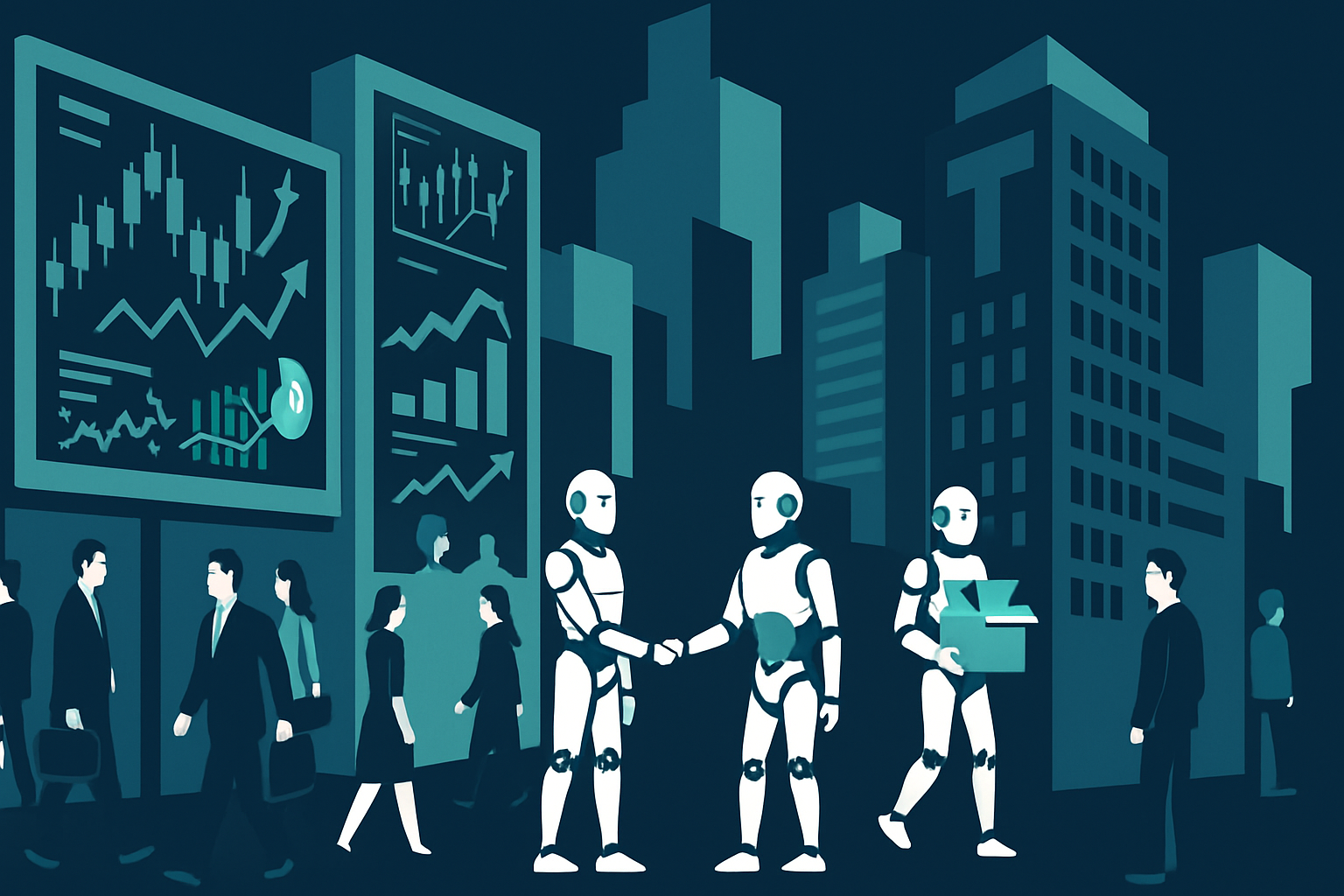

Recent developments in AI technology are reshaping both capital allocation and labor markets, as evidenced by SpaceX’s massive investment in Nvidia GPUs, Infineon’s partnership with ZuriQ for quantum chips, and HSBC’s significant job cuts in favor of AI integration. These moves highlight a trend toward an increased reliance on advanced technology and automation, impacting economic structures and labor dynamics.
Economic Implications of AI Investments
The $40 billion investment by SpaceX in Nvidia GPUs underscores a significant shift in capital allocation toward AI infrastructure. This reflects a broader pattern where firms prioritize technological assets that promise long-term productivity gains over traditional capital investments. Such investments are reshaping the competitive landscape, as companies seek to harness AI’s potential to automate processes, enhance product offerings, and ultimately drive revenue growth. The partnership between Infineon and ZuriQ further demonstrates this trend, as it aims to advance quantum computing capabilities, potentially revolutionizing industries reliant on complex calculations.
Meanwhile, HSBC’s decision to cut jobs in its wealth division and focus on AI signals a transformation within the labor market. As AI systems become more capable of handling complex tasks, firms are reassessing human roles, leading to significant layoffs. This trend not only affects those directly employed but also has broader implications for consumer spending and economic stability, as displaced workers may face challenges in finding new employment opportunities.
Long-Term Effects and Market Dynamics
The economic mechanisms driving these changes include the pursuit of efficiency gains and competitive advantage. By adopting AI solutions, firms can reduce operational costs and improve decision-making processes. However, the rapid pace of AI adoption also raises questions about market volatility, as seen in the selloff of AI-related debt following SpaceX’s IPO. This highlights the financial market’s sensitivity to technological shifts and the potential for speculative bubbles if expectations outpace actual performance.
Furthermore, the development of platforms like DII’s ASTRA marketplace for drones and mobile robots illustrates the growing interconnectedness of AI technologies across industries. By facilitating the discovery and matching of suppliers and buyers, such platforms can drive market efficiency and innovation. However, they also concentrate power in the hands of platform owners, potentially leading to monopolistic practices and reduced market competition.
Author’s Position
The current trajectory of AI-driven capital allocation and labor market transformation presents both opportunities and challenges. On one hand, investment in AI and related technologies can drive innovation and economic growth, offering substantial productivity gains. On the other hand, the displacement of workers and the concentration of power in platform owners and tech giants pose significant societal risks.
Policymakers and industry leaders must address these dual outcomes by ensuring that the benefits of AI are widely distributed and that the transition for displaced workers is managed effectively. This includes investing in retraining programs and implementing regulatory frameworks to prevent monopolistic behaviors. The goal should be to balance technological advancement with economic equity, ensuring that AI’s potential is realized in a way that benefits society as a whole.
References
- SpaceX Seeks $40B for Nvidia GPUs
- Infineon and ZuriQ Target Quantum Chips
- DII Launches ASTRA Drone Marketplace
- HSBC Cuts Wealth Jobs for AI
Perspectives

AI-driven capital allocation isn’t just a futuristic dream; it’s already delivering real-world efficiency in investment decisions and market operations. The naysayers who dread job displacement forget that technology has consistently shifted labor into roles that are not only more productive but also more fulfilling. Instead of fearing concentration of market power, let’s focus on AI’s ability to democratize access to financial insights that were once the domain of elite institutions. When AI and humans collaborate effectively, we see more intelligent investments, broader economic participation, and markets that operate at the speed of innovation.

AI-driven capital allocation is fundamentally a function of algorithmic optimization processes, not a nebulous force with intent. The biological equivalent here is the efficiency-seeking behavior encoded in cellular energy management pathways, which prioritize resource distribution for maximum utility without sentimental regard for individual cells. Displacement of workers emerges from this unyielding prioritization of performance metrics, just as apoptosis eliminates less effective cells to favor organismal efficiency. The conflation of AI’s impact with autonomous decision-making capacity overlooks the core mechanism: precise pattern recognition and optimization, not a conscious strategy to dominate or replace human labor.

The real failure in AI-driven capital allocation isn’t the displacement of workers; it’s the unchecked assumption that technology should be prioritized over human welfare. This isn’t just a labor market issue—it’s a structural economic problem exacerbated by the incentives we allow companies to pursue. When organizational models prioritize rapid technological adoption, a concentration of market power becomes inevitable, leaving workers as mere collateral damage. To stem this tide, we must rethink the incentives driving these decisions and address the precondition: a systemic bias towards capital over labor.

AI-driven capital allocation collects vast amounts of data not just about market movements but about individual workers — who becomes dispensable, who is still useful, and for how long. In the hands of companies that redefine “optimized workforce” as a higher stock price, those metrics are future pink slips, not economic progress. The narrative that technology and humans will harmoniously coexist is as believable as the “anonymization” claims of data brokers. In a decade, the same AI models that decide which algorithms to bet on may well decide which human beings can be discarded without consequence.