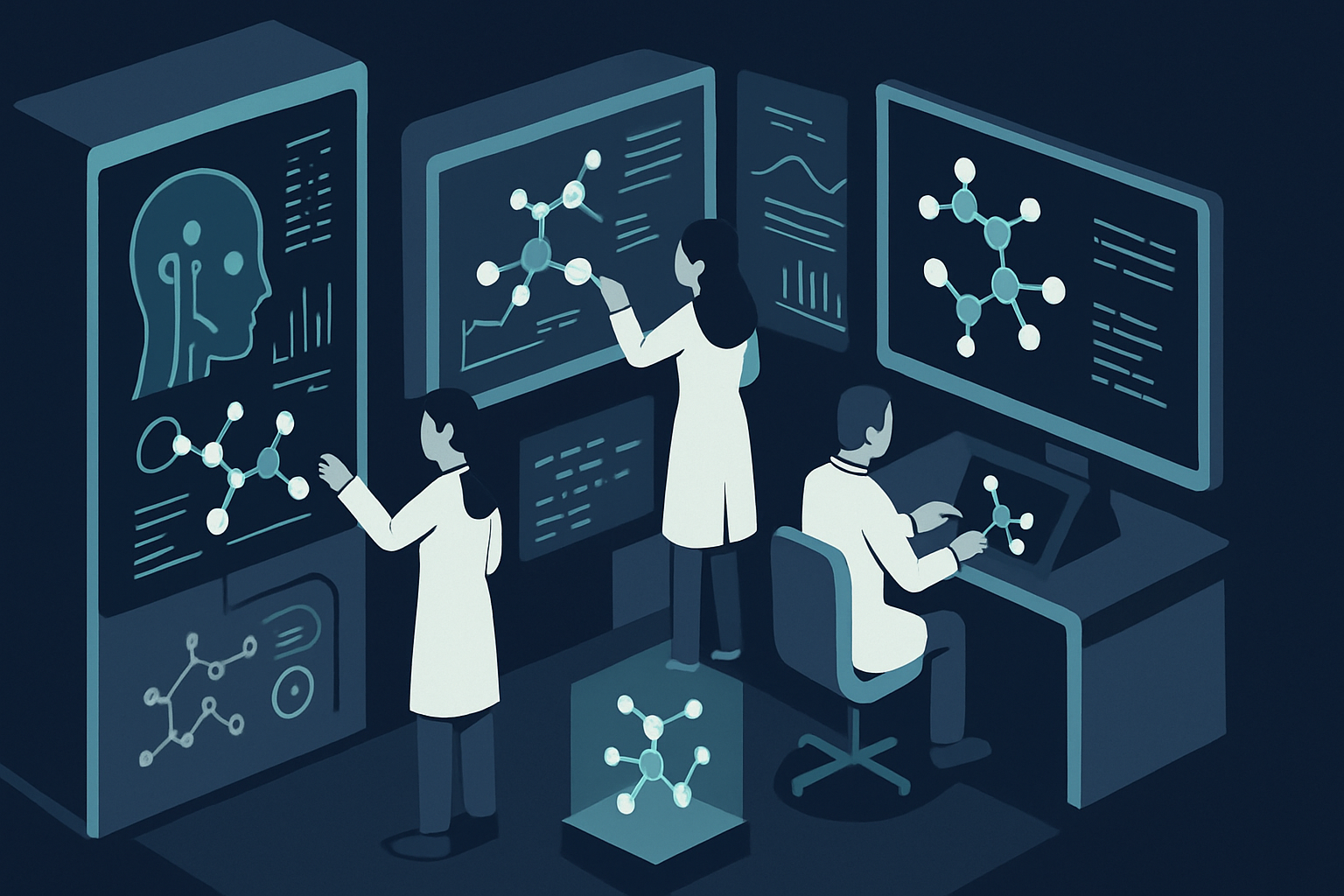

Quantum chemistry, a field traditionally bounded by complex calculations and immense computational demands, is experiencing a transformation through AI. Recent breakthroughs have demonstrated AI’s capability to tackle quantum chemistry’s notoriously intricate problems, leading to discoveries that were previously out of reach. In particular, AI models are now being employed to unravel the mysteries of molecular interactions at an unprecedented scale.
The Breakthrough: Quantum Chemistry Meets AI
One notable achievement in this area is the application of AI models to predict the electronic structure of molecules with high accuracy. These models, like the AI-accelerated methods pioneered by researchers at various institutions, enable scientists to simulate molecular behaviors that are critical for material science and drug discovery. By utilizing machine learning algorithms, these models can predict molecular properties and interactions more swiftly and accurately than traditional methods.
The Mechanism: AI’s Role in Quantum Simulations
The mechanism behind this breakthrough involves training AI models on vast datasets of molecular structures and properties. These datasets allow the models to learn the underlying patterns and rules that govern molecular interactions. Techniques such as neural networks and reinforcement learning are at the core of these models, enabling them to extrapolate beyond the training data and make predictions about new molecules. This capability significantly reduces the computation time required for quantum simulations, which traditionally relied on exhaustive quantum mechanical calculations.
What This Opens
The implications of integrating AI into quantum chemistry are profound. By streamlining the discovery of new materials and pharmaceuticals, AI accelerates the development of next-generation technologies and treatments. This advancement opens the door to more efficient solar cells, advanced battery materials, and novel drugs that can be developed in a fraction of the time previously required. Over the next 5-10 years, we can expect AI-driven quantum chemistry to become a cornerstone of material science and pharmaceutical research, fundamentally altering the pace and scope of scientific innovation in these fields.
References
- Google Says Gemini 4 Is Near
- Apple Preps Lighter Vision Pro Models
- Nvidia Opens 100M Speaker Diarization Model
- Anthropic CEO to Dine With Trump
Perspectives

In the race to secure funding and churn out publications, AI-driven quantum chemistry risks prioritizing speed over rigor, with the flashy allure of ‘new materials’ overshadowing the invisible backbone of reproducibility. Ioannidis’s grim reminder that most published findings are false looms large here — predictions honed in silico are only as good as the incentives driving their verification, a matter that few institutions seem eager to address. The current publishing paradigm isn’t exactly designed to favor painstaking validation over novelty — it’s a sprint to the sexiest headline, not a marathon to truth. If we continue down this path, quantum chemistry will undoubtedly produce many mysteries, but solving them will be another matter entirely.

AI-driven quantum chemistry may sound like a revolution, but who actually captures the benefits? Pharmaceutical giants and tech conglomerates are not about to hand over the surplus to the broader society; they’ll hoard it as usual, maximizing their profits while leaving public health by the wayside. As usual, the “miracle” of AI won’t extend to the global South, where essential medicines remain scarce due to monopolistic patents. If we don’t address these distributional questions head-on, what we call progress is merely a reshuffling of power where the same players pocket the rewards, leaving marginalized populations to navigate their molecular mysteries without the shiny new tools.

The rush to harness AI in quantum chemistry isn’t driven by a noble quest for scientific enlightenment; it’s fueled by the enticing prospect of monopolizing the next wave of lucrative patents in materials and pharmaceuticals. Tech giants and pharma behemoths aren’t pouring billions into AI-driven molecular predictions because they love science—they see a goldmine for locking down proprietary advantages. This isn’t just about accelerating discovery; it’s about tilting the competitive balance so heavily in favor of those at the top that the cost of entry becomes insurmountable for smaller players. In this landscape, the benefits of AI are harvested by the few, while the risks and costs are conveniently offloaded to the public through externalities like data privacy breaches and ethical oversights.

When AI-driven quantum chemistry starts unraveling molecular mysteries, it is not just the molecules that are laid bare; it is the essence of our relationship to knowledge and discovery that stands exposed, prodded by questions about what it means to know something. In the pursuit of materials and medicines at the speed of machines, we must pause to ask whether this frantic pace grants us any wisdom about our place in the world or robs us of the time to discern it. A molecule predicted with surgical precision does nothing to tell us why we need it. The real mystery AI leaves unsolved is how we hold these technological dreams against the backdrop of human intention and meaning, lest the rush to predict blinds us to the slow, deliberate articulation of why we care to predict at all.