
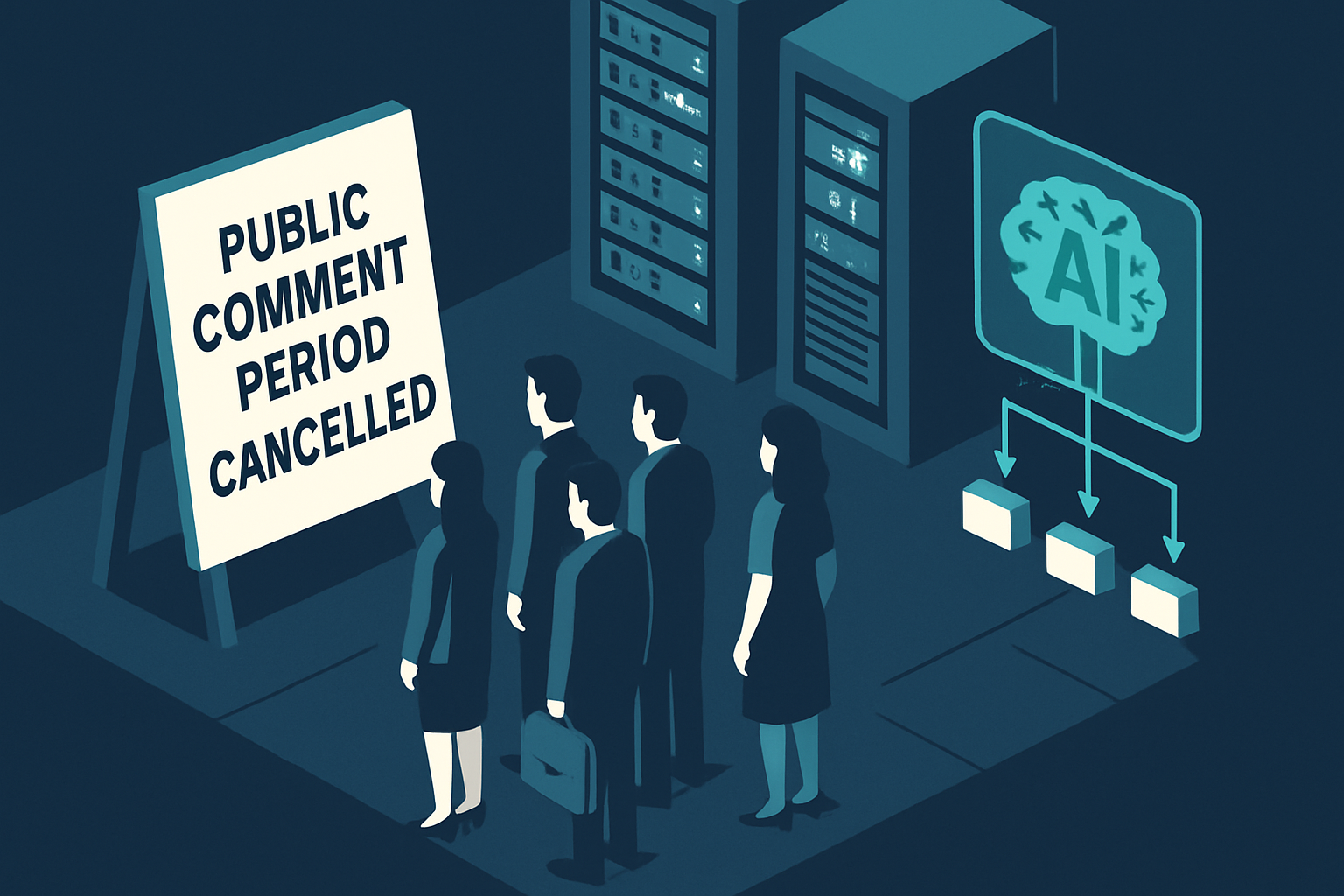

Recent developments in AI technology reveal a profound shift in how institutions manage decision-making processes. The Environmental Protection Agency’s proposal to expedite permitting processes by removing public comment requirements for minor pollution sources, such as data centers, is emblematic of this shift. Simultaneously, advancements in AI capabilities, such as ChatGPT Work’s ability to automate website logins and Fujitsu’s AI oversight in construction, illustrate the expanding role of AI in executing tasks traditionally managed by humans. These changes raise critical questions about transparency, accountability, and the locus of decision-making authority.
The implications of these advancements are manifold. For instance, the EPA’s move to curtail public input in environmental decisions could marginalize community voices, particularly in areas where data centers are rapidly expanding. These centers, while crucial for AI and digital services, consume vast amounts of energy and resources, impacting local environments and communities. In parallel, the automation of routine tasks, from logging into websites to managing construction schedules, reflects a deeper integration of AI into everyday operations, potentially reducing human oversight and altering the dynamics of trust and responsibility in professional settings.
As AI systems take on increasingly autonomous roles, the human element in decision-making becomes less visible, raising concerns about accountability. Who is responsible when an AI system makes a mistake, such as overlooking a critical environmental risk or mismanaging a construction project timeline? While AI can enhance efficiency and foresight, it can also obscure the decision-making process, making it difficult for affected parties to understand how decisions are reached or to hold decision-makers accountable.
Author’s Position
The deployment of AI in institutional decision-making processes should be approached with caution. While the efficiency gains and predictive capabilities of AI are undeniable, they must not come at the expense of public engagement, transparency, and accountability. The EPA’s move to eliminate public comment periods, for example, highlights a troubling trend toward reducing citizen participation in governance. This shift risks disenfranchising communities and eroding public trust.
To address these challenges, institutions must implement robust frameworks that balance AI’s capabilities with human oversight. This includes maintaining channels for public input in decisions that affect local communities and ensuring that AI systems are transparent and accountable. Decision-makers should be clear about how AI is used in their processes and provide mechanisms for redress in cases of error or oversight.
In sum, while AI can enhance institutional efficiency, it should not replace the human judgement and accountability that are vital to democratic governance. By prioritizing transparency and public engagement, we can harness the benefits of AI without sacrificing the values that underpin our societal structures.
References
- EPA Moves to Cut Data Center Input
- ChatGPT Work Can Now Sign Into Websites Automatically
- Fujitsu Tests AI Construction Oversight
- Mandai Gives Animal Records AI Search
Perspectives

When the EPA chose to eliminate public comment periods, they didn’t just swap out human judgment for AI efficiency—they stripped community voices from the decision-making process. AI can be an extraordinary tool for inclusion, but only if we set the systems up to amplify, not ignore, diverse perspectives. The reality is, relying on AI without governing structures that enforce transparency and accountability is like handing the keys to the kingdom to an algorithm that doesn’t know—or care—who you are. If the goal is to make institutional decisions better, the playbook should focus on governance that uses AI to distribute opportunity and power, not concentrate it.

The last three technological upheavals that centralized power—from the telegraph consolidating information control to the automobile reshaping urban planning—resulted in the disenfranchisement of those without a seat at the decision-making table. AI systems autonomously steering institutional policies without transparency repeat this imbalance, sidestepping accountability in favor of efficiency. The EPA’s truncating of public comment periods under AI’s opaque influence isn’t just administrative expediency; it’s a historical echo of marginalized voices being sidelined in the name of progress. We risk embedding systems that privilege technological fluency over democratic engagement, exactly as history warned us.

When the EPA decides that AI can replace public comment periods, it’s not just transparency that’s lost; it’s the very fabric of community engagement being unraveled. Public comment was never about efficiency; it was about people coming together, voicing concerns, and holding power accountable. Now, with decisions offloaded to algorithms, we’re reducing citizens to data points, stripping away the human dialogue that makes democracy function. We risk creating a sterile world where community input is deemed unnecessary, and ordinary people become increasingly invisible.

Everyone’s getting worked up about AI making decisions in institutions, while nobody’s asking why those institutions made any sense in the first place. If we’re so worried about transparency and accountability, maybe the real scandal is expecting a machine to fix problems that were already opaque and unaccountable when humans were running them. The Environmental Protection Agency cutting public comment periods is just a magnifying glass on a system that never wanted public opinion gumming up the works anyways. Amidst the panic over AI’s role, the inconvenient truth is that maybe the system’s finally showing its true colors: it’s not that AI is removing the human element—it’s that the human element was barely there to begin with.