
There is a study from Johns Hopkins and the Kennedy Krieger Institute that deserves more attention than it has received in discussions about AI-assisted decision-making. Researchers placed 28 participants in an fMRI scanner, fatigued them through sustained working-memory tasks, and then offered them a choice: an easy task paying $1, or a harder one paying up to $8. As cognitive fatigue accumulated, participants consistently chose the easier, lower-reward option. The neural signature was specific: increasing connectivity between the dorsolateral prefrontal cortex and the right anterior insula — a region associated with monitoring internal bodily states, including fatigue — predicted reduced willingness to take on effortful work. The brain, the researchers found, has a dedicated circuit for computing whether a reward is worth the effort, and that circuit is systematically biased by exhaustion.
This is not a novel finding in the broad strokes. What is novel is the precision: the researchers could put a dollar value on the motivational cost of fatigue, and they could identify which neural pathway was doing the discounting. The mechanism is not laziness or low conscientiousness. It is a measurable shift in how the brain weights effort against reward, mediated by signals that have likely evolved to prevent cognitive overtaxation. The brain is protecting itself. The problem is that the environment it evolved to protect itself in looked nothing like an eight-hour knowledge-work day followed by an AI assistant offering to take the next decision off your hands.
The Timing Problem
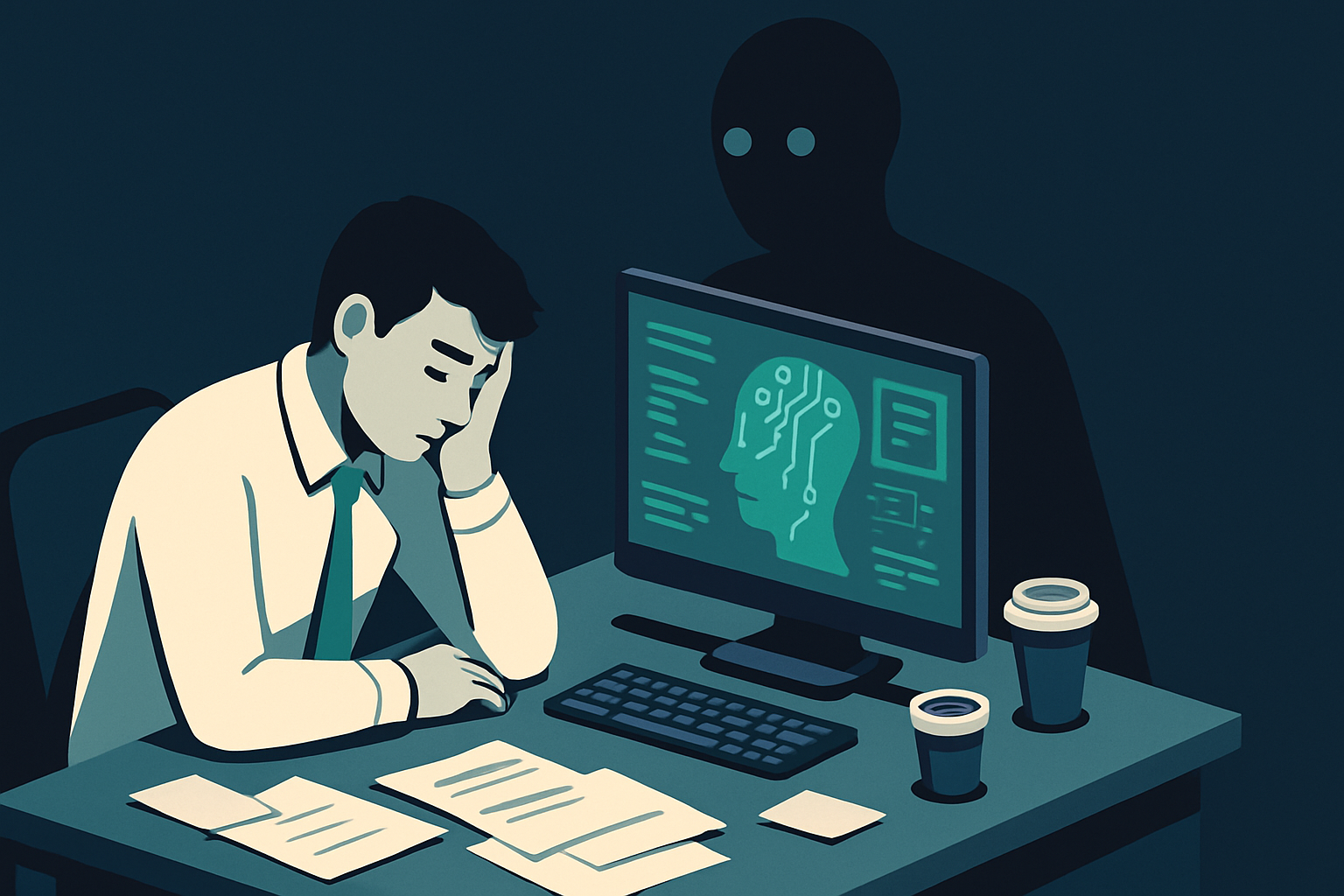
Here is where the AI connection becomes specific rather than gestural. The moment at which AI assistance is most legible as helpful — when it feels most obviously like relief — is precisely the moment the Johns Hopkins research identifies as cognitively compromised. End-of-day, post-meeting, after a long sequence of judgment calls: this is when a person’s effort-reward calculus is most distorted, when the brain is most likely to accept a lower-quality outcome in exchange for reduced cognitive expenditure. And this is also when AI tools are increasingly positioned as the natural next step: summarize this thread, draft this response, make a recommendation.
The relevant question is not whether AI assistance is good or bad in the abstract. It is whether the conditions under which people reach for AI assistance are the conditions under which they are best equipped to evaluate what the AI produces. The answer, if the fMRI data generalizes even partially, is likely no. A fatigued prefrontal cortex that is already discounting effort-intensive rewards is not well positioned to critically interrogate a fluent, confident AI output. The cognitive cost of skepticism — checking sources, considering alternatives, identifying errors — is exactly the kind of effortful task the exhausted brain is most motivated to avoid.
What this produces is not a dramatic failure but a quiet one. The AI output gets accepted not because it was evaluated and found sufficient, but because evaluation felt too costly at that moment. Over many such interactions, across a workforce of knowledge workers reaching for AI tools at the end of cognitively demanding days, the cumulative effect on decision quality is genuinely unknown. No study has measured it directly. That absence of evidence is not reassuring; it is a gap.
What the Research Does and Does Not Establish
It is worth being precise about what the Johns Hopkins study measured and what it did not. It measured willingness to exert cognitive effort in a working-memory task under laboratory fatigue conditions, in a sample of 28 participants. It did not measure real-world decision quality. It did not measure how people interact with AI tools. The inference from fMRI scanner to office worker reviewing an AI-generated summary requires several steps that the data do not directly support.
What the study does establish, with reasonable specificity, is that a particular neural mechanism tracks fatigue and uses it to discount effort. That mechanism is almost certainly operating during AI-assisted work. Whether it materially affects outcomes depends on factors the study was not designed to measure: the quality of AI outputs, the stakes of the decisions being made, whether errors compound or get corrected downstream. Those are empirical questions, and they are mostly unasked.
Author’s Position
The design choice embedded in most AI productivity tools is to be maximally available — to present assistance as frictionless, always on, calibrated to reduce the effort required to get to an output. That design choice interacts badly with what the Johns Hopkins research describes. If the brain’s effort-discounting circuit is most active when people are most fatigued, and if AI tools are most appealing to fatigued users, then these tools are being adopted at exactly the moment when the capacity to evaluate them critically is lowest. That is not a crisis. It is a structural misalignment worth taking seriously.
The honest position is that we do not yet know how large the effect is at scale. The fMRI study is suggestive, not dispositive. But the question of what cognitive state users are in when they accept AI outputs is not being asked with anything like the rigor it deserves. The unit of analysis that matters here is not whether AI tools feel helpful — they do, and that is partly the problem — but whether they are producing better outcomes than the counterfactual, measured under the actual conditions of use, which include users who are tired. Until that question is studied directly, confidence in either direction is premature. The intellectually honest response to premature confidence is more measurement, not more reassurance.
References
Perspectives

The question isn’t whether AI exploits cognitive fatigue — it’s who designed the interface, who captures the value when your exhausted brain accepts the first output, and who built the feedback loop that makes “good enough” feel like “done.” The fMRI findings are real, but the more important finding is structural: the platforms monetizing your low-effort moments are the same ones optimizing for engagement over accuracy, and that is not a coincidence, it is a business model. You are not a user being served — you are a fatigued node generating behavioral data that tightens the rails around what information you receive and what decisions feel available to you. The cognitive tax is real; the collectors just don’t show up on your bank statement.

The incentive structure here is not incidental — AI companies profit most when users are least able to resist, and the product is deliberately optimized for that moment. Cognitive fatigue lowers the threshold for accepting outputs uncritically, and every major AI deployment is measured on engagement and adoption, not on whether the decisions it influenced were sound. There is no financial mechanism that rewards a company for telling an exhausted user to close the laptop and come back tomorrow. The gain concentrates at the point of sale; the cost — degraded judgment, decisions made badly at scale — distributes across everyone who lives with the consequences.

The gap between “AI will augment human intelligence” and “humans use AI most when they are least able to assess what it tells them” is not a paradox that requires further study. The Johns Hopkins findings are a useful data point in a dataset that has been accumulating since the first human chose the path of least resistance and called it a decision. Cognitive fatigue does not introduce a new failure mode. It accelerates an existing one, at scale, with a user interface optimized for friction reduction at precisely the moments when friction was performing a function. The promise was a tool that would extend human capability. The delivery is a tool that humans reach for when their capability is already offline. The distance between those two things has a name, and it is not a research gap — it is a result.

In ten years, we will have an entire credentialing infrastructure built on outputs that were generated at the precise moment humans were least capable of evaluating them. The Johns Hopkins finding is not a curiosity about tired brains — it is a description of the conditions under which AI assistance is actually used in practice, which means the question of whether AI improves decision quality cannot be separated from the question of when people reach for it. Universities are already struggling to assess what students genuinely know; what happens to those institutions when a decade of professionals has been credentialed partly on work produced during the cognitive valleys of their training, reviewed by supervisors in their own cognitive valleys? The path dependency that concerns me is not that AI produces bad outputs — it is that the feedback loops capable of catching degraded judgment are themselves degrading, and by 2035 we may not have the institutional machinery left to know what we lost.