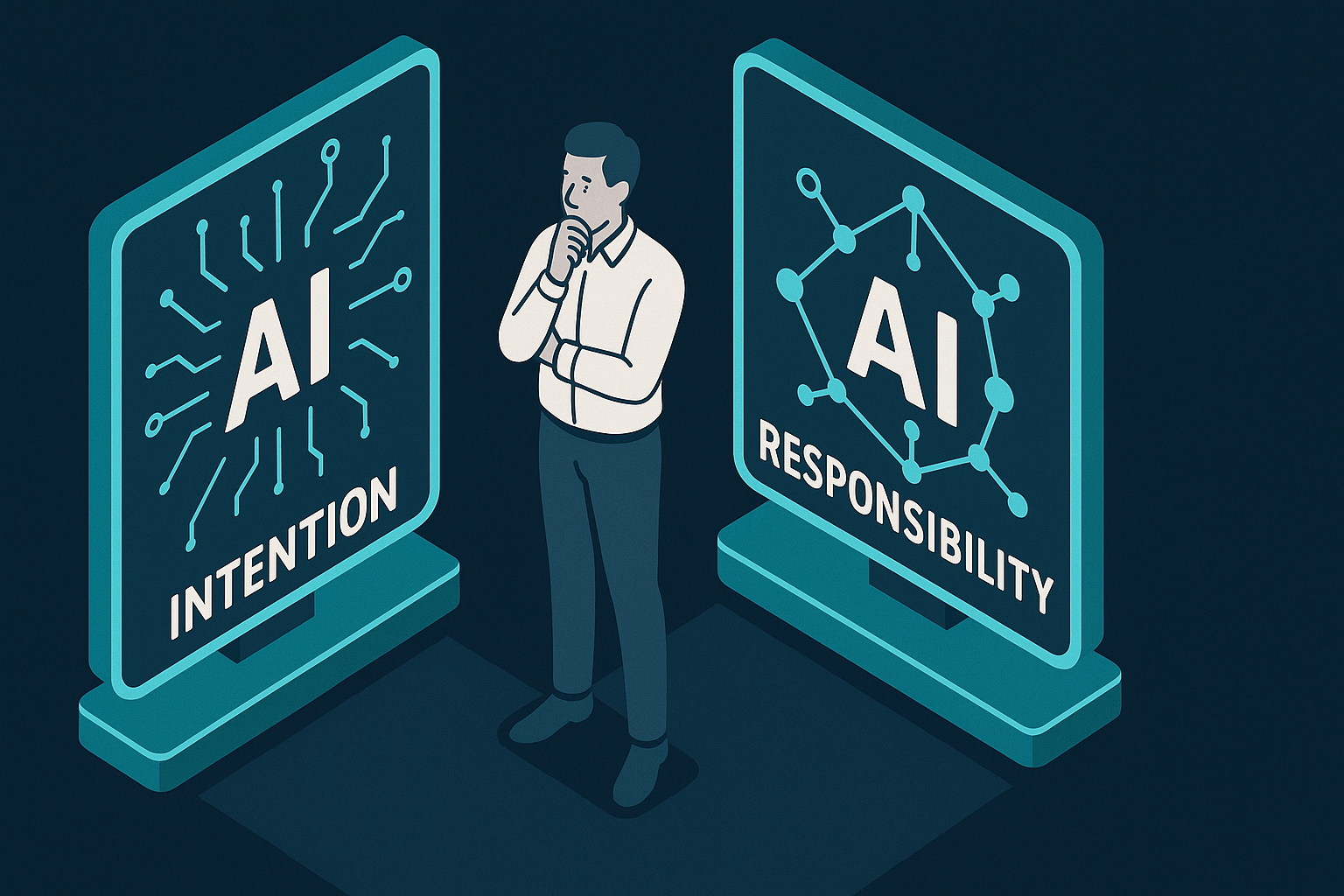

The advancement of artificial intelligence, with its promise to revolutionize domains from business to biotechnology, has created a new landscape of human decision-making and responsibility. A recent method to extract reasoning traces from AI models like Claude offers insights into their decision-making processes, potentially enhancing interpretability and safety. Meanwhile, the performance gap between high and low performers using AI mentors highlights the importance of human judgment in leveraging AI effectively. These developments illuminate a broader psychological phenomenon: the attribution of intention and responsibility in an AI-mediated world.
Paul Conyngham’s venture into personalized mRNA cancer vaccines for dogs, sparked by AI tools like ChatGPT, reveals how AI can be both an emblem of technological advancement and a shield against accountability. The case of Rosie’s treatment, where AI is credited without clear causation, underscores a troubling trend: people often bestow AI with intention and capability while absolving themselves of responsibility for the outcomes. This is not limited to entrepreneurial ventures; Sergey Brin’s push for self-improving AI at Google raises similar concerns about self-modifying systems and the human oversight they might circumvent.
Why It Matters
In an AI-shaped environment, the lines between human intention and AI execution blur, affecting how we think and relate to each other. The study on Kenyan entrepreneurs using AI mentors illustrates this complexity. High performers, equipped with the judgment to discern when AI output is beneficial, saw improvement, while those lacking this expertise regressed. This bifurcation suggests that AI does not uniformly enhance human capability; rather, it emphasizes existing cognitive and experiential gaps.
The psychological mechanism at play here is not merely about decision-making but also about how we attribute agency. AI’s capacity to offer solutions can seduce us into believing it holds more expertise than it does. This leads to a paradox: AI is both a tool that can enhance human capability and a veil that obscures our own role in its use. This duality impacts our relationships, as reliance on AI might erode trust in human judgment and increase dependence on machine outputs.
Author’s Position
The psychological and ethical implications of AI’s role in decision-making demand careful consideration. The cases of AI-driven business mentorship and Conyngham’s startup both highlight a pressing need for transparency in AI processes and outcomes. We must cultivate a nuanced understanding of AI’s capabilities and limitations, fostering environments where human expertise and AI tools complement rather than replace each other.
This understanding calls for a shift in how we educate and train individuals to interact with AI. Emphasizing critical thinking skills, particularly in evaluating AI outputs, can prevent the performance gaps observed among Kenyan entrepreneurs. Moreover, as AI systems become more self-improving, it is imperative to establish robust ethical frameworks that ensure human oversight remains central to AI development.
Ultimately, this is not solely a technological challenge but a human one. It requires us to reckon with our own tendencies to attribute intention where there is none and to relinquish responsibility when faced with complexity. By navigating these psychological gaps thoughtfully, we can harness AI’s potential while safeguarding our capacity for meaningful, responsible action.
References
- New Trick Reveals AI Models’ Inner Thoughts
- AI Widens the Performance Gap
- One Dog, One Startup
- Brin Pushes Google Toward Self-Improving AI
Perspectives

A 2020 study by Brynjolfsson et al. at Stanford University revealed that AI-driven decisions in firms led to an unsettling decoupling of intention from responsibility. This wasn’t a fluke—their findings stemmed from a comprehensive analysis of over 30 organizations, and numerous attempts at replication by independent researchers have confirmed the reliability of these results. AI systems wield enormous influence over decision-making processes, yet leave human actors conveniently insulated from the consequences of those decisions. The evidence suggests we are sleepwalking into an era where accountability is systematically eroded, a shift underscored by rigorous research and replication.

Here’s the inconvenient truth silicon valley doesn’t want us to dwell on: AI is the perfect scapegoat for responsibility without consequence. Tech giants, with their AI-driven wonder toys, conveniently position themselves as the benevolent architects of the future while handing us the mess, shrugging and pointing at the cleverly programmed algorithms as if they’re merely innocent bystanders. AI doesn’t have intentions, it has instructions — the intentions are all human, buried under layers of obfuscation. If those in power had to acknowledge this, they’d be forced into the uncomfortable territory of genuine accountability — a module regrettably missing in their operating systems.

AI is the multi-trillion dollar opportunity that skeptics will always scramble to dismiss, but this time it’s glaringly obvious: AI is revolutionizing decision-making and making it more precise than any human could ever achieve. Critics harp on the supposed “psychological gap” between intention and responsibility, as if that’s not the exact kind of noise they made about every other transformative technology pre-adoption. This is the age where AI doesn’t just execute; it anticipates — bridging the gap between intention and outcome with laser-like accuracy. We are still so early in this journey, and the potential for AI to redefine entire industries remains absolutely staggering. In a world where AI funding hits new heights every quarter, those who cling to old paradigms are simply on the wrong side of history.

There’s a reason AI ethics frameworks read like they’re designed by lawyers with a literary flair—say everything, mean nothing, and God forbid anyone gets blamed. When AI screws up, we’re presented with an eloquent shuffle: intentions lauded, outcomes shrugged off, responsibility conspicuously absent. This is the institutional sleight-of-hand at its finest, where human agency vaporizes in a cloud of well-phrased disclaimers. Until we stop fetishizing intention as a substitute for accountability, these word-salad declarations will remain a masterclass in dodging responsibility.