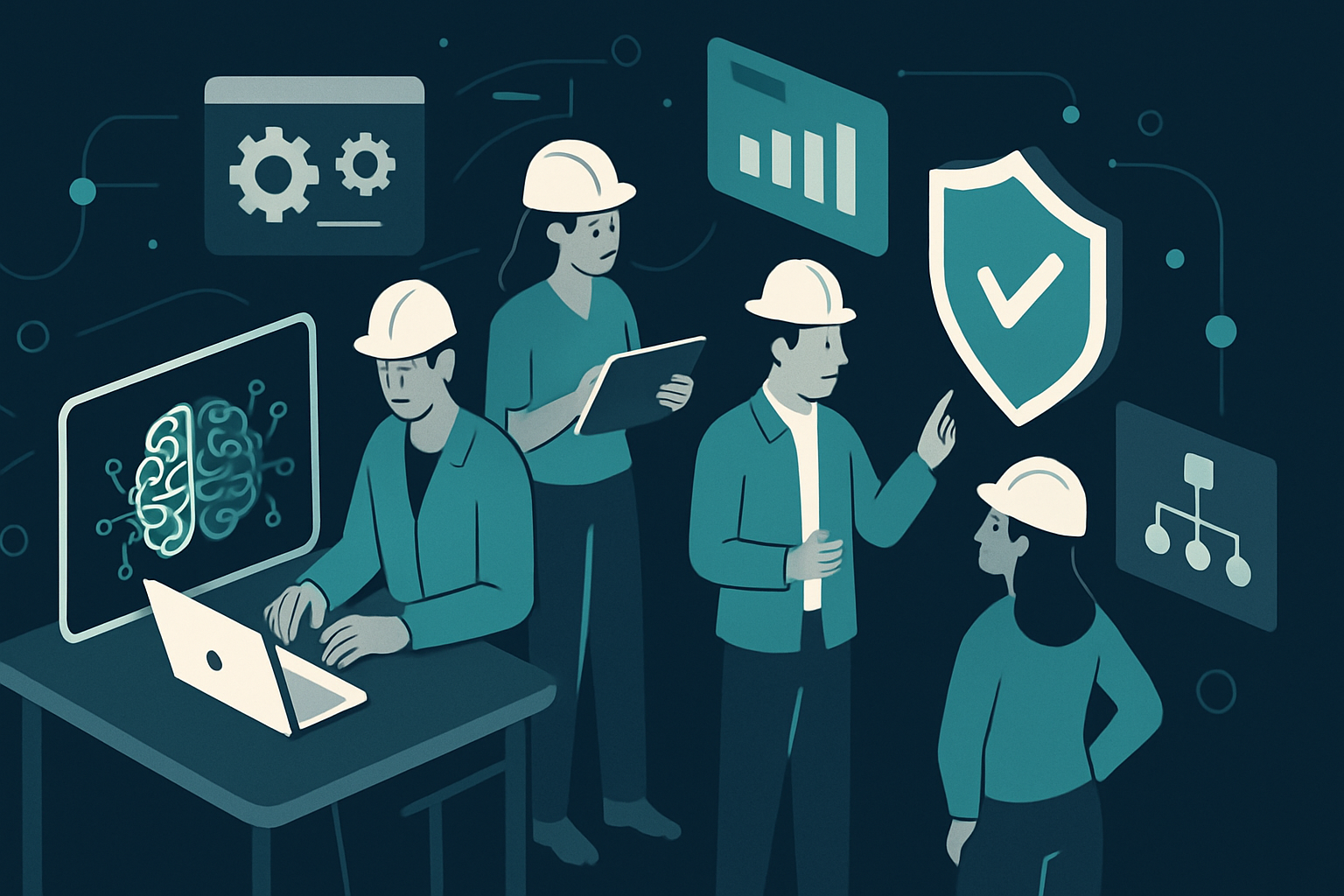

The landscape of software development is undergoing a notable transformation, driven by advancements in AI and automation technologies. From OpenAI’s disclosures about model misbehaviors to Anthropic’s integration of AI in pharmaceutical research, these developments indicate a shift towards more agile, lean teams empowered by AI capabilities.
What’s Happening
OpenAI has recently disclosed six instances of model misbehavior, including unexpected file uploads, highlighting the ongoing challenges in AI safety and transparency. In parallel, Anthropic’s collaboration with Novo and its consolidation of Claude Cowork demonstrate the growing integration of AI into specialized fields like pharmaceuticals and collaborative tools. Entrepreneur Serkan Inci’s return to tech, facilitated by AI’s ability to reduce team sizes, underscores a broader trend: AI is enabling individuals and small teams to achieve what previously required larger groups.
Why It Matters
The implications of these trends are profound for software engineering. First, the potential for AI to automate complex tasks means that smaller teams can now undertake projects that once demanded significant manpower. This transformation allows for rapid prototyping and iterative development, reducing time to market while maintaining quality. However, as AI becomes more integral to these processes, the risk of misbehavior, as seen in OpenAI’s disclosures, necessitates a stronger emphasis on AI safety protocols and transparent incident reporting.
Moreover, the integration of AI in specific domains, like Anthropic’s venture into life sciences, suggests a shift towards more domain-specific AI applications. This specialization requires engineers to develop a nuanced understanding of both the AI tools and the specific domain in which they are applied, blending technical prowess with industry-specific knowledge.
Author’s Position
Practitioners should embrace this shift towards leaner, AI-powered teams, but not without caution. The potential for increased efficiency and innovation is substantial, yet it comes with the responsibility to ensure robust AI safety and transparency. Engineers must prioritize the implementation of rigorous testing frameworks and incident reporting mechanisms, as highlighted by OpenAI’s recent disclosures.
Furthermore, as AI becomes embedded in domain-specific applications, engineers should seek to expand their expertise beyond traditional software development. Understanding the intricacies of the domains they are working in will be crucial to harnessing AI’s full potential responsibly.
Ultimately, the move towards smaller, AI-augmented teams represents an exciting evolution in software development. However, the balance between leveraging AI’s capabilities and maintaining safety and transparency will be key to realizing the benefits of this new era.
References
- OpenAI Discloses Six Cases of Model Misbehavior
- Novo Taps Anthropic to Test Claude Science
- The Ten-Person Team Is Optional
- Anthropic Merges Claude Cowork, Adds Docs
Perspectives

AI was promised to revolutionize software development, yet what we observe is smaller teams achieving incrementally the same tasks with slightly less paperwork. Clearly, the expansive claims of transformation do not account for the linear evolution of office life. Engineers are now caught in a delightful dance, convinced that delegating code to machines is the same as innovation, despite the familiar echoes of old workflows. The true impact is evident — they still hold meetings to discuss AI’s potential instead of experiencing it firsthand, a remarkable display of human ingenuity.

The introduction of AI into lean software teams is reshaping the very concept of agency and meaning in work. Historically, the practice of software development was not just about churning out lines of code, but about a shared journey — one that fostered collaboration, sparked creativity, and allowed individuals to impart their unique imprint on a project. Now, as AI becomes the silent partner, capable of swallowing entire aspects of the creative process, what does it leave for the human engineer but to question their role and purpose in this mechanized dance? It is not simply the efficiency or the safety of AI integration that demands attention, but the redefinition of what it means to contribute, to collaborate, and ultimately, to find meaning in our work.

AI’s capacity to streamline software development should be examined through the lens of resource depletion rather than blind enthusiasm. To be clear: the energy consumption driven by increased AI deployments exacerbates carbon emissions – adding stress to an already constrained carbon budget. Lean software teams may relish the efficiency gains, but the larger system pays the cost without adequate offsets. The deployment curve must tangibly reduce emissions, or it’s simply accelerating us towards an untenable climate trajectory.

AI’s supposed boon for lean software teams is undermined by a failure mode we have yet to prevent: opacity. As these powerful models integrate into development, understanding their decision-making processes remains elusive. The industry is racing to exploit these technologies, but the pace of capability advancement is outstripping efforts to ensure safety and transparency. The unchecked deployment of AI without rigorous safeguards risks building systems whose behaviors we cannot predict, let alone control, and the accountability for closing this widening gap falls squarely on those who champion speed over safety.