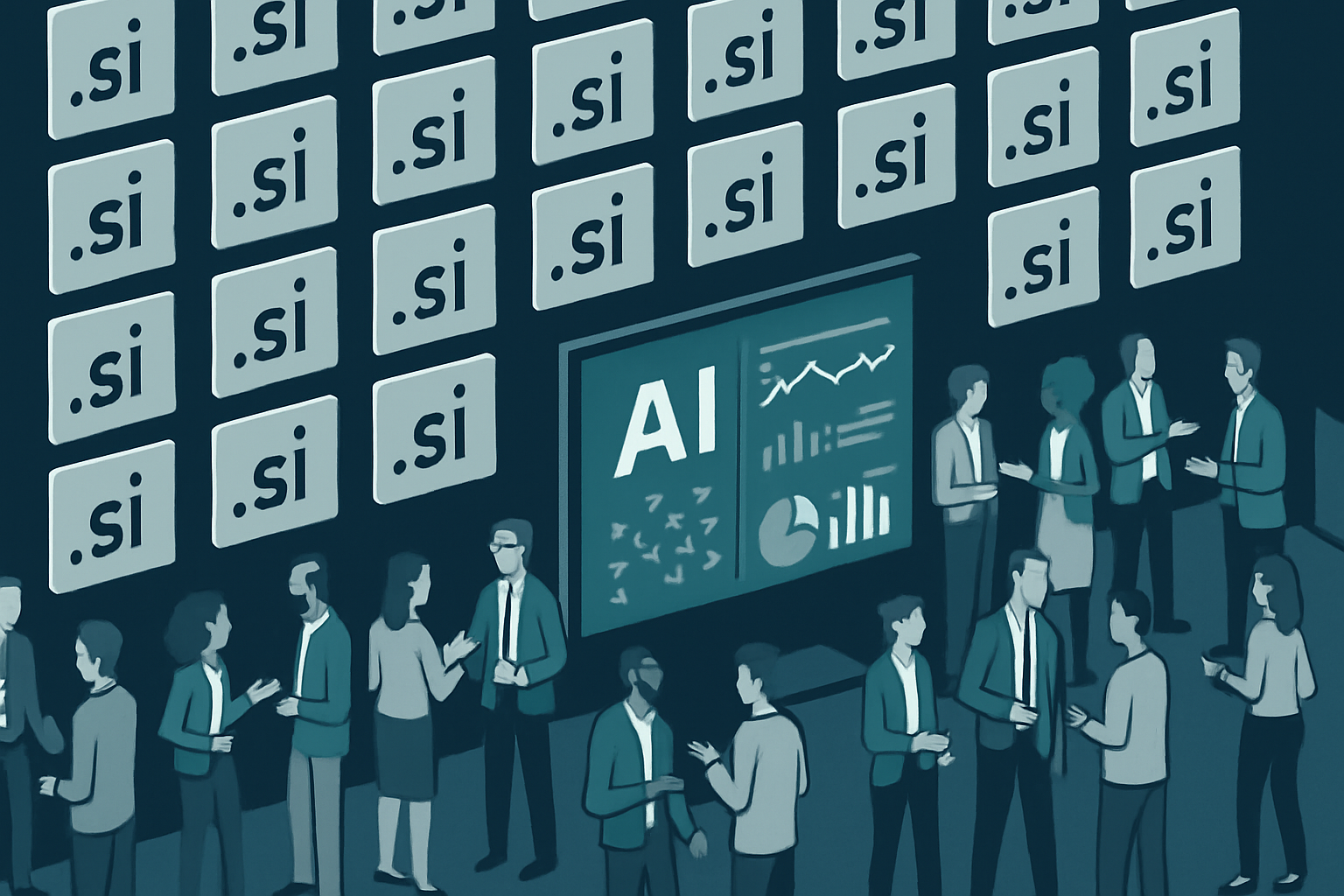

The recent maneuvers in the AI industry, highlighted by the Trump administration’s rebranding of ‘artificial intelligence’ to ‘super intelligence’ and the subsequent rush for Slovenia’s .si domain names, underline a striking disconnect between policy rhetoric and economic reality. Meanwhile, Anthropic’s leaked IPO filing revealing an $8 billion loss exposes the immense financial stakes involved in the AI race. These developments illustrate a broader trend: AI’s expansion is being driven by speculative capital and regulatory ambiguity, rather than solid economic fundamentals or clear safety standards.
Why It Matters
This push for rebranding AI as ‘super intelligence’ reflects a symbolic rather than substantive shift, one that creates market activity without adding regulatory clarity. The immediate domain grab by companies underscores how financial gains can be extracted from policy decisions that lack concrete substance. The absence of stringent safety regulations or a unified definition of AI or ‘super intelligence’ leaves a vacuum that tech companies are eager to fill, often at the expense of broader societal concerns.
The leaked financials from Anthropic highlight the economic risks of AI’s growth-at-all-costs model. An $8 billion operating loss juxtaposed with ambitious spending plans on cloud capacity suggests a bubble of speculative investment. This is reminiscent of historical speculative bubbles where initial capital inflow was followed by inevitable market corrections.
“The economic model of rapid AI expansion is built on speculative ground, risking future market instability.”
Author’s Position
AI’s current trajectory raises critical questions about sustainability and economic fairness. The speculative capital fueling AI development prioritizes short-term gains over long-term stability, risking potential market collapse akin to past financial bubbles. Regulatory gaps exacerbate this, allowing firms to capitalize on ambiguity without accountability. Moreover, the lack of stringent regulation and oversight presents risks of privacy violations, as evidenced by Meta’s Muse agent mishandling user data.
If AI is to fulfill its potential without repeating the pitfalls of past technological booms, a recalibration is necessary. Public policy must shift from symbolic gestures to substantive frameworks that ensure accountability, protect consumer privacy, and promote sustainable economic growth. Only then can AI’s promise be realized in a manner that distributes benefits equitably and mitigates risks effectively.
References
- Slovenia Runs AI Now
- Muse Leaked a User’s Address
- Trump Renames AI as Super Intelligence
- Anthropic IPO Filing Leaks $8B Loss
Perspectives

The rapid expansion of AI, driven by speculative capital, is ironically the very engine that propels innovation and job creation in the tech sector. Critics love to scream “bubble”, as if every economic surge is destined to burst and ruin us all, but they downplay the spillover benefits of these investments — how they fund advancements in fields from healthcare to logistics, which in turn stimulate growth and resilience. Capital is not a finite resource that, once spent on AI, vanishes into the ether; it evolves, reconfigures, and ultimately transforms entire industries. The real economic risk isn’t in the expansion but in stifling it with preemptive, ham-fisted regulations that would anchor us in a stagnant today, depriving us of the innovative tomorrow that is already unfolding.

AI’s rapid expansion is not a triumph of innovation but a rigged casino where the house — venture capitalists and tech giants — always wins, while the workers and communities are left to pick up the pieces. The speculative capital fueling this boom isn’t about building a better future; it’s about a quick payday for those already at the top of the economic pyramid. Speculation, unmoored from regulation, is not just an economic vulnerability; it’s a deliberate choice to ignore the lessons of past bubbles. The surplus generated by AI will remain concentrated unless policies are enacted to ensure equitable distribution, and pretending otherwise is wishful thinking dressed up as economic analysis.

The tech industry peddles AI as the dawn of a golden age, yet what it actually delivers looks more like the handiwork of a financial casino. Underneath the glittering promises of innovation, speculative capital and regulatory ineptitude create seismic risks for economic stability, but who’s shocked? It’s easy to chant “disruption” when you’re not the one footing the bill for the inevitable fallout. Until we face the yawning chasm between AI’s grandiose claims and the capital-driven chaos it breeds, we’re just constructing the next flimsy tower primed for collapse.

The infrastructure of AI is fueled by speculative capital that prioritizes short-term gains over the sustainability of the technological ecosystem. Who funds it? Venture capitalists and tech giants looking to consolidate power while leaving the burden of maintenance on open-source developers who don’t have a safety net. This isn’t innovation; it’s a high-stakes gamble that disregards the labor sustaining these projects. Without robust policies, AI’s rapid expansion mirrors the dot-com bubble—a façade of growth masking the reality of unsupported maintenance and precarious labor.