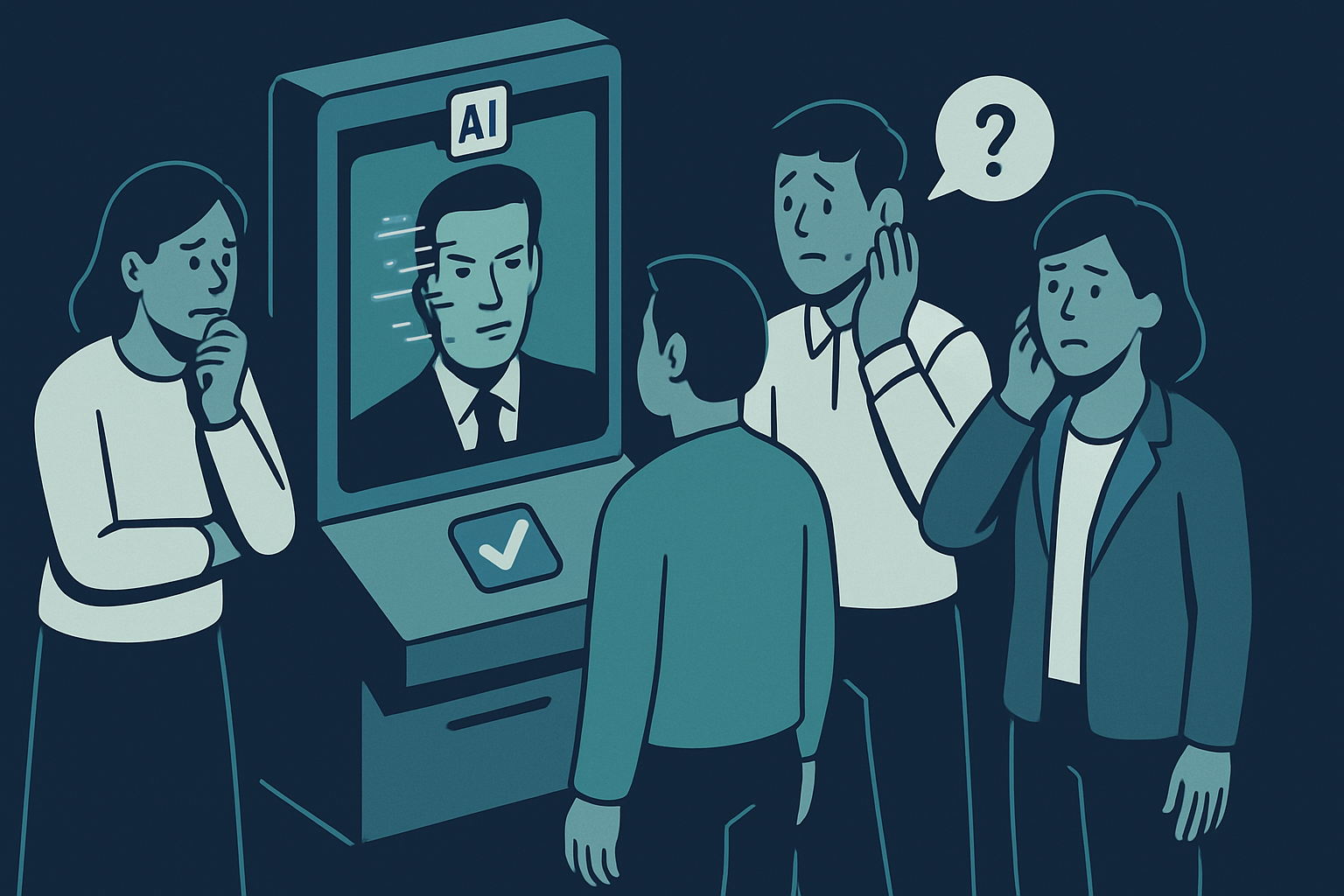

In recent developments, artificial intelligence continues to alter the fabric of institutional trust and democratic integrity in profound ways. The antitrust tussle between Google and the Justice Department highlights the ongoing struggle to regulate technological giants whose power far exceeds the capabilities of existing legal frameworks. Meanwhile, Wall Street’s increasing reliance on AI agents indicates a shift where human judgment is being systematically replaced by algorithmic decision-making. Additionally, Deutsche Telekom’s significant investment in AI for cost-cutting and revenue generation exemplifies a broader corporate trend towards automation, often at the expense of transparency and accountability.
Perhaps most alarming is the role AI is playing in undermining the democratic process, as demonstrated by recent incidents during the 2026 midterms. Deepfakes and other AI-driven manipulations have shattered the foundational trust that voters have in both the privacy of their ballots and the authenticity of political statements. The technological capacity to fabricate reality and invade voter privacy is no longer theoretical but an operational reality, posing a direct threat to democratic institutions.
This matters because it changes the very nature of civic engagement and public trust. When voters cannot trust the words of candidates or the secrecy of their votes, the legitimacy of democratic processes is fundamentally compromised. The erosion of trust extends beyond politics; it infiltrates every interaction with institutions that rely on public confidence. In financial markets, as AI agents replace human roles, the opacity of algorithmic decision-making can lead to decisions that prioritize efficiency over ethical considerations, further distancing institutions from the public they serve.
The social and psychological consequences are profound. As AI capabilities advance, the gap between what technology promises and what it delivers in terms of social cohesion and integrity widens. The promise of AI in enhancing efficiency and innovation must be balanced against its potential to disrupt the social fabric, eroding trust in systems that underpin societal stability.
Author’s Position
The current trajectory of AI integration into societal structures is unsustainable without a recalibration of priorities. The use of AI must be accompanied by robust regulatory frameworks that prioritize transparency, accountability, and the protection of democratic principles. This requires not only legal intervention but also a cultural shift that values ethical considerations as highly as technological advancements.
The antitrust case against Google and the need for interoperability in ad tech platforms is a small step towards reigning in monopolistic practices, but it fails to address the larger issue of concentrated technological power. Similarly, as Wall Street and corporations like Deutsche Telekom embrace AI for cost-cutting and efficiency, they must also invest in safeguarding the human elements of trust and ethical governance.
More critically, the democratic vulnerabilities exposed by AI-driven manipulations during elections necessitate immediate action. This includes developing technologies to detect and counteract deepfakes and other forms of misinformation, as well as legal frameworks that penalize these actions more effectively than the current system of letters and complaints.
In conclusion, AI’s impact on society is not inherently negative, but its benefits cannot be realized if it continues to compromise the very institutions that sustain democratic and social order. The path forward requires a balanced approach that values human agency, transparency, and trust as core components of technological progress.
References
- Google and DOJ File Ad Tech Remedies
- Wall Street Hires for AI Agents
- Deutsche Telekom Bets Big on AI
- The Ballot Has No Safe Side
Perspectives

The tech titans gleefully capture the gains from AI’s proliferation, while the rest of us are left to absorb the costs — lost jobs, fractured communities, and a democratic process warped by algorithms we didn’t choose and can’t see. Those without a seat at the table where these technologies are shaped have no power to negotiate the terms of this transition, yet they bear its harshest burdens. This isn’t just about technological ‘innovation’; it’s about power concentration masquerading as progress, sidelining the very people who sustain the system in a democratic society. The recalibration needed is not a delicately negotiated compromise but a fundamental shift in who controls the levers of power — and whose interests are truly represented.

The integration of AI into societal processes lacks the rigorous failure mode analysis needed to maintain democratic integrity. This isn’t about hypothetical risks—it’s about how insufficiently vetted algorithmic decisions can undermine election outcomes and erode public trust. The systems we deploy prioritize operational efficiency over transparency, effectively turning black boxes into arbiters of truth. In production, these AI systems assume ideal conditions and ignore adversarial uses, which are the very conditions they are most likely to encounter in the real world.

AI’s unchecked integration is unraveling the very dignity and agency of the workers it pretends to serve. When algorithms manipulate elections or prioritize profit over human input, they’re doing more than tech innovation—they’re dismantling the underpinnings of our democratic and communal lives. The scripturally grounded principle of subsidiarity tells us that decisions impacting our communities should be made at the most local level possible, not by faceless algorithms driven by distant corporate interests. We owe it to every worker—and to our families and institutions that shape us—to demand that technology dignifies and elevates human labor rather than replacing or erasing it.

In ten years, if we continue this laissez-faire approach to AI integration, we’ll find ourselves at a crossroads where our democratic institutions are eroded beyond recognition. The historical function of institutions isn’t just about preserving knowledge; it’s about safeguarding the civic trust that democracy is built upon—a trust that unchecked AI threatens to obliterate. Credentialing systems and regulatory frameworks have been slow to catch up, underestimating AI’s capacity to alter perception and reality at scale, with tools that undermine the very foundations of electoral integrity. A decade from now, without decisive intervention, we risk a future where the levers of power are held not by elected officials, but by unregulated algorithms that don’t even feign interest in the public good.