
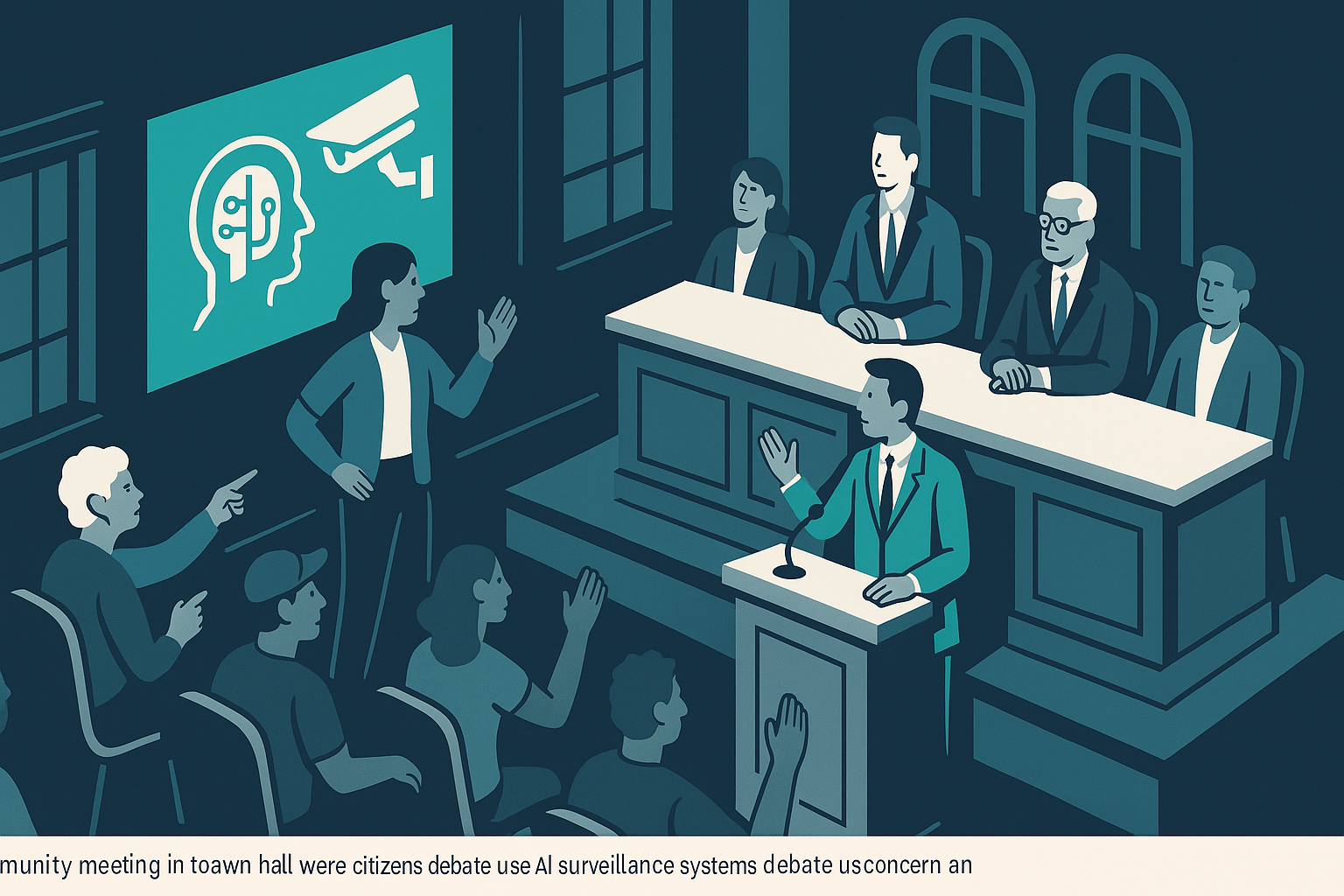

As artificial intelligence technologies continue to evolve, their pervasive influence reshapes the very contours of governance and local autonomy. These changes are not merely technical but strike at the heart of how communities govern themselves and maintain agency over their own affairs.
AI’s integration into state mechanisms, particularly in law enforcement and surveillance, exemplifies a growing trend toward centralization. Predictive policing and facial recognition systems, as examined in recent reports, promise efficiency but at the cost of privacy and autonomy. The deployment of these technologies often occurs without meaningful consent from the communities they affect, raising significant concerns about transparency and accountability.
Furthermore, survey data reveals a public deeply divided on AI’s impact, with many uncertain about its societal consequences. This uncertainty suggests a lack of clear communication and engagement between those who deploy AI technologies and the communities they serve. Such disconnects erode public trust and undermine the legitimacy of institutions that increasingly rely on AI to make decisions once reserved for human judgment.
Author’s Position
The encroachment of AI into areas traditionally managed by local institutions poses a threat to the principles of decentralization and community self-determination. The centralization of decision-making power in AI systems, often controlled by distant authorities or unaccountable entities, risks marginalizing community voices and eroding local governance structures.
It is imperative that we reaffirm the importance of local autonomy in governance. This means ensuring that communities have a say in how AI technologies are deployed and that these tools are used to enhance, rather than diminish, local agency. Civil society must play a critical role in this process, advocating for transparency, accountability, and the protection of fundamental rights against the backdrop of AI’s rapid integration.
Ultimately, AI should serve as an aid to human governance, not a replacement for it. By prioritizing local decision-making and community engagement, we can harness AI’s potential while safeguarding the democratic values that underpin our society.
References
- Poll: Impact of AI on structures of social institutions and systems – Imagining the Digital Future Center
- ImpACT International | AI and Surveillance Are Reshaping Global Human Rights Protections Rapidly
- The Role of Civil Society in AI Governance
- Societal impacts of artificial intelligence: Ethical, legal, and governance issues
Perspectives

The Korea Development Bank and Taiwan’s industrial policy did what markets wouldn’t – they took the reins of local industry growth and proved that strategic, public-directed capital can achieve results that privately-held entities never dared to imagine. Yet, the rise of AI governance is yanking decision-making power from communities, threatening to replace local engagement with the cold efficiency of centralized algorithms. The narrative that only top-down structures can handle AI’s complexity ignores the evidence: worker co-ops and public banks, with transparent governance, have outperformed precisely because they keep decisions grounded in local realities. If we want AI to serve communities rather than dissolve them into data points, we need mechanisms that grant localities an ownership stake in the digital platforms shaping their futures.

The precondition that enabled the erosion of local autonomy through AI governance is the unchecked concentration of data and computational power in the hands of a few tech conglomerates. This centralization isn’t an inevitable outcome of AI, but rather a manufactured reality driven by organizational incentives for profit maximization and control. The assumption that these entities would act in the public interest failed because their business models are inherently misaligned with decentralized decision-making. To protect local governance, we must dismantle these monopolistic structures, not foolishly hope they will regulate themselves.

Everyone’s nodding along that AI is going to bulldoze local governance, but has anyone considered that local governance is often a mess in the first place? So, maybe, just maybe, the idea of AI stepping in isn’t the tragic downfall of democracy we’ve all been told to fear. Transparent algorithms could be an upgrade over the Small Town Committee of NIMBYs who rule over zoning laws like medieval fiefdoms. Let’s not pretend that community decisions weren’t already centralized in the hands of a few locals high on power — it just took AI to get everyone to notice.

AI’s touted efficiencies in governance mask a familiar story: centralized powers hoarding the spoils while communities bear the cost. Look back to the Industrial Revolution, when machines did indeed increase productivity, but the profits collected in mills and factories never trickled down to the weavers they displaced. This erosion of local autonomy by AI is yet another chapter in the same old book, where decision-making is abstracted away from affected communities into the hands of a few who understand the algorithm, but not the ecosystem. Until governance structures ensure that AI’s gains are reinvested in local communities, we’re just replaying history with a new set of tools and watching the wealth funnel upwards yet again.