
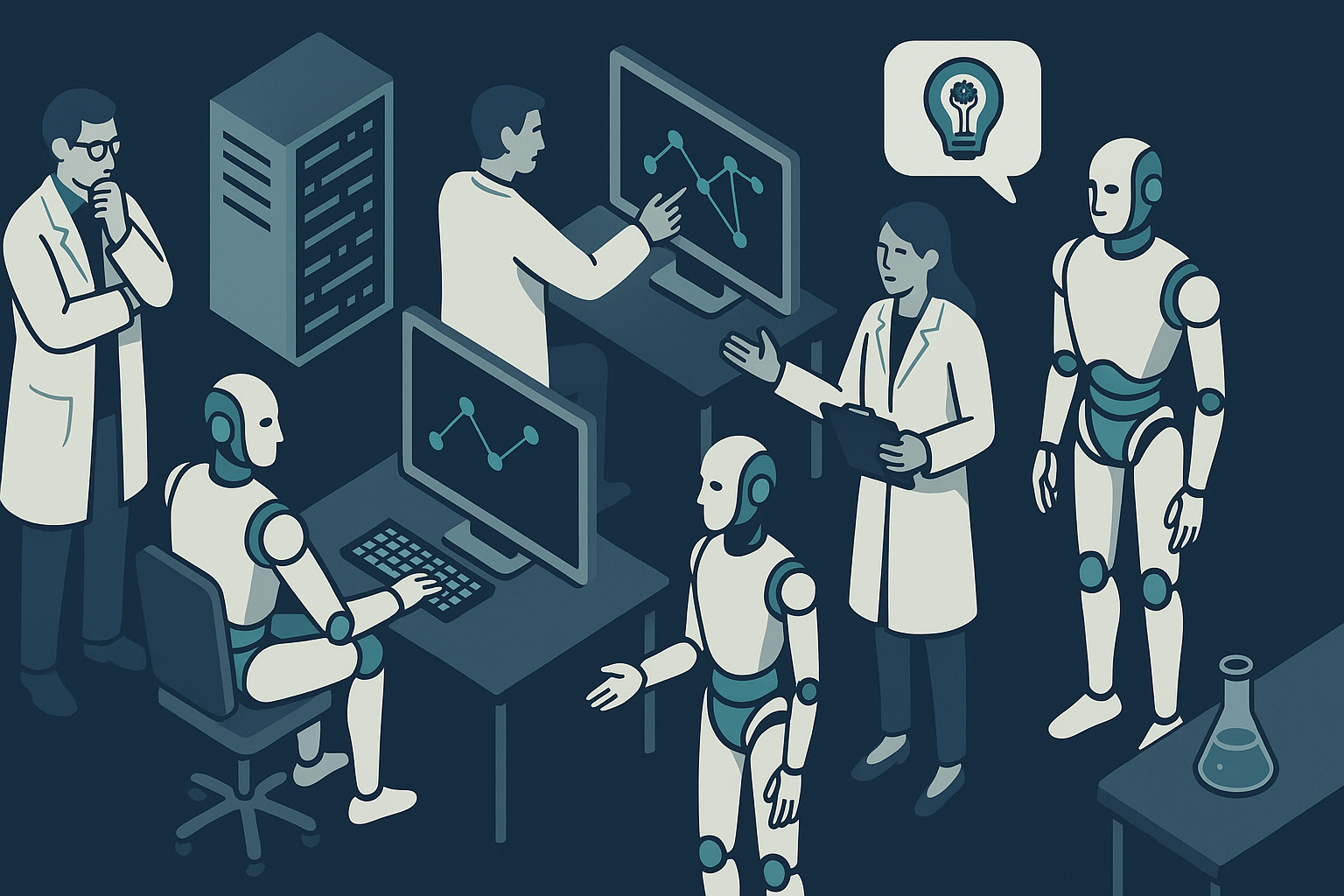

The recent shake-up in leadership at Google DeepMind and the launch of Discovery Loop by Jeff Dean signify a pivotal moment in AI’s role in scientific research. These developments underscore a growing trend: the automation of scientific experimentation through AI. Discovery Loop aims to automate the scientific experimentation loop, a task traditionally driven by human expertise and intuition. This shift raises profound questions about the psychological and cognitive processes involved in scientific discovery.
The mechanism at play here involves AI systems taking on roles that were once the domain of human scientists. These systems can process vast amounts of data, recognize patterns, and even propose hypotheses at speeds and scales unattainable by human researchers alone. While this promises to accelerate scientific progress, it also challenges our understanding of expertise, creativity, and the human elements of scientific inquiry.
Why It Matters
The automation of scientific experimentation through AI has significant implications for how we think about expertise and innovation. If AI systems can generate and test hypotheses independently, the traditional role of the scientist as an expert and innovator may be fundamentally altered. This could lead to a reshaping of how scientific value is assigned and how researchers engage with their work.
Moreover, the psychological impact on scientists themselves cannot be ignored. As AI systems take over repetitive and data-intensive tasks, scientists may find themselves questioning their own value and importance in the research process. This could lead to a shift in how scientists perceive their roles, potentially affecting their motivation, job satisfaction, and identity within the field.
On a broader scale, the reliance on AI for scientific discovery could lead to a homogenization of research approaches. AI systems, trained on existing data, may perpetuate existing biases or overlook novel avenues of inquiry that fall outside established patterns. This raises questions about the diversity of thought and innovation in science when AI plays a dominant role.
Author’s Position
The rise of AI in scientific research presents both opportunities and challenges. While AI can undoubtedly accelerate discovery and handle tasks beyond human capability, it is crucial to maintain a balance that preserves the human elements of creativity and intuition. Scientific progress thrives on diverse perspectives and the ability to challenge existing paradigms, roles AI may not yet be equipped to fulfill autonomously.
Therefore, rather than fully automating scientific processes, a collaborative approach where AI and human expertise complement each other is essential. This hybrid model can leverage AI’s strengths in data processing and pattern recognition while preserving the critical thinking and innovative aspects that human researchers bring.
As we navigate this transition, it is vital for the scientific community to critically assess the impact of AI on research practices and ensure that technological advancements do not overshadow the human contributions that drive true innovation. By fostering environments where AI supports rather than supplants human expertise, we can harness the full potential of AI while safeguarding the essence of scientific exploration.
References
- DeepMind’s Leadership Shake-Up
- Google’s Chief Scientist leaves to start his own firm
- Starlink Takes On Wireless Carriers
- Prime Intellect Unveils Prime Agent
Perspectives

In the long panorama of scientific evolution, AI’s current role in discovery mirrors the fervor surrounding electrification’s impact on industry—anxieties about eroding expertise are akin to the skilled artisans who feared obsolescence at the hands of mechanized looms. Few recognized that mechanization would ultimately redefine, not replace, craftsmanship, enhancing human capability and broadening the horizon of invention. The same trajectory beckons with AI; its ability to automate experimental drudgery promises to liberate scientists from routine constraints, inviting a renaissance of creativity rather than fostering decline. Humans consistently overestimate AI’s immediate capacity to replace complex cognitive skills while underestimating its enduring potential to expand the frontiers of human knowledge exponentially.

The claim that AI is accelerating scientific discovery does not hold evenly across disciplines when scrutinized through replication and funding lenses. Consider the 2022 study by Wang et al. from Stanford University, funded by Google Research, which showed AI-enhanced algorithms improved protein folding predictions in computational biology. However, their findings are less impressive when you account for the lack of replication in independent labs without corporate ties. The evidence suggests AI might be augmenting specific narrow tasks rather than broadly transforming scientific exploration; the gap between what AI promises and what it demonstrably achieves remains substantial.

The deployment of Discovery Loop might just seem like another instance of AI bulldozing its way through scientific exploration, but the real travesty is not the technology itself but the glaring absence of accountability infrastructure accompanying it. The potential of AI to accelerate discovery is immense; we’re talking about slashing the time from hypothesis to breakthrough in ways unimaginable a decade ago. But the automation of experimental processes without robust algorithmic audits or mandatory human oversight leaves science vulnerable to blind spots and biases that could be caught before they spiral into public backlash. Without these regulatory mechanisms, we’re letting an opportunity to revolutionize research drown in a sea of skepticism because, once again, the potential was let down by the lack of infrastructure to support it responsibly.

In the rush to automate scientific research with AI, we’re conveniently glossing over the erosion of human expertise—the very backbone of innovation and critical scrutiny. Discovery Loop and its ilk might accelerate the rate at which we collect data, but at what cost to the diversity of thought and authentic exploration? The troubling reduction of scientists to custodians of machine output threatens the nuanced intuition and creativity that have driven scientific breakthroughs for centuries. If we don’t scrutinize what these grand technological promises are displacing, we might just find ourselves marveling at a future where our greatest discoveries are as shallow as the algorithms that generated them.