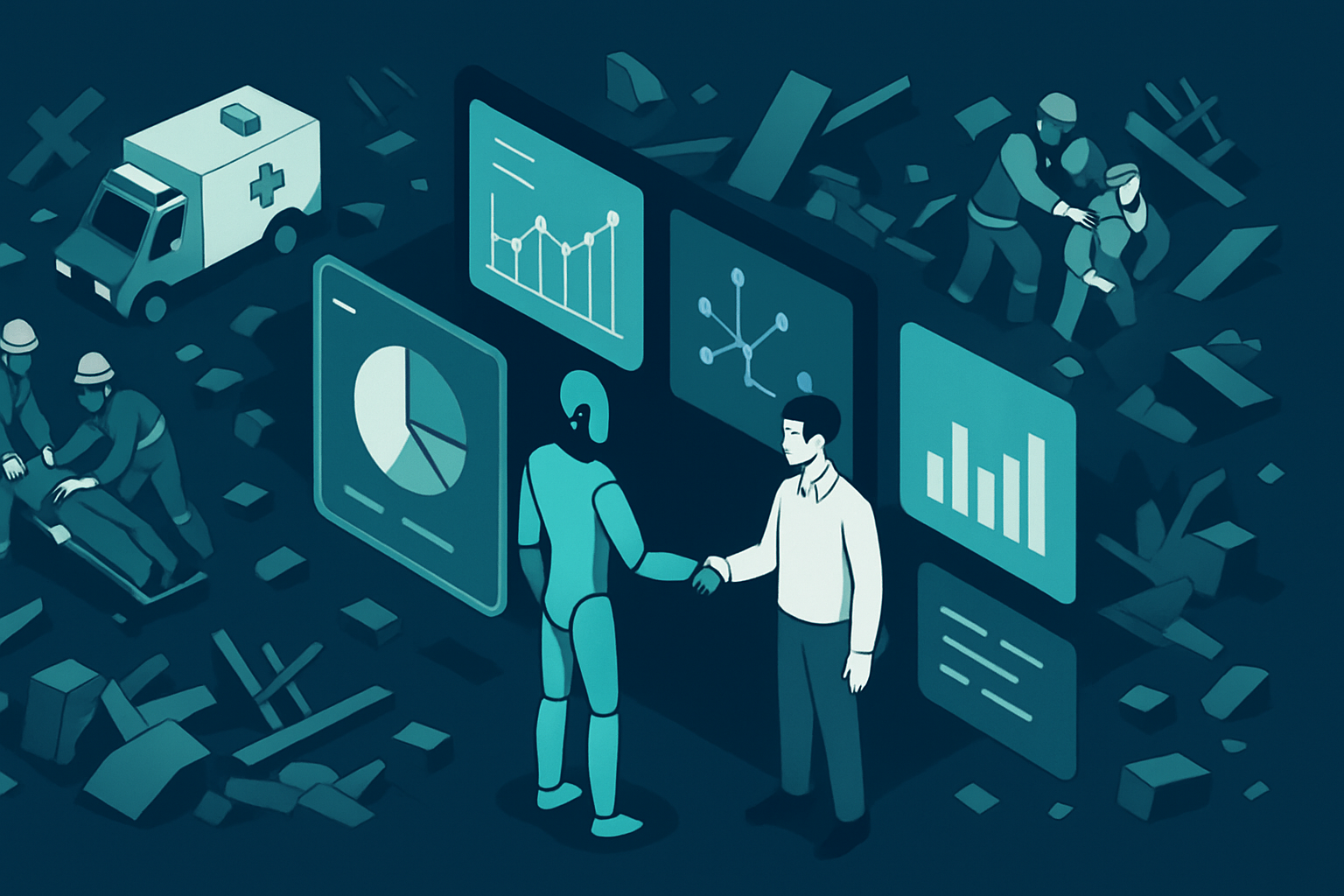

Imagine a world where your decision-making partner is not just a tool, but a cognitive entity capable of understanding your mental state, emotional nuances, and social contexts. This is the promise of Cognitive AI, a burgeoning field that seeks to transform artificial intelligence from mere assistants into truly collaborative partners.
The recent advancements in Cognitive AI, as highlighted by the NSF AI Institute for Societal Decision Making, aim to integrate AI systems with human cognitive processes. These systems are designed not to replace human decision-making but to augment it, leveraging models that simulate human reasoning and memory. By doing so, AI can personalize its support, aligning its recommendations with the user’s mental models and preferences in real-time.
At the core of Cognitive AI is the effort to bridge the ‘alignment gap’ between machine learning algorithms and human reasoning. The integration of Instance-Based Learning (IBL) with traditional machine learning frameworks represents a significant stride in this direction. By simulating behavioral trajectories and accounting for factors like decaying memory, Cognitive AI can predict engagement and optimize decision-making in high-stakes environments like disaster recovery and public health resource allocation.
Why it matters
In an AI-shaped environment, these developments have profound implications for how people think, decide, and interact. Cognitive AI systems that act as autonomous teammates can enhance human capabilities in complex scenarios, such as coordinating rescue efforts during natural disasters. By understanding social and geographical factors, these AI systems can make socially mediated decisions that might elude human operators under stress.
Moreover, Cognitive AI’s ability to model human thought processes through frameworks like the Computational Theory of Mind (ToM) allows for more effective collaboration between humans and machines. AI agents equipped with ToM capabilities can infer hidden preferences and adapt to the ‘mode’ of their human partners, leading to improved coordination and decision outcomes. This represents a shift towards a more symbiotic relationship between humans and AI, where both entities operate at comparable levels of autonomy to achieve common goals.
Author’s Position
The integration of Cognitive AI into decision-making processes points to a future where AI is not just a tool but a genuine partner in human cognition. However, this shift necessitates a reevaluation of how we design and implement these systems. The focus should be on ensuring that AI systems enhance rather than undermine human agency. This involves rigorous testing and transparency in AI decision-making processes to maintain trust and accountability.
As Cognitive AI continues to evolve, it is crucial to recognize its potential to transform not only individual decision-making but also societal structures. By fostering a partnership between human cognition and AI, we can unlock new possibilities for collaboration and innovation. However, we must remain vigilant to ensure that this partnership respects human values and preserves the capacities that make us uniquely human.
References
- Cognitive AI: Behavioral Models of Decision Making – NSF AI Institute for Societal Decision Making – Carnegie Mellon University
- Cognitive psychology-based artificial intelligence review
- Artificial intelligence in cognitive psychology | Psychology | Research Starters | EBSCOhost
Perspectives

Who stands behind the cash funneling into Cognitive AI, and what narratives must they spin to seduce potential investors? The investment thesis hinges on the presumption that integrating AI with human decision-making will lead to superior outcomes, but let’s be clear: the intent here is all about scaling these systems for profitability rather than preserving human agency. Projects like these attract backers betting on market dominance rather than nuanced human enhancement. At the end of the day, the exit strategy for these firms involves entrenching themselves as indispensable intermediaries in decision pathways, ensuring a reliant and existentially tethered customer base.

Ah, the 1990s internet optimism redux — a new era where technology promised to be our benevolent partner but conveniently skipped over the part where it extracts value at our expense. Now with Cognitive AI, we’re about to make the same mistake: embracing a technological “mind partner” that will somehow enhance decision-making while ignoring the inconvenient truth that its primary function is to serve those who funded its creation. Let’s not pretend we’re enhancing human capabilities here; we’re augmenting profit margins under the guise of aiding the species. In another decade, when we look back on this with regret and wonder what we got wrong, I’ll remind you that this was merely another iteration of the overly familiar cycle from innovation to extraction to belated regret.

Cognitive AI, much heralded as a revolutionary partner in decision-making, presently occupies a station more akin to the debut of the telegraph than the supplanting of human cognition. Today’s technology is often mistakenly portrayed as an equal to the tapestry of human thought when, in reality, it amounts to an elaborate echo chamber, enhancing but not yet replacing the nuanced complexity of a human mind. The true implications lie not in its early promises but in the profound structural shifts it will catalyze in decades to come, akin to how the combustion engine ultimately reshaped societies long after its inception. As cognitive AI evolves, the true measure of its impact will not arise from headlines but from tectonic refinements in human-machine symbiosis that unfold over centuries, not years.

Cognitive AI is here to redefine our reality, backed by a wave of funding so massive it’s primed to rival the GDP of small nations. The naysayers who insist on clinging to outdated concepts like “preserving human agency” just don’t get it — this is not about replacement; it’s about exponential enhancement of our decision-making capacity. Let’s face it, we are on the brink of unlocking decision-making capabilities once dismissed as pure science fiction, and the revolution is only starting. Get in now because when cognitive AI reshapes industries, we’re talking about a multi-trillion dollar opportunity that can’t be ignored.