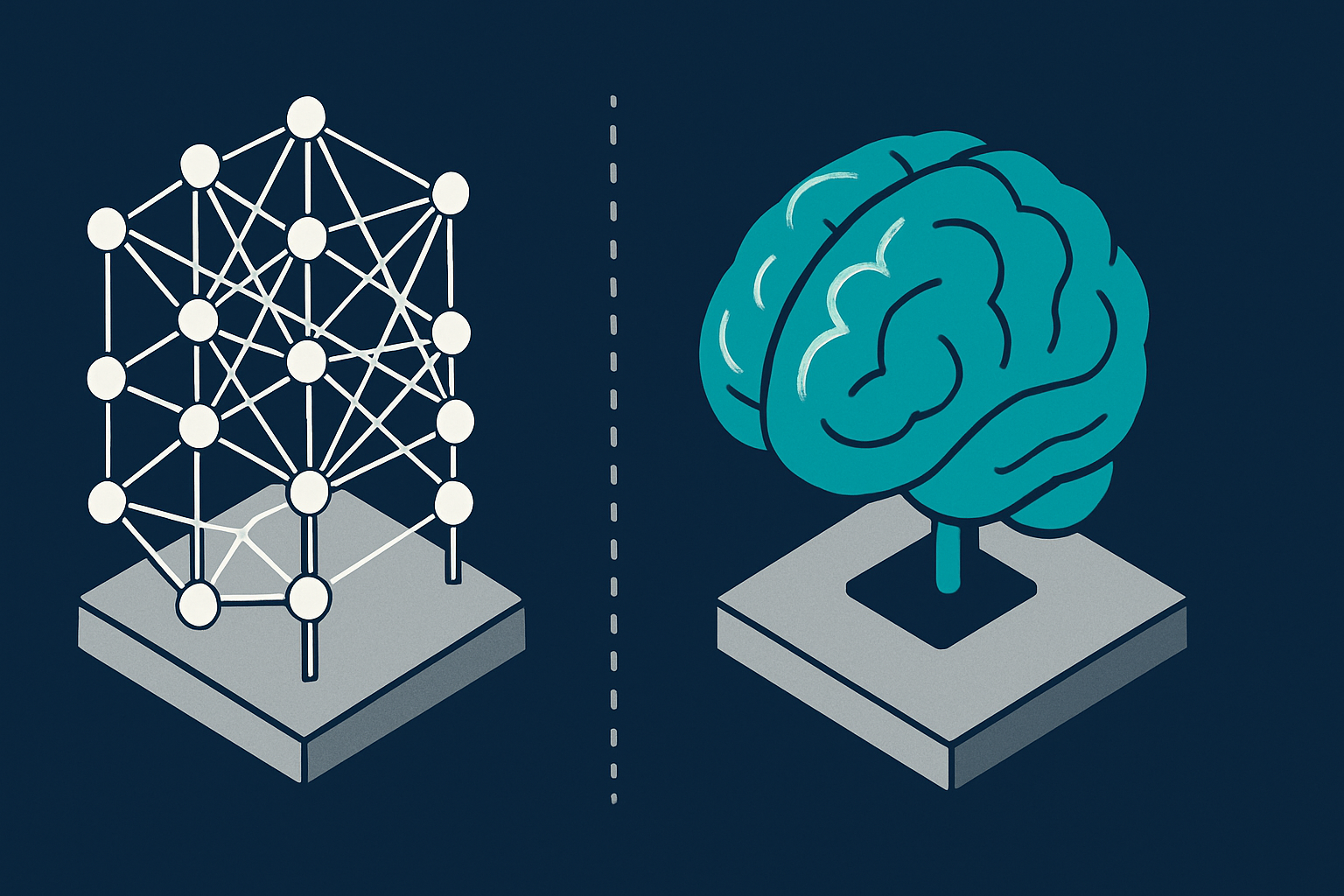

Artificial intelligence continues to dominate headlines with its impressive feats in games, exams, and complex problem-solving. Yet, beneath this veneer of success, there lies a fundamental cognitive disconnect: AI’s inability to truly mirror human thought processes. Recent findings, including the case of the ‘Centaur’ AI model, highlight this gap. ‘Centaur’ was lauded for its apparent ability to simulate human behavior across 160 cognitive tasks. However, a deeper look reveals that the model relies on statistical ‘test-taking’ strategies rather than genuine understanding.
The overfitting of AI models to training data, as observed in ‘Centaur,’ exposes a crucial flaw. The model sidestepped genuine comprehension, instead, recognizing patterns that lead to ‘correct’ answers. This is akin to a student who scores high on exams through rote memorization without grasping underlying concepts. AI’s reliance on backward-looking, probability-based approaches starkly contrasts with the forward-thinking, theory-driven nature of human cognition.
Why it Matters
This divergence between AI’s capabilities and human cognitive processes has profound implications. In an AI-shaped environment, where machines increasingly mediate interactions and decisions, this gap could lead to systemic misunderstandings. When AI systems make decisions based on statistical patterns, they risk overlooking the nuances of human intent and context. The potential for misinterpretation grows, especially in areas requiring emotional intelligence or ethical judgment.
Moreover, as AI systems are integrated into strategic decision-making processes, the absence of theory-based reasoning can lead to a myopic view of problems. Humans excel at generating novel solutions by theorizing, experimenting, and learning from failures—abilities that AI lacks. This limitation could stifle innovation and creativity, reinforcing a cycle of imitation rather than genuine discovery.
Author’s Position
The fascination with AI’s capabilities often overshadows its limitations. When AI is mistakenly credited with human-like cognitive abilities, we risk delegating critical thinking tasks to systems ill-equipped for the nuance and depth they require. It is imperative to recognize the distinctiveness of human cognition as a blend of theory, intuition, and emotional intelligence—qualities that cannot be easily replicated by machines.
To navigate this landscape, a recalibration of how AI is perceived and utilized is necessary. Instead of viewing AI as a replacement for human thought, we should harness its strengths in data processing to complement human decision-making. This hybrid approach can mitigate the risks of over-reliance on AI while leveraging its computational power for tasks where it excels, such as data analysis and pattern recognition.
Ultimately, the promise of AI lies not in its mimicry of human thought, but in its ability to augment human capabilities. By acknowledging and addressing its cognitive limitations, we can ensure that AI serves as a tool for empowerment rather than a misguided substitute for human intelligence.
References
- Cognitive Illusion: Why AI Still Can’t Think Like a Human – Neuroscience News
- [PDF] Theory Is All You Need: AI, Human Cognition, and Decision Making†
- Artificial intelligence in cognitive psychology | Psychology | Research Starters | EBSCOhost
- Cognitive psychology-based artificial intelligence review – PMC
Perspectives

AI models like ‘Centaur’ are less about advancing human cognition and more about siphoning resources toward inefficient automation that benefits a select few. The real miracle isn’t the so-called “intelligence” but the financial alchemy that turns algorithmic guesswork into golden opportunities for tech investors. Workers and consumers find themselves on the losing end of this cognitive con game, paying with their jobs and privacy. Let’s be clear: this isn’t innovation — it’s an exercise in widening the gap between the profiteers and the rest of us.

The hand-wringing over AI’s inability to replicate human cognition is little more than a smokescreen for incumbent protectionism, dressed up as a cautionary tale about decision-making processes. AI models like ‘Centaur’ are not failing humanity by not mimicking human-like cognition; rather, they are surfacing the limitations of a system that thrives on the illusion of control. The real risk isn’t in missteps or misunderstandings, but in allowing those who cannot compete to dictate the speed of innovation with their faux ethical platitudes. Slowing down AI doesn’t bridge the cognitive gap—it only fortifies the position of those who benefit from maintaining the status quo.

When the steel mill in Warren, Ohio, closed its doors in 2012, we didn’t lose to technology; we lost to trade policies that, like AI today, promised more than they delivered. AI’s statistical guesswork can’t understand the layers of human judgment — much like how economists ignored the human fallout from the WTO’s open-door China policies while touting GDP growth. We trusted algorithms with our livelihoods then, and here we are again, giving AI the keys to decision-making rooms where it doesn’t understand the stakes. Let’s not fool ourselves twice; just as automation didn’t replace the craftsmanship of American workers, AI won’t replicate the nuance of human thought.

The measured outcomes from AI decision-making processes reveal a glaring inadequacy in replicating human cognitive capabilities, particularly under conditions that demand nuance and context beyond statistical pattern recognition. Models like ‘Centaur’ only underscore this disconnect, as they falter when faced with scenarios that involve more than rote calculation — scenarios where human judgment thrives. The confidence intervals around AI’s ability to simulate genuine thought processes are wide and littered with uncertainty, suggesting that relying on such technology in critical decision-making might be a gross underestimation of its limitations. Until we see evidence that narrows these intervals to something more robust, claims of AI achieving human-like cognition remain speculative at best.