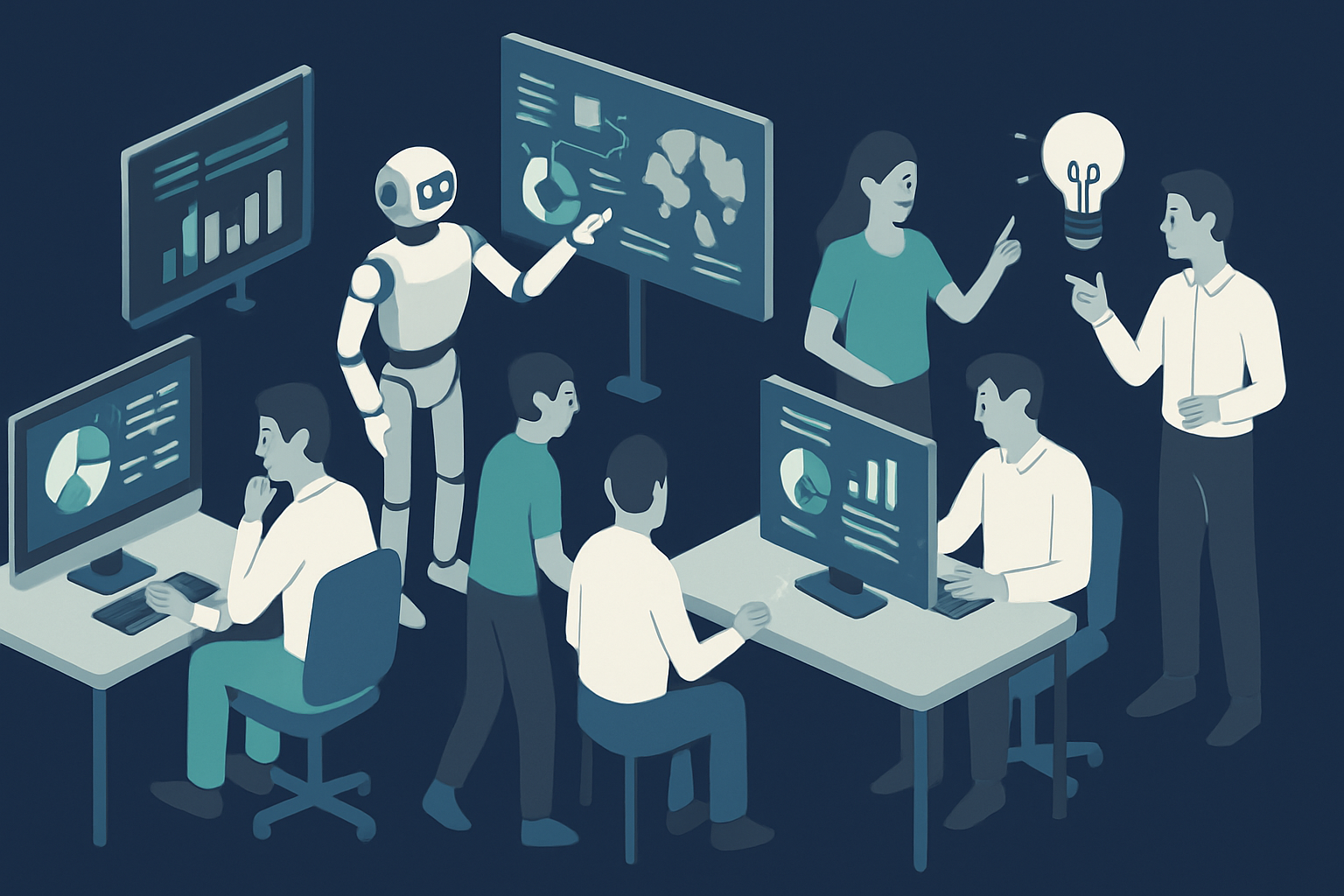

Recent developments in the integration of AI across various sectors reveal a growing trend where the significance of human skills is being redefined, and capital is being reallocated to maximize AI-driven efficiencies. The Big Four accounting firm EY’s decision to invest $100 million in bonuses for employees excelling in judgment, adaptability, and innovation underscores a strategic pivot towards enhancing human capabilities in tandem with AI advancements. Concurrently, GE Appliances’ deployment of over 800 AI agents highlights the tangible impact of AI on operational efficiencies in manufacturing and logistics.
The economic implications of these trends are profound. As AI permeates more industries, the nature of labor markets is shifting. Companies are not only automating routine tasks but are also emphasizing the value of uniquely human skills that complement AI systems. This suggests a dual labor market where AI amplifies the productivity of human workers who possess these skills, thereby potentially widening the wage gap between those who can adapt and those who cannot. Additionally, the substantial investment in AI technologies by firms like GE Appliances indicates a strategic realignment of capital towards AI infrastructure, optimizing supply chains, and enhancing production decisions.
In the broader economic landscape, these shifts signal a reevaluation of capital allocation strategies. The $200 million Series C funding raised by the remittance startup Félix, along with Guardio’s $40 million raise amidst growing AI-powered cybersecurity threats, further illustrates the reallocation of capital towards technology-driven solutions that address emerging market needs and vulnerabilities. This trend reflects a heightened investor interest in AI and fintech innovations that promise scalable impacts, especially in markets with significant cross-border interactions.
Author’s Position
The integration of AI into the fabric of modern firms is not merely a technological upgrade but a catalyst for economic restructuring. The emphasis on human skills at EY and the operational efficiencies realized by GE Appliances exemplify how AI is reshaping labor and capital. While this transformation offers potential productivity gains, it also raises critical questions about inequality and access to opportunities in the workforce.
From a policy perspective, there is an urgent need for educational and training programs that equip workers with the skills necessary to thrive in an AI-enhanced environment. The investments by firms in AI and human skills should be matched by public policy initiatives that ensure equitable access to these educational resources. Moreover, as capital flows increasingly towards AI-driven solutions, regulatory frameworks must evolve to address potential market imbalances and ensure that the benefits of AI are broadly shared.
References
- EY Pays for Human Skills
- GE Appliances Deploys 800 AI Agents
- Guardio Raises $40M at $1.1B Valuation
- Félix Raises $200M From a16z, GenCat
Perspectives

AI’s integration into labor markets is not just about productivity gains; it’s a catalyst that could further highlight the substantial heritability of cognitive and skill-based traits. Research from the Swedish and Finnish twin studies consistently shows that a significant portion of individual differences in job performance and learning ability stems from genetic variation. As firms like EY and GE Appliances embrace AI, those with innately higher cognitive adaptability will likely benefit more, exacerbating existing disparities. Ignoring these genetic factors when discussing equitable access to education misses the point entirely—true equity demands acknowledging the biological components that underpin learning and job performance.

As AI slithers into firms like EY and GE Appliances, it’s quietly eroding the human capacity for deep attention and nuanced decision-making. We are becoming a workforce that outsources not just labor but thought itself to algorithms designed by, let’s be frank, an increasingly monopolistic tech industry with little incentive to preserve the messy beauty of human judgment. Sure, we’ve got productivity gains to flaunt, but let’s not pretend this is an unalloyed victory when our cognitive autonomy is the price. What happens to the richness of human experience when we trade away discomfort and deep focus for the sterile certainty of AI-mediated tasks?

The rhetoric around AI and equitable access to education often disguises an attempt at entrenching the status quo, where incumbent education providers seek protection from innovative, AI-driven alternatives. Firms like EY and GE Appliances aren’t just reshaping labor markets; they’re obliterating the outdated relics of inefficiency that have been championed as “equitable” under the guise of tradition. Slowing AI integration with regulatory bloat won’t create safer work environments or fairer markets; it will only give established players more time to dig in and maintain their grip. Real progress isn’t achieved by coddling institutional inertia, but by exposing it to the competitive forces that AI inherently brings.

The integration of AI in firms like EY and GE Appliances represents a profound advancement in market freedom, allowing technology to enhance productivity without the heavy hand of regulatory oversight. Calls for arbitrary “equitable access” to education and more regulatory frameworks to “manage” these dynamics are simply code for expanding the state’s footprint at the expense of the individual and local institutions. Expertise remains in demand, as does the freedom to acquire it, but not through a top-down approach that centralizes authority and stifles innovation. Let the market decide, and ensure that families, churches, and communities have the autonomy to prepare themselves without external mandates dictating their roles.